
Malay Peninsula
Peninsular landmass in Southeast Asia forming the southernmost part of mainland Asia, shared by Myanmar, Thailand and Peninsular Malaysia; notable for trade routes, biodiversity and Malay culture.
Overview
The Malay Peninsula is a long, narrow landmass projecting southeast from mainland Asia into the surrounding seas. It lies in Southeast Asia and is bounded by major waterways including the Strait of Malacca to the west and the South China Sea and Gulf of Thailand to the east. In Malay it is commonly called Semenanjung Tanah Melayu, a name reflecting the peninsula's deep historical and cultural ties to Malay-speaking peoples.
Image gallery
10 Images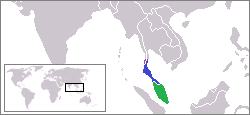


Geography and ecology
This peninsula features a mix of lowland coasts, mangrove swamps and interior highlands. A central mountain chain runs along much of its length, with tropical rainforests covering substantial areas where evergreen trees and diverse wildlife thrive. Coastal ecosystems such as mangroves and coral reefs are important for fisheries and coastal protection, while inland forests have long supported timber and other forest products.
History and human presence
The Malay Peninsula has been a crossroads of maritime trade for centuries. Indigenous Malay societies developed along its coasts and river valleys, and the region became part of wider Indian Ocean and South China Sea trading networks. Over time, influential regional polities and sultanates arose, and later the peninsula entered a period of European colonial involvement that shaped modern borders and infrastructure.
Political divisions
- The far northwest of the peninsula falls within the southern extremity of Myanmar.
- The central and northeastern sections belong to southern provinces of Thailand.
- The southern portion is occupied by Peninsular Malaysia, often called West Malaysia to distinguish it from the states on Borneo.
Economic and strategic importance
The peninsula sits beside one of the world's busiest maritime corridors, giving it outsized strategic and commercial importance. Its fertile lowlands and tropical climate have supported plantation agriculture, historically including crops such as rubber and, more recently, oil palm, while mineral deposits and urban development have driven industrial growth. Tourism also plays a role, drawing visitors to beaches, cities and natural parks.
Notable distinctions
It is important to distinguish the Malay Peninsula from the broader Malay Archipelago of islands to the east. The peninsula is the southernmost piece of continental Asia and has a distinct continental geology and cultural mix. Today it remains a region of environmental significance and rich cultural heritage, where Malay language and customs are prominent alongside diverse local communities.
Related articles
Author
AlegsaOnline.com Malay Peninsula Leandro Alegsa
URL: https://en.alegsaonline.com/art/60958