
Reichstag fire (1933): arson, response, and its role in Nazi consolidation
The Reichstag fire of 27 February 1933 destroyed much of Germany’s parliamentary building. The blaze, arrests, and emergency measures accelerated the Nazis' seizure of power and remain the subject of scholarly debate.
Overview
On 27 February 1933 the German parliament building in Berlin was set ablaze in an event known in German as Der Reichstagsbrand. The incident was an act of arson that destroyed large sections of the Reichstag chamber and produced a crisis atmosphere that the new government exploited. Occurring only weeks after Adolf Hitler became Chancellor of Germany, the fire immediately reshaped the political landscape and helped pave the way for authoritarian rule under the National Socialists (Nazis).
Image gallery
7 Images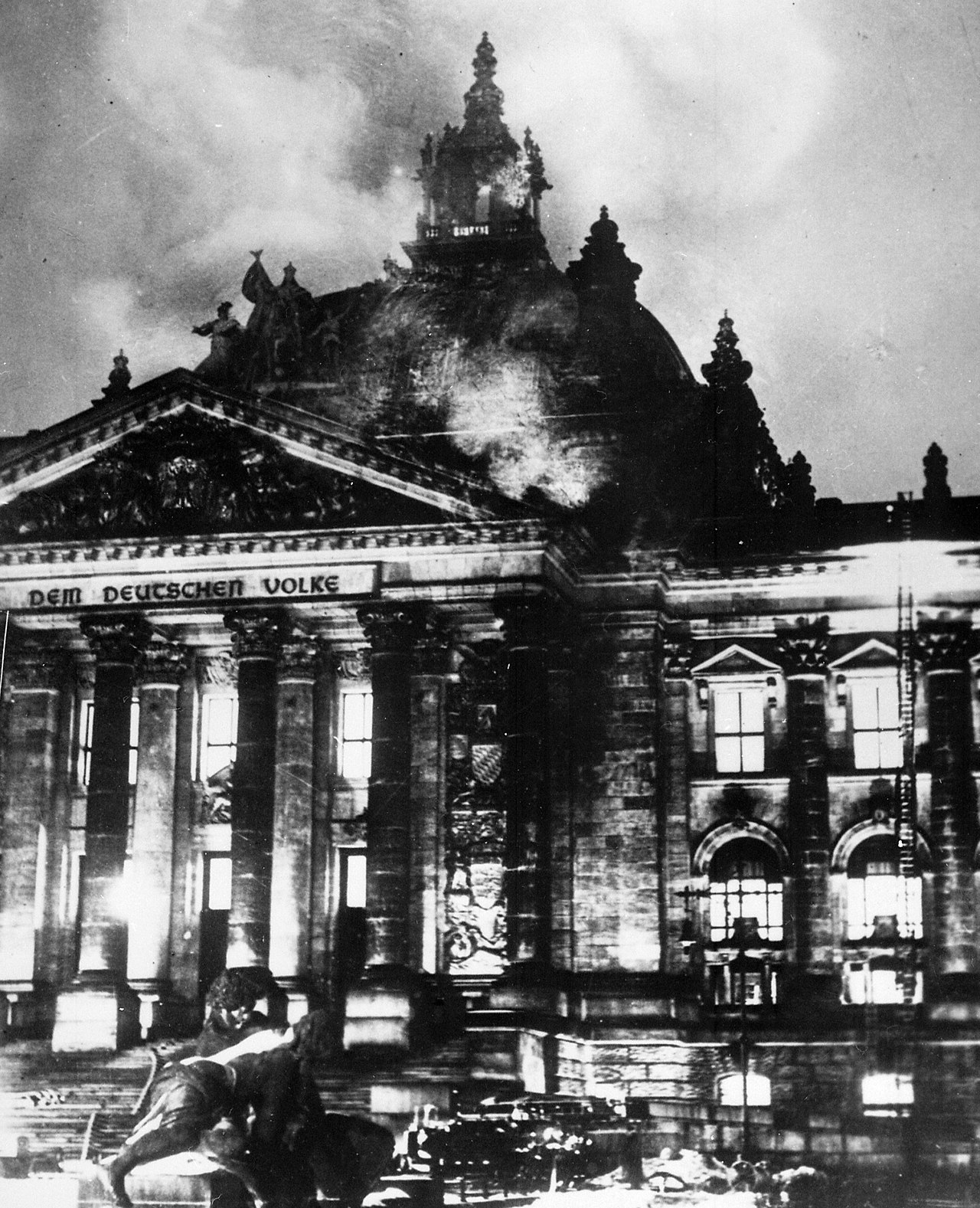


Immediate events and arrests
Fire crews and police were summoned to the burning building and, when they entered, they found a Dutch man, Marinus van der Lubbe, inside. Van der Lubbe was identified as a Dutch communist and was swiftly arrested. The Nazi leadership claimed the blaze proved a wider conspiracy by communists to overthrow the state. Within hours the government moved to portray the fire as evidence of imminent revolutionary action, and Adolf Hitler urged President Paul von Hindenburg to authorize extraordinary measures to suppress what the Nazis called the threat from the Communist Party.
Legal measures and political consequences
On 28 February 1933, acting on Hitler's advice, President Hindenburg issued an emergency decree that suspended a range of civil protections. The decree curtailed freedoms of speech, assembly and the press, authorized widespread searches and detention without standard judicial safeguards, and set the stage for mass arrests.
Using that legal opening, the government detained thousands of suspected opponents and targeted members of the Communist Party, including elected deputies. The removal of Communist legislators helped convert the Reichstag into a body in which the Nazis enjoyed effective control. These developments culminated in the passage of the Enabling Act a few weeks later, which allowed the cabinet to enact laws without parliamentary consent and made Hitler the effective dictator of Germany.
Investigation, trial and contested responsibility
Marinus van der Lubbe stood trial in a widely publicized proceeding. Alongside him were three other accused who were described at the time as senior Bulgarian agents of the Comintern; one of the best-known co-defendants was Georgi Dimitrov, who mounted a vigorous defense and was acquitted. Van der Lubbe was convicted and executed in early 1934, while the acquittal of other defendants was used internationally as evidence that not all aspects of the case were straightforward.
Scholars and commentators have long debated who planned or set the fire. Explanations range from the view that van der Lubbe acted alone as a politically motivated arsonist to theories that Nazi officials either planned, encouraged or opportunistically exploited the blaze to justify repressive measures. Contemporary evidence and later archival research have not produced universal agreement, and the question of responsibility remains a subject of historical inquiry.
Legacy and significance
The Reichstag fire is widely regarded as a decisive turning point in the collapse of Weimar democracy. Its immediate consequence—the emergency decree and the removal of civil protections—demonstrated how a single dramatic event can be turned into legal authority for sweeping repression. The episode also illustrated the power of rapid propaganda and administrative action: the Nazi leadership quickly framed the fire to create a climate of fear and to neutralize political opponents.
Physically, the Reichstag building remained damaged and was not fully restored until after the Second World War; in the postwar era the structure became a potent symbol. Its later renovation and reuse for the federal parliament helped transform it into a site of democratic renewal, contrasting with its earlier association with the events of 1933.
Further reading and context
- Contemporary accounts, government decrees and the trial proceedings illuminate how the event was exploited politically.
- Historians continue to examine archival material and testimonies to refine understanding of motives and actors involved.
- The fire serves as a case study in emergency law, political violence and the erosion of democratic institutions.
For concise primary and secondary summaries, see an overview of the incident and its aftermath: Nazi Germany background, the role of emergency measures and civil rights implications (fire response and reports), and the parliamentary implications for members of Parliament. Scholarly treatments emphasize the interplay of opportunism, accusation and legal change, while contemporary coverage shows how quickly the regime consolidated power. Additional resources: accounts of the arson, legal texts related to the emergency decree (civil liberties implications), and biographies of central figures including Hitler and Hindenburg.
Questions and answers
Q: What event was the Reichstag Fire?
A: The Reichstag Fire was an arson on the Reichstag building, the meeting place of the German Parliament, in Berlin on 27 February 1933.
Q: Who was found inside the burning building?
A: Inside the burning building, Marinus van der Lubbe was found. He was a Dutch communist.
Q: What did Hitler urge President Paul von Hindenburg to do after the fire?
A: After the fire, Adolf Hitler urged President Paul von Hindenburg to pass an emergency law to fight back "the confrontation of the Communist Party of Germany". As a result, Enabling Act of 1933 was passed.
Q: What decree did German President von Hindenburg issue in response to the fire?
A: In response to the Reichstag fire, German President von Hindenburg issued The Reichstag Fire Decree which suspended most civil liberties in Germany and led to many Communists being arrested including all Communist Party members of Parliament.
Q: How did this give Hitler more power?
A: This gave Hitler more power because it made him effectively dictator as he had become Chancellor four weeks before and now had majority control over Parliament due to all Communist Party members being arrested.
Q: Who were brought to court shortly after for investigation into who planned or executed it?
A: Shortly after for investigation into who planned or executed it three men were brought to court - senior Bulgarian Comintern agents. One Communist was found guilty and executed; while two others were acquitted and went back to Soviet Union.
Q: Is there any definitive answer as who planned or executed it yet?
A: No, there is no definitive answer yet as historians still do not know who planned or executed it and it is still an ongoing topic of research.
Related articles
Author
AlegsaOnline.com Reichstag fire (1933): arson, response, and its role in Nazi consolidation Leandro Alegsa
URL: https://en.alegsaonline.com/art/81948