
Precambrian: Earth's early supereon from formation to the rise of complex life
The Precambrian covers Earth's history from its formation (~4.56 billion years ago) to the start of the Cambrian (~542 million years ago), including the Hadean, Archean and Proterozoic eons and early life.
Overview
The Precambrian is the informal name for the vast span of time in Earth history before the Cambrian Cambrian Period. It extends from the planet's formation roughly 4.56 billion years ago to the beginning of the Phanerozoic eon about 541–542 million years ago. The term groups together the earliest chapters of geologic and biological evolution, when the solid crust, oceans and primitive atmosphere formed and the first life-forms appeared.
Image gallery
4 Images


Subdivisions and chronology
Geologically, the Precambrian is commonly divided into three eons (see three eons): the Hadean, the Archean (sometimes spelled Archaean) and the Proterozoic. These are conventionally dated as:
- Hadean — the interval from Earth's formation to the establishment of a stable crust.
- Archean — when the first well-preserved continental fragments and microbial life appear in the rock record.
- Proterozoic — a long era that witnessed major changes in atmosphere, life, and continental growth.
Key geological and environmental developments
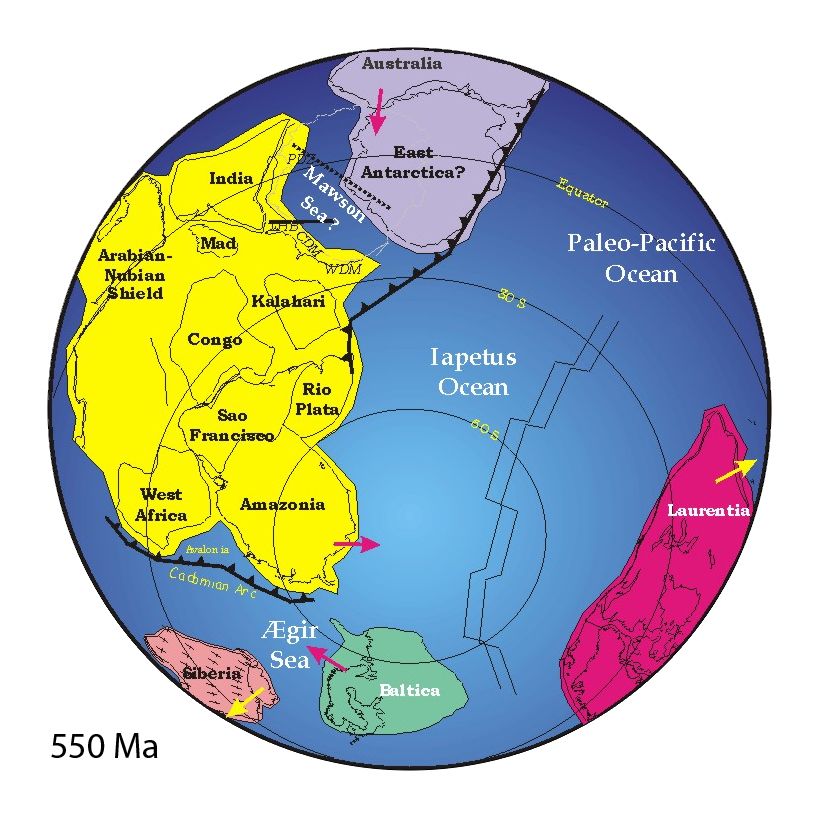
During the Precambrian the planet cooled from its molten beginnings, allowing solid crust and oceans to form. Early plate motions assembled and broke apart protocontinents and cratons; many of today's oldest exposed rocks and shields preserve evidence of these processes (rocks studied by geologists). The Proterozoic includes important events such as the oxygenation of the atmosphere, which had profound effects on chemistry and biology.
Life and the fossil record
Life for most of the Precambrian was dominated by microscopic organisms—bacteria and archaea—and their collective structures such as stromatolites. Photosynthetic microbes gradually increased atmospheric oxygen in steps often summarized as the Great Oxidation Event. Multicellular and more complex organisms begin to appear toward the end of the Precambrian: the Ediacaran Ediacaran assemblage preserves soft-bodied, multicellular forms, and by the Cambrian boundary a diversity of hard-shelled animals had emerged (hard-shelled animals became common in the fossil record thereafter).
History of the name and study
The label "Precambrian" literally means "before the Cambrian" and reflects the naming of the Cambrian after Cambria, the Latin name for Wales (Cambria/Wales), where classic Cambrian rocks were first described. Early geologists applied the prefix "pre-" to denote older rocks; those studies relied on field mapping and stratigraphic work of ancient rocks. Because the Precambrian lacks abundant, easily dated fossils, its subdivisions and timelines rely strongly on radiometric dating and isotopic studies.
Importance and notable facts
The Precambrian sets the stage for all later Earth history: it records the origin of continents, the first evidence of life, the slow rise of oxygen, and tectonic cycles that built the early lithosphere. Economically, Precambrian terrains host many mineral deposits, including banded iron formations and base-metal ores. Although often less familiar than later periods, the Precambrian contains the critical early chapters of planetary evolution and planetary habitability.
Related articles
Author
AlegsaOnline.com Precambrian: Earth's early supereon from formation to the rise of complex life Leandro Alegsa
URL: https://en.alegsaonline.com/art/78671
Sources
- pubs.usgs.gov : "Age of the Earth"
- doi.org : 10.1144/GSL.SP.2001.190.01.14
- doi.org : 10.1016/0012-821X(80)90024-2