
Hadean eon — Earth's earliest geologic eon (about 4.6 to 4.0 billion years ago)
The Hadean is Earth’s earliest eon (≈4.6–4.0 Ga), marked by planetary accretion, core formation, heavy bombardment, early crustal evolution and an atmosphere low in free oxygen.
The Hadean describes the earliest interval of Earth's history, traditionally defined as the geologic eon that extends from the planet's formation about 4.6 billion years ago to roughly 4.0 billion years ago. The name is derived from Hades, the Greek underworld, a reference to the infernal conditions once imagined for the young planet. Because intact rock records from this time are extremely rare, much of what is known about the Hadean is inferred from a combination of tiny mineral grains, lunar samples, meteorites, and computer models of planetary evolution.
Image gallery
6 Images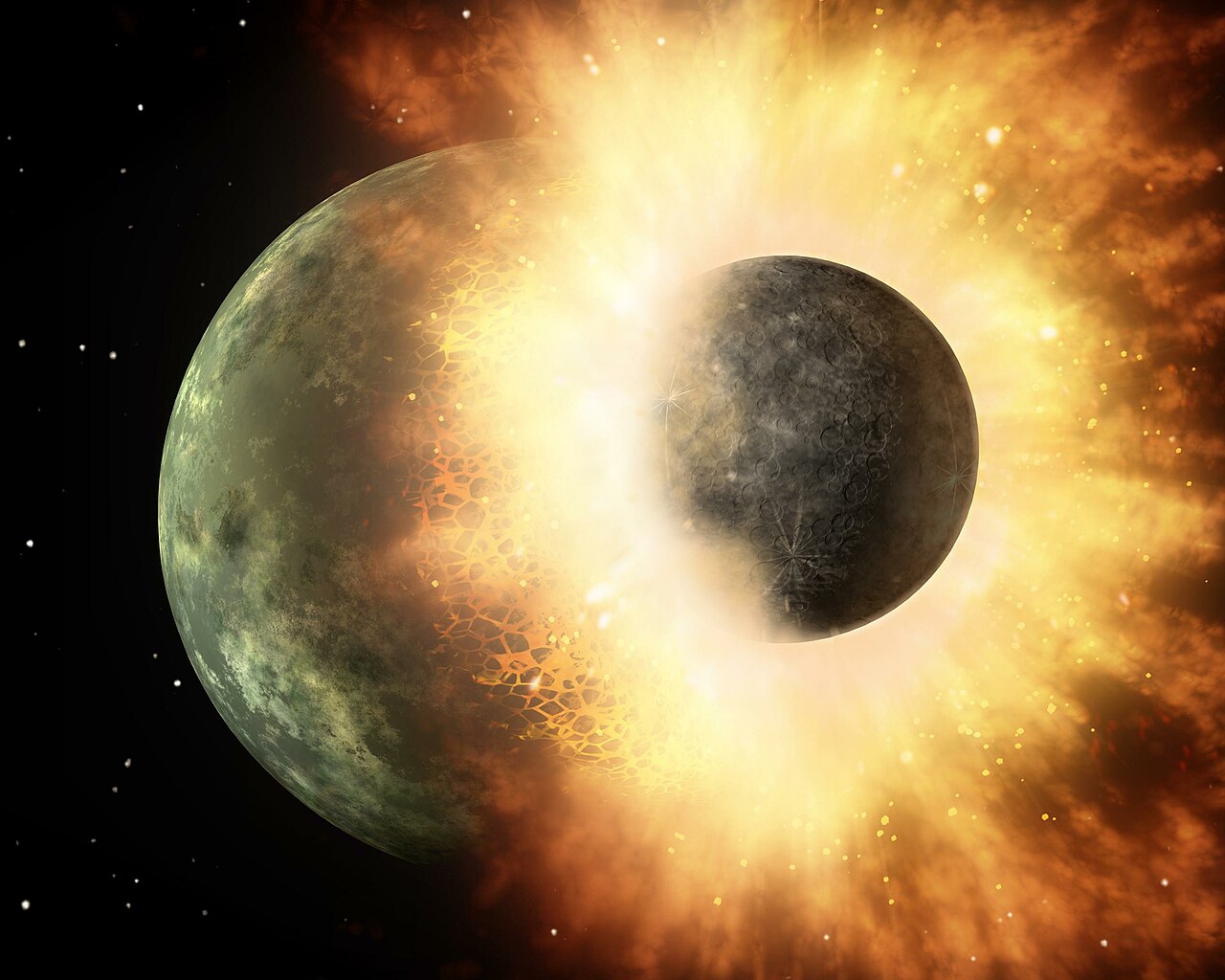


Physical environment and early crust
Conditions during the Hadean were markedly different from those of the modern Earth. Intense volcanism, high internal heat flow, rapid differentiation between core, mantle and crust, and frequent energetic impacts characterised the interval. Permanent, extensive sedimentary deposits are absent: few if any intact Hadean sedimentary rocks survive. The oldest terrestrial materials presently recognised are detrital zircon crystals dated to about 4.4 billion years; these resistant minerals provide isotopic and chemical clues about early crust formation, the presence of liquid water and the thermal state of the near-surface environment. Studies of isotopes in zircons and associated minerals constrain early crustal recycling, magma compositions and the timing of continental crust emergence.
Moon formation and large impacts
A defining episode in the Hadean was the hypothesised giant impact between the proto-Earth and a Mars-sized body. The giant impact hypothesis is a leading explanation for the Moon's origin and for features of the Earth–Moon system. Supporting observations include compositional similarities between Earth's outer layers and lunar samples, the relatively low iron content inferred for the Moon's interior, and the current angular momentum of the Earth–Moon pair. The same era saw many leftover planetesimals, proto-planets, asteroids and comets crossing the inner Solar System, delivering energy and volatiles to Earth and repeatedly modifying its surface.
Bombardment history and the Late Heavy Bombardment
Throughout the Hadean, the young Earth experienced a high flux of impacts from remnant Solar System debris. Some models propose a peak interval of large collisions, often called the Late Heavy Bombardment, which may have occurred near the end of this eon and profoundly affected the survival of early crustal fragments. Repeated large impacts could melt or fragment protocontinental crust, redistribute heat and volatiles, and intermittently sterilise surface environments. The timing, intensity and global effects of this bombardment remain active topics of research and debate among planetary scientists.
Oceans, atmosphere and chemistry
Geochemical evidence and modelling suggest that liquid water may have existed at Earth's surface during parts of the Hadean, once temperatures allowed condensation. The early atmosphere was likely dominated by gases such as carbon dioxide, methane and nitrogen, with very little free oxygen. Volcanic outgassing, impact delivery of volatiles and later degassing all contributed to the composition and pressure of the primordial atmosphere. Redox conditions, availability of dissolved ions in early oceans and episodic changes driven by impacts were important for subsequent chemical evolution.
Implications for the origin of life
No undisputed fossils from the Hadean have been found. Nonetheless, isotopic signatures in ancient minerals and later Archean rocks leave open the possibility that prebiotic chemistry or even nascent life may have originated relatively early, perhaps in localized habitable niches such as hydrothermal systems or surface pools. Because solid evidence is sparse, suggested scenarios for life's origin during or shortly after the Hadean are provisional and tested against multiple lines of indirect evidence.
Geochemical tracers and indirect evidence
Mineral grains, particularly zircons, carry oxygen and hafnium isotope ratios and trace-element signatures used to infer early crustal processes, liquid water interactions and mantle chemistry. Meteorites and lunar samples provide comparative constraints on Solar System formation and the impact environment. Numerical models of heat transport, mantle convection and surface cooling help reconcile the sparse physical record with likely evolutionary pathways for Earth's earliest lithosphere.
Open questions and research directions
Important unresolved issues about the Hadean include the timing and style of the first stable continental crust, the intensity and duration of the late bombardment, when plate tectonics began in a recognizable form, the development of a planetary magnetic field, and the detailed chemistry of early oceans and atmosphere. Progress depends on improved laboratory analyses of ancient minerals, refined geochronology, continued study of lunar and meteoritic materials, and advances in planetary-scale numerical models.
For summaries and further context consult general overviews and specialist resources on geological timescales, planetary accretion and early Earth studies: geological overview, eon definitions, Archaean comparisons, Earth formation, planetary formation, geologic time, Hades (name origin), Greek language, volcanism, sedimentary record, zircon studies, giant impact hypothesis, angular momentum, protoplanets, cometary and asteroidal material, impact processes, Late Heavy Bombardment, carbon dioxide, methane, nitrogen.
Questions and answers
Q: What is the Hadean eon?
A: The Hadean eon is the geological eon before the Archaean. It began at Earth's formation about 4.6 billion years ago, and ended 4 billion years ago.
Q: Where does the name "Hadean" come from?
A: The name "Hadean" comes from Hades, Greek for "Underworld", due to the conditions on Earth at that time.
Q: Who first used the term "Hadean"?
A: The geologist Preston Cloud first used the term in 1972.
Q: What were conditions like on early Earth?
A: Meteorite bombardment, volcanism and high temperatures were very widespread on early Earth.
Q: Are there any sedimentary rocks from this eon?
A: No, there are no sedimentary rocks from the Hadean at all.
Q: What evidence supports a giant impact hypothesis for how our Moon was formed?
A: Evidence supporting a giant impact hypothesis includes similarity between Earth's crust and Moon's composition, low iron concentration in Moon's centre, and high angular momentum of Earth-Moon system.
Q: Why are there so few rocks from this era?
A: An explanation for lack of Hadean rocks (older than 3800 mya) is large amount of rocky and icy debris present in early Solar System which bombarded early Earth until approximately 3800 mya, preventing large crustal fragments from forming by shattering protocontinents.
Related articles
Author
AlegsaOnline.com Hadean eon — Earth's earliest geologic eon (about 4.6 to 4.0 billion years ago) Leandro Alegsa
URL: https://en.alegsaonline.com/art/41711
Sources
- nature.com : "Wilde S.A. Valley J.W. Peck W.H. and Graham C.M. 2001. Evidence from detrital zircons for the existence of continental crust and oceans on the Earth 4.4 billion years ago. Nature 409, 175-178"
- doi.org : 10.1038/35089010