
Axillary nerve (circumflex nerve)
Peripheral nerve arising from C5–C6 roots of the brachial plexus; supplies deltoid and teres minor and skin over the lateral shoulder. Travels through the quadrangular space and is vulnerable in shoulder injury.
The axillary nerve, also called the circumflex nerve, is a major peripheral nerve that supplies muscles and skin around the shoulder. It carries fibers originating mainly from the C5 and C6 ventral rami and is one of the terminal branches of the posterior cord of the brachial plexus. In everyday language it is often described as the nerve of the armpit or axilla, since it passes close to that region of the upper limb.
Image gallery
8 Images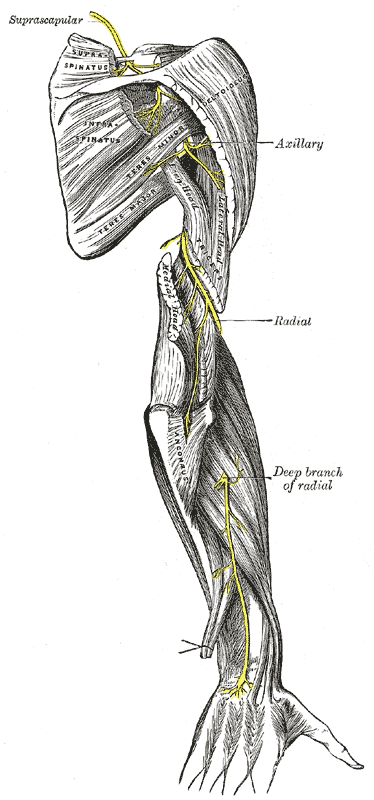



Anatomy and course
After leaving the posterior cord, the axillary nerve runs posterolaterally and exits the axilla by passing through the quadrangular space. It then winds around the surgical neck of the humerus together with the posterior circumflex humeral artery. Within its course the nerve divides into anterior and posterior branches and gives rise to a sensory branch known as the superior lateral cutaneous nerve of the arm.
Motor and sensory functions
- Motor: innervates the deltoid muscle (major shoulder abductor) and the teres minor (external rotator).
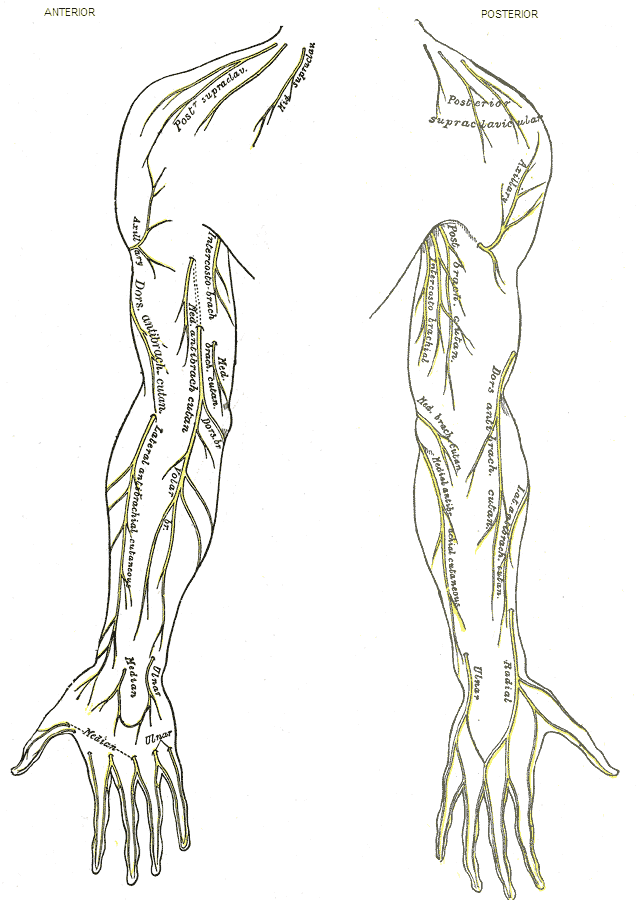
- Sensory: supplies sensation to a small area of skin over the lateral shoulder, often called the "regimental badge" area.
These functions explain why lesions of the nerve produce a characteristic combination of weakness in shoulder abduction and altered sensation over the lateral aspect of the shoulder.
Clinical significance and common injuries
The axillary nerve is vulnerable to injury in several settings: anterior shoulder dislocations, fractures of the proximal humerus, penetrating trauma near the surgical neck, and iatrogenic injury during shoulder surgery. Damage may cause deltoid atrophy, difficulty initiating abduction above the horizontal, and numbness at the lateral shoulder. Evaluation typically includes a focused neurological examination, imaging when indicated, and sometimes electrodiagnostic testing.
Treatment depends on cause and severity: many neurapraxic injuries recover with conservative management (physiotherapy and time), while severe lesions may require surgical exploration or nerve repair. Knowledge of this nerve's anatomy is important for clinicians performing injections or procedures around the shoulder to avoid inadvertent injury.
For a concise anatomical overview and clinical correlations, consult resources on peripheral nerve anatomy and the axillary region. Further details on the quadrangular space and surgical landmarks are available in surgical anatomy references and on educational sites covering the quadrangular space.
Related articles
Author
AlegsaOnline.com Axillary nerve (circumflex nerve) Leandro Alegsa
URL: https://en.alegsaonline.com/art/7832
Sources
- doi.org : 10.1007/s00276-004-0253-z
- pubmed.ncbi.nlm.nih.gov : 15365769