
Quadrangular space of the shoulder: anatomy and clinical relevance
An anatomical interval in the posterior shoulder that transmits the axillary nerve and posterior circumflex humeral artery; important in shoulder injuries, surgical approaches, and entrapment syndromes.
The quadrangular space is a defined anatomical interval in the posterior shoulder region that provides a passage for neurovascular structures between the axilla and the posterior scapular region. It is an important surgical and clinical landmark because injury or compression within this space can affect shoulder movement and sensation. The region is also referred to in some sources as the quadrilateral space.
Image gallery
4 Images
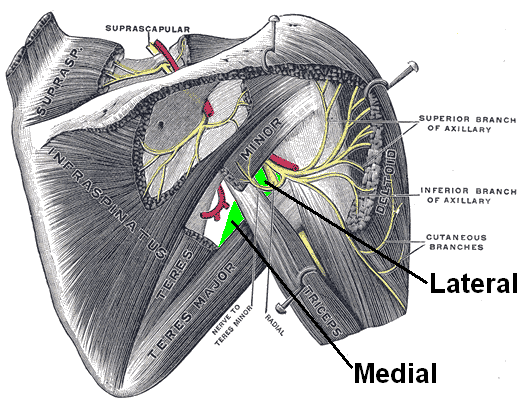
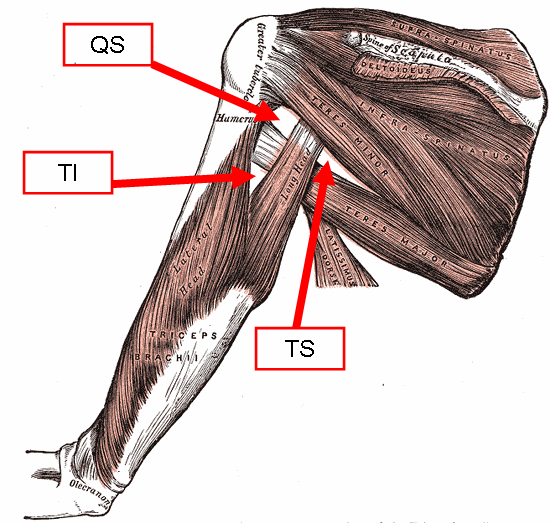

Anatomy and boundaries
The space is bounded by muscular and osseous structures that create a roughly four-sided opening. Commonly described borders are:
- Superior: teres minor (posteriorly) and the inferior margin of the subscapularis (anteriorly)
- Inferior: teres major
- Medial: long head of the triceps brachii
- Lateral: surgical neck of the humerus — often referenced in surgical anatomy texts as the lateral boundary (surgical neck of humerus)
These boundaries may be described with slight variation in different sources depending on whether emphasis is placed on anterior or posterior relations, but the general arrangement is consistent: the space lies between the posterior scapular muscles and the proximal humerus.
Contents
Two important structures traverse the quadrangular space:
- Axillary nerve — a mixed motor and sensory branch of the posterior cord of the brachial plexus. It innervates the deltoid and teres minor muscles and supplies cutaneous sensation to a patch over the lateral shoulder (the "regimental badge" area).
- Posterior circumflex humeral artery — a branch of the axillary artery that provides blood supply to the deltoid region and proximal humerus and participates in anastomoses around the shoulder.
Clinical significance
Because the axillary nerve and posterior circumflex humeral artery are confined within this space, trauma or space-occupying conditions can produce characteristic findings. Common clinical associations include:
- Fractures of the surgical neck of the humerus and anterior shoulder dislocations — both can stretch or lacerate the axillary nerve and compromise blood flow via the posterior circumflex humeral artery.
- Quadrangular (quadrilateral) space syndrome — a compressive neuropathy in which the axillary nerve is compressed, often by fibrous bands, hypertrophy of surrounding muscles, or repetitive overhead activity, producing posterolateral shoulder pain and weakness of shoulder abduction.
- Surgical considerations — surgeons use knowledge of this space during posterior approaches to the shoulder, in humeral implant placement, and when performing decompression procedures. Careful dissection is required to avoid iatrogenic nerve injury; anatomical landmarks such as the surgical neck of the humerus help guide safe exposure.
Diagnosis and management
Diagnosis of pathology related to the quadrangular space is based on history, physical examination, and targeted investigations. Electromyography (EMG) and nerve conduction studies can document axillary nerve dysfunction. MRI or ultrasound may show muscle denervation changes, space-occupying lesions, or vascular abnormalities. Initial management of compressive conditions is often conservative — activity modification, physiotherapy, and anti-inflammatory measures — while persistent or progressive cases may require surgical decompression or repair.
Understanding the quadrangular space is essential for clinicians who evaluate shoulder pain and weakness, as well as for surgeons working around the proximal humerus. Its consistent anatomical relationships make it a reliable landmark, but individual variation means that careful assessment and imaging are often necessary in complex cases.
Related articles
Author
AlegsaOnline.com Quadrangular space of the shoulder: anatomy and clinical relevance Leandro Alegsa
URL: https://en.alegsaonline.com/art/80353