
Pilosa: the order of sloths and anteaters
Pilosa is an order of xenarthran mammals that includes sloths and anteaters. Overview covers anatomy, evolution, ecology, fossil history, and conservation issues.
Overview
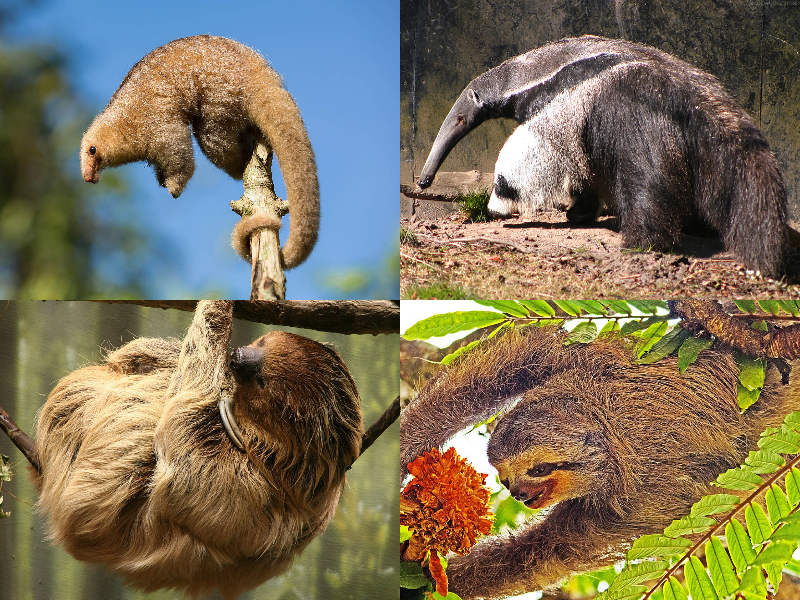
Pilosa is an order of mammals that groups two distinctive, closely related lineages: the sloths and the anteaters. In taxonomic treatments the order name appears alongside other ancient South American groups such as the armadillos within the superorder Xenarthra. Pilosa is recognized for its unusual skeletal features, specialized diets and a long evolutionary history confined mainly to the Americas. Modern members are represented by tree-dwelling sloths and several anteater species adapted to insectivory.
Image gallery
4 Images


Characteristics
Members of Pilosa share a set of anatomical and physiological traits. Common features include robust, curved claws used for climbing or digging, modified vertebrae known as xenarthrous articulations that strengthen the backbone, and low metabolic rates compared with many other mammals. Dental condition varies: most anteaters are toothless with elongated snouts and long sticky tongues, while sloths possess simple peg-like teeth and a folivorous digestive system.
- Locomotion: sloths are largely arboreal and slow; antecedents include both tree and ground forms.
- Feeding: anteaters specialize on ants and termites; sloths feed mainly on leaves and associated microorganisms.
- Reproduction: small litters and parental care are typical.
Evolution and fossil history
Pilosa originated in South America and diversified there for tens of millions of years. The fossil record includes a wide array of extinct forms, notably the giant ground sloths, which reached enormous sizes and occupied terrestrial niches until the end of the last ice age. During the Great American Biotic Interchange some pilosan lineages spread northward after the Isthmus of Panama formed. Their deep evolutionary roots tie them to other xenarthrans and to distinct anatomical specializations not seen in most other mammals.
Ecology, importance and conservation
Ecologically, pilosans play roles as seed dispersers, herbivores, and insect predators. Anteaters control social insect populations; sloths influence canopy ecology through their feeding and by hosting algae and invertebrates in their fur. Many modern species face threats from habitat loss, fragmentation and human activity, and several are subjects of conservation concern. For general taxonomy and further reading see entries on the order Pilosa, broader treatments of mammals, and resources about sloths and anteaters.
Notable distinctions
Pilosa differs from its sister clade of armored armadillos by its lack of external armor and by more pronounced skeletal modifications for climbing or digging. The group's mix of arboreal and terrestrial lifestyles, together with both tiny and giant extinct members, makes Pilosa an especially varied and informative order for studies of adaptation and mammalian evolution.
Related articles
Author
AlegsaOnline.com Pilosa: the order of sloths and anteaters Leandro Alegsa
URL: https://en.alegsaonline.com/art/76920