
Pink-footed goose (Anser brachyrhynchus)
A medium-sized migratory goose of northwest Europe and Arctic breeding areas, the pink-footed goose is known for its pink bill and feet, seasonal migrations, grazing habits, and growing conservation interest.
The pink-footed goose (Anser brachyrhynchus) is a medium-sized migratory waterfowl native to the North Atlantic region. It breeds on high-latitude islands and coastal tundra and spends the winter months in northwest Europe. Its common name comes from the pink coloring on the middle of its bill and on its feet, a useful field mark for identification.
Image gallery
8 Images

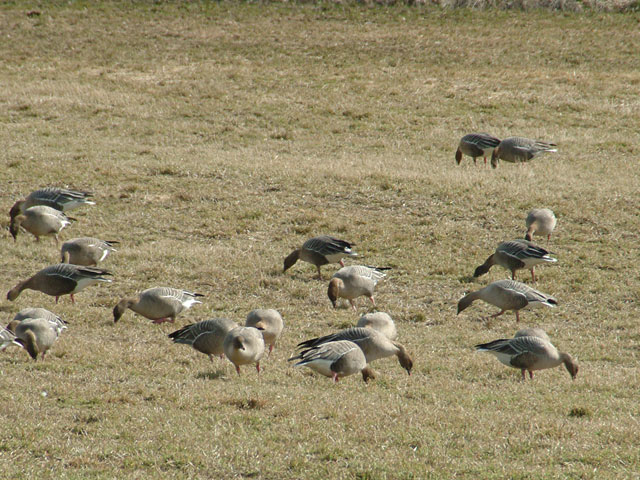


Description and distinguishing features
The species is typically 60–75 cm long with a wingspan around 135–170 cm. Plumage is a generally grey-brown body with a slightly darker head and neck, a white rump, and a grey tail tipped broadly with white. The bill is short and distinctive: pink in the middle with darker base and tip, and the legs and feet are pink. Vocalizations are high-pitched, giving a more nasal call than larger grey geese.
- Size: medium compared with other wild geese.
- Bill: short with pink band and dark tip.
- Plumage: grey-brown body, white rump.
- Legs: pink feet visible in flight and on the ground.
Range, migration and habitat
Breeding takes place in eastern Greenland, Iceland and the Svalbard archipelago, where birds nest on tundra and rocky coastal areas. During migration they move south to wintering areas in northwest Europe, most notably Great Britain, the Netherlands and western Denmark. Movements are highly seasonal: flocks depart the breeding grounds in late summer and autumn and return in spring. For general species information see the species profile.
Key breeding regions include Greenland, Iceland and Svalbard, while important wintering countries include Great Britain, the Netherlands and Denmark. Researchers and conservation bodies track timing and routes; see material on migration studies at migration resources.
Breeding, diet and behavior
Pink-footed geese nest on the ground, often on elevated or stony sites that offer good visibility. They typically lay a clutch of eggs in late spring; both parents defend the nest and care for goslings after hatching. Diet consists mainly of grasses, sedges and agricultural grains in wintering areas. They feed by grazing in fields and short wetland vegetation and may travel between roosting waters and feeding grounds in daily commutes.
Conservation and human interactions
The species has been the subject of conservation attention because of its predictable wintering flocks and interactions with agriculture. In some areas flocks can cause local crop damage, prompting management measures. Conversely, protection on breeding grounds and regulated hunting in some regions have contributed to population recovery since the mid-20th century. The pink-footed goose is also a frequent subject of ringing and telemetry studies that inform international conservation cooperation.
Similar species and identification tips
When identifying wild geese, note the short pink-banded bill and pink feet to separate the pink-footed goose from larger greylag geese or darker bean geese. Size, voice, and the white rump in flight are additional cues for field identification. For further regional guidance and observation records, consult local birding resources and the species profile or regional pages for Great Britain and the Netherlands.
Questions and answers
Q: Where does the pink-footed goose breed?
A: The pink-footed goose breeds in eastern Greenland, Iceland, and Svalbard.
Q: Is the pink-footed goose migratory?
A: Yes, the pink-footed goose is migratory.
Q: Where does the pink-footed goose spend its winters?
A: The pink-footed goose winters in northwest Europe, especially Great Britain, the Netherlands, and western Denmark.
Q: What is the size of the pink-footed goose?
A: The pink-footed goose is a medium-sized goose, measuring 60-75 cm (24-30 in) in length, with a wingspan of 135-170 cm (53-67 in) and weighing 1.8-3.4 kg (4-7.5 lbs).
Q: What characteristics does the bill of the pink-footed goose have?
A: The pink-footed goose has a short bill that is bright pink in the middle with a black base and tip.
Q: What colors are present on the body of the pink-footed goose?
A: The body of the pink-footed goose is grey-brown, with the head and neck being a richer, darker brown. The rump is white, and the tail is grey with a broad white tip.
Q: What is the appearance of the feet of the pink-footed goose?
A: The pink-footed goose has pink feet.
Related articles
Author
AlegsaOnline.com Pink-footed goose (Anser brachyrhynchus) Leandro Alegsa
URL: https://en.alegsaonline.com/art/76999
Sources
- iucnredlist.org : Anser brachyrhynchus
- commons.wikimedia.org : Anser brachyrhynchus
- wikidata.org : Q209419
- species.wikimedia.org : Anser brachyrhynchus
- animaldiversity.org : Anser_brachyrhynchus
- avibase.bsc-eoc.org : AFA7EE7470F000E9
- biolib.cz : 8432
- datazone.birdlife.org : 22679872
- cms.int : anser-brachyrhynchus
- ebird.org : pifgoo
- gd.eppo.int : ANSEBR
- eunis.eea.europa.eu : 877
- eu-nomen.eu : 96475
- fauna-eu.org : 7632ecd8-285d-4106-be8a-0731da9e89ae
- fossilworks.org : 369032