
Partition of India (1947): division, migration, and legacy
The 1947 Partition divided British India into India and Pakistan, triggering mass migration, communal violence, territorial disputes—most notably over Kashmir—and long-lasting political and social consequences.
Overview
The Partition of India in 1947 was the political and territorial division of British India that produced the independent states of India and Pakistan (initially configured as West and East Pakistan). The change marked the end of the British Raj and a major reordering of the Indian subcontinent. Formal transfer of power took place in August 1947, but the decisions that led to partition developed over decades of political negotiation, communal politics, and constitutional planning.
Image gallery
10 Images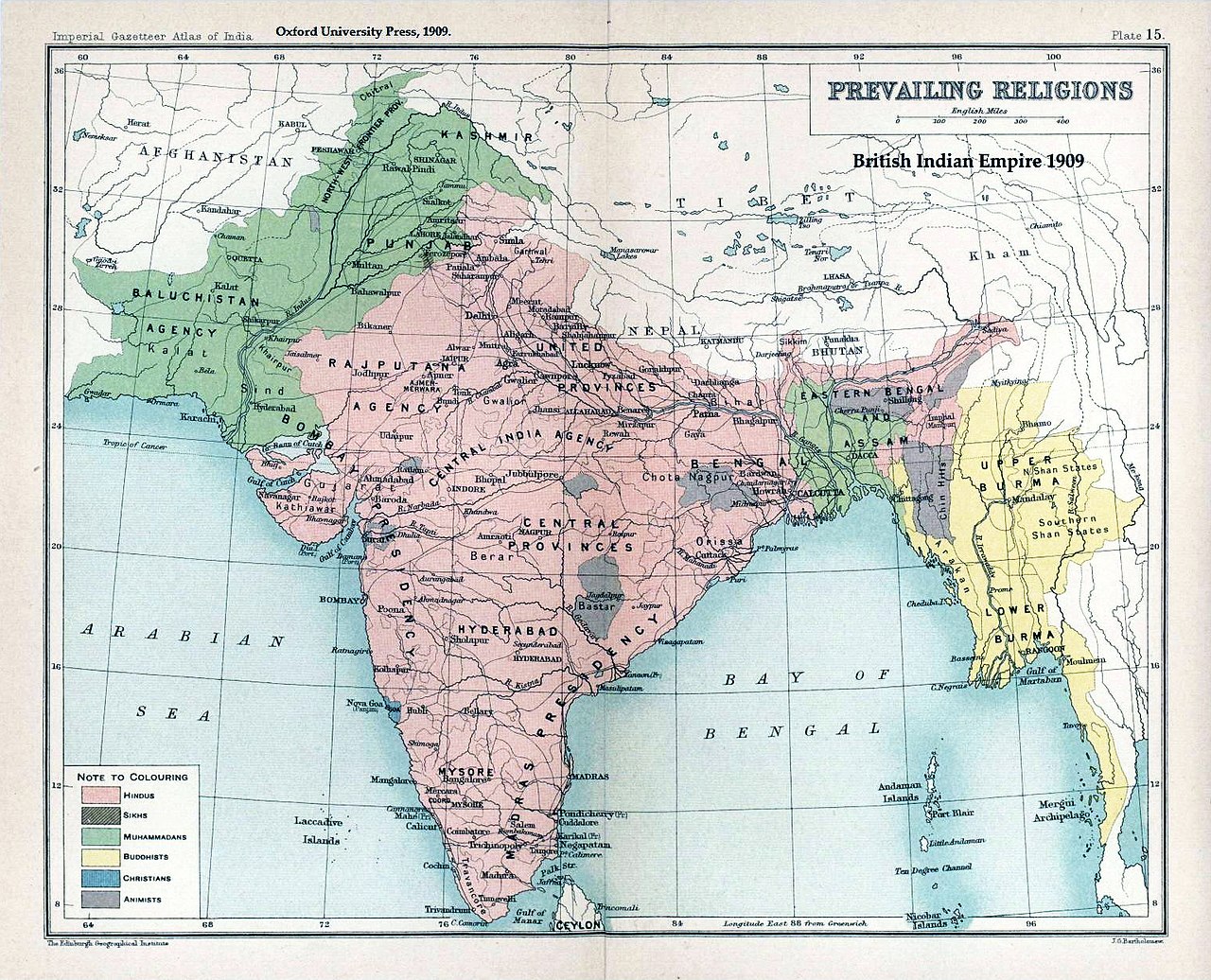




Causes and political context
Several factors shaped the move toward partition. One influential argument, often called the two-nation theory, held that Muslims and Hindus constituted separate nations with incompatible political interests; proponents such as leaders of the All-India Muslim League gave this idea political force. Muhammad Ali Jinnah became the principal advocate for a separate Muslim-majority state and later served as Pakistan’s first Governor-General. Negotiations among the British government, the Indian National Congress, and the Muslim League produced the plan for separate states rather than a unified federal arrangement.
Drawing the border and immediate outcomes
A boundary commission chaired by Sir Cyril Radcliffe drew the demarcation line between the two dominions—commonly called the Radcliffe Line. The speed of transfer and the commission’s late decisions left many districts divided between the new states. Pakistan initially comprised geographically separated western and eastern wings; the eastern wing later became Bangladesh in 1971. The abrupt partition generated one of the largest forced migrations in history, as millions crossed new frontiers seeking safety among religious majorities.
Migration, violence and humanitarian impact
Mass population movement and communal violence unfolded rapidly. Contemporary counts and later censuses recorded millions of displaced people on both sides of the new border; historians estimate that some 10–20 million people were affected by migration. Administrative systems were unprepared for the scale and speed of the movement, and relief and law enforcement were overwhelmed. Violence, including massacres, rape, looting and arson, occurred in many regions. Casualty estimates vary; many historians place deaths in the range of several hundred thousand to over a million, though precise totals remain disputed.
Territorial disputes and political consequences
Partition left unresolved border and sovereignty questions. The princely state of Jammu and Kashmir became a flashpoint, producing the first of several wars between India and Pakistan and long-term contention over the region’s status; see more on the Kashmir conflicts here. The new governments faced immense tasks of state-building: establishing administrations, resettling refugees, defining citizenship and property rights, and rebuilding economies amid communal polarization. The partition also changed demographic and cultural patterns in cities, towns and countryside across the subcontinent.
Legacy and notable facts
The legacy of 1947 continues to shape South Asian politics, society and memory. Key elements include:
- Large-scale refugee resettlement programs and long-lasting demographic shifts.
- Enduring political rivalry and periodic armed confrontations between India and Pakistan.
- Legal and constitutional reforms in both countries as they defined citizenship, minority rights and state identity; for example, India’s constitution established a secular republic, and the wording evolved through later amendments.
- Historical debates about responsibility, memory and reconciliation, which influence education and commemoration across generations.
Scholars continue to study the Partition through archival research, oral histories, and interdisciplinary work. For further context on the colonial administration and negotiations that preceded 1947, see primary records and analyses linked to British governance (British India) and the end of imperial rule (British Raj). For perspectives on migration and refugee experiences, consult specialized studies of forced migration here and comparative regional histories that consider cross-border movements involving neighboring areas such as Tibet and regions near China. Additional resources on the partition-era leaders, political movements and subsequent state developments are available at collections related to Jinnah, the modern states of India and Pakistan, and constitutional and territorial debates summarized in public archives (subcontinental history) and boundary studies (Radcliffe Line).
Related articles
Author
AlegsaOnline.com Partition of India (1947): division, migration, and legacy Leandro Alegsa
URL: https://en.alegsaonline.com/art/74845