
Partitions of Poland (Polish–Lithuanian Commonwealth, 1772–1795)
Three late-18th-century divisions of the Polish–Lithuanian Commonwealth by Russia, Prussia and Habsburg Austria that erased the state until 1918 and shaped Central European politics.
Overview
The Partitions of Poland were a series of three territorial divisions carried out in 1772, 1793 and 1795 that removed the Polish–Lithuanian Commonwealth from the map of Europe. Conducted by the neighbouring powers of the Kingdom of Prussia, the Russian Empire and Habsburg Austria, these partitions combined military pressure, diplomatic agreements and formal annexations. They followed decades of internal political dysfunction within the Commonwealth and a period of increasing influence by its richer, centralized neighbours. For contextual summaries see further reading and background analyses at related studies.
Image gallery
10 Images
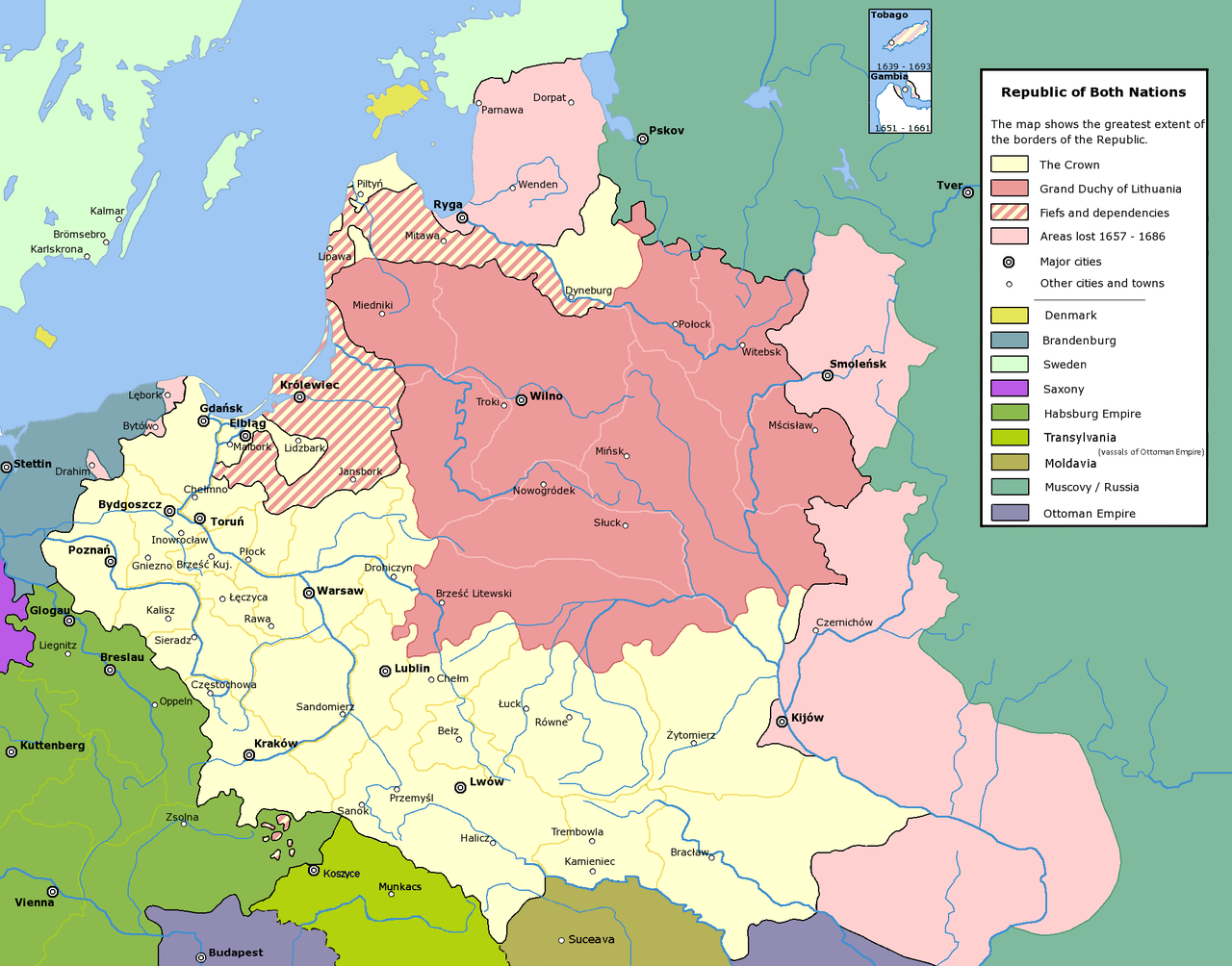


Causes and characteristics
The immediate causes included a weak central government, the liberum veto that hindered parliamentary reform, noble factionalism, and the opportunism of neighbouring monarchies. The partitions mixed negotiated treaties with force: at times one power seized territory while another accepted compensation elsewhere. The process was as much diplomatic as military and relied on alliances among the partitioning states. For archival material and source collections see documentary resources.
The three partitions
- First Partition (5 August 1772) — large border areas of the Commonwealth were ceded after pressure and secret agreements among the three powers.
- Second Partition (23 January 1793) — following internal reform efforts and regional wars, Prussia and Russia took further lands.
- Third Partition (24 October 1795) — the remaining territory was divided and the Commonwealth ceased to exist as an independent state.
Between the second and third partitions, a national uprising led by Tadeusz Kościuszko in 1794 attempted to restore independence but was suppressed, accelerating the final division.
Consequences and legacy
The partitions erased a state that had been a major multiethnic polity in Europe for centuries. They produced new administrative systems under the annexing powers, affected the rights and identities of local populations, and stimulated political and cultural responses among Poles and Lithuanians. In the 19th century, the idea of Polish independence persisted through emigration, literature, clandestine political organisations and periodic uprisings. Napoleonic rearrangements briefly created the Duchy of Warsaw, and the Congress of Vienna (1815) later reshaped partitions' territories, but full restoration of an independent Polish state did not occur until after World War I.
Notable distinctions
Historians sometimes use the phrase "Fourth Partition" informally to describe later territorial adjustments or occupations that further reduced Polish autonomy at different times, but the three 18th-century acts are the central events referred to as the Partitions of Poland. The partitions deeply influenced Central European borders, national movements, and the modern political map of the region.
Questions and answers
Q: What are the Partitions of Poland?
A: The Partitions of Poland refer to the division of the Polish-Lithuanian Commonwealth into three parts by Prussia, Russia and Habsburg Austria in the second half of the 18th century.
Q: When did the Partitions of Poland take place?
A: The Partitions of Poland took place in three stages, on 5 August 1772, 23 January 1793 and 24 October 1795.
Q: What was the purpose of the Partitions of Poland?
A: The purpose of the Partitions of Poland was to divide up the Commonwealth lands among Prussia, Russia and Habsburg Austria, thus ending the existence of the Polish-Lithuanian Commonwealth.
Q: Who carried out the Partitions of Poland?
A: The Partitions of Poland were carried out by Prussia, Russia and Habsburg Austria.
Q: What is the "Fourth Partition of Poland"?
A: The less often used term "Fourth Partition of Poland" may refer to any later division of Polish lands.
Q: When did the Fourth Partition of Poland take place?
A: There is no specific time frame for the Fourth Partition of Poland, as it refers to any later division of Polish lands.
Q: Why is the Fourth Partition of Poland a less often used term?
A: The Fourth Partition of Poland is a less often used term because the three original partitions are more well-known and significant in the history of the Polish-Lithuanian Commonwealth.
Related articles
Author
AlegsaOnline.com Partitions of Poland (Polish–Lithuanian Commonwealth, 1772–1795) Leandro Alegsa
URL: https://en.alegsaonline.com/art/74846
Sources
- books.google.com : A Study of Crisis