
Oil sands (tar sands): composition, extraction, impacts, and global significance
Oil sands are deposits of sand, clay, water and dense bitumen used as an unconventional petroleum source; extraction is energy‑intensive and has important environmental and economic consequences.
Overview
Oil sands, also called tar sands, are a form of unconventional petroleum resource in which a viscous form of crude — bitumen — is bound to sand and clay particles with water. Because the bitumen is too thick to flow like conventional crude, oil sands require special extraction and processing to make liquid fuels. They are considered an important but controversial component of the world’s hydrocarbon resources. For a general definition see unconventional petroleum.
Image gallery
8 Images



Composition and characteristics
Typical oil sands are a mixture of coarse sand grains, finer clay minerals, variable amounts of water and dense, asphalt‑like bitumen. The bitumen contains heavy hydrocarbons and impurities that make it chemically and physically different from light crude oils; this complicates refining and increases energy demands for upgrading. Geological settings and the relative proportions of sand, clay and water vary among deposits; detailed mineralogy and rheology influence the choice of recovery method. For information about associated minerals and clays see clay and sediment.
Where oil sands occur
Large natural accumulations of bitumen occur in several regions around the world. The most economically important deposits are in Canada (notably Alberta), with additional significant resources reported in Kazakhstan and Russia. Globally these deposits are commonly estimated at more than two trillion barrels of bitumen in place, although only a fraction is technically and economically recoverable. Canada is frequently cited as holding roughly 70% of the world’s proven oil‑sands reserves; see regional summaries at Canada, Kazakhstan and Russia.
Extraction and production methods
Two broad recovery approaches are used:
- Surface mining: Applied where deposits lie close to the surface. Excavation removes overburden and the sands are transported to processing facilities for separation of bitumen from solids and water.
- In‑situ methods: Used for deeper deposits. Technologies such as steam‑assisted gravity drainage (SAGD) inject heat (steam) into the reservoir to reduce bitumen viscosity so it can be pumped to the surface.
Both routes require additional steps — upgrading and refining — to convert heavy bitumen into transportable and saleable petroleum products. These processes consume energy and can use hydrogen or catalytic methods to reduce viscosity and remove impurities.
Environmental, energy and economic considerations
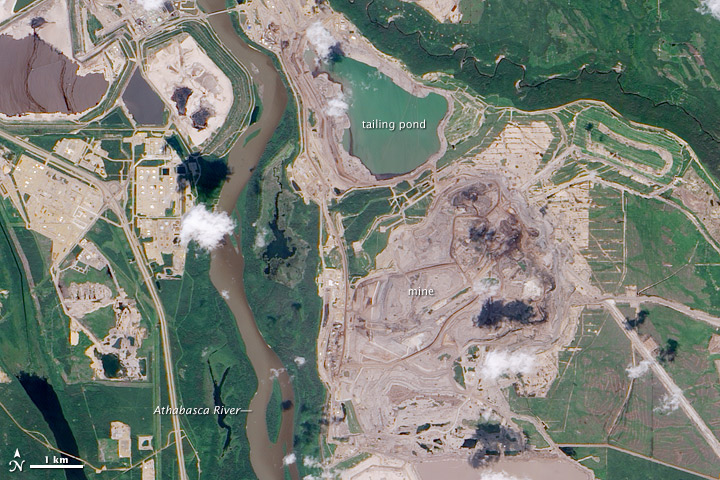
Oil‑sands development is energy intensive. Lifecycle studies commonly find higher greenhouse gas emissions per barrel from bitumen‑derived fuels than from many conventional crudes; estimates vary, and some analyses report roughly 10–15% higher emissions (with figures around 12% cited in several comparisons), depending on technology and boundaries used. Other environmental concerns include large water use, the creation of tailings ponds containing process waste, and extensive land disturbance from surface mining.
Economic viability depends on oil prices, regulatory regimes, technological advances (improving recovery and reducing emissions) and access to markets. Historically, higher oil prices and improvements in in‑situ technology have made previously uneconomic deposits commercially attractive.
Uses, importance and social impacts
Processed bitumen produces fuels and petrochemical feedstocks similar to conventional crude after upgrading and refining. Oil sands are therefore an important source of liquid hydrocarbons where conventional reserves are limited. Development has significant social and political dimensions, including impacts on local and Indigenous communities, employment and regional economies, and debates over environmental regulation and greenhouse gas policy. International and national policies, technological innovation and investment decisions continue to shape the role oil sands play in global energy supplies; for policy and emissions discussions see environmental analyses.
Further technical, economic and regulatory information is available through regional energy agencies and scientific reviews; for an introductory survey consult resources on unconventional oil at unconventional petroleum and regional pages for major producing areas (Canada, Kazakhstan, Russia).
Questions and answers
Q: What are oil sands, and what are they made of?
A: Oil sands are an unconventional source of petroleum made up of a mixture of sand, clay, water, and a dense and extremely sticky form of petroleum known as bitumen.
Q: Where can natural bitumen be found, and which countries have the largest quantities?
A: Natural bitumen can be found in many countries around the world, but the largest quantities are located in Canada, Kazakhstan, and Russia.
Q: How many worldwide deposits of oil sands are estimated, and do these estimates include undiscovered deposits?
A: There are estimated to be more than 2 trillion barrels (320 billion cubic metres) of oil sands worldwide, and these estimates do include deposits that have not yet been discovered.
Q: What percentage of all proven reserves of oil sands are located in Canada?
A: Around 70% of all proven reserves of oil sands are located in Canada.
Q: Why is oil produced from bitumen sands often referred to as unconventional oil, and how does its production process compare to that of traditional liquid oil?
A: Oil produced from bitumen sands is often referred to as unconventional oil because it comes from a source that is different from traditional liquid oil. Its production process is much more energy-consuming compared to traditional oil, resulting in a smaller net energy gain.
Q: How does the production of liquid fuels from oil sands compare to the production of traditional oil in terms of greenhouse gas emissions?
A: The production of liquid fuels from oil sands requires much more energy and produces 12 percent more greenhouse gases per barrel of final product than the production of traditional oil.
Q: Why have oil sands only recently been considered to be part of the world's oil reserves?
A: Oil sands have only recently been considered to be part of the world's oil reserves because their extraction and processing were not profitable at lower oil prices. However, the recent rise in oil prices has made oil sands extraction and processing more profitable.
Related articles
Author
AlegsaOnline.com Oil sands (tar sands): composition, extraction, impacts, and global significance Leandro Alegsa
URL: https://en.alegsaonline.com/art/72149
Sources
- environment.alberta.ca : "Alberta's Oil Sands: Opportunity, Balance"
- ostseis.anl.gov : "About Tar Sands"
- huffingtonpost.com : "Canada's Tar Sands Battle With Europe" · webcitation.org
- greenpeace.org : greenpeace.org
- treehugger.com : "Alberta Tar Sands: A North American Overview"
- guardian.co.uk : "Canada threatens trade war with EU over tar sands"