
Notoceratops — a disputed southern horned dinosaur
Notoceratops is a poorly known Late Cretaceous ceratopsian named from a single jaw fragment discovered in South America; its identity and significance remain debated among paleontologists.
Overview
Notoceratops, meaning "southern horned face," is a genus of ornithischian dinosaur known only from a single lower jaw fragment recovered from Cretaceous rocks in southern continents. It has traditionally been associated with the horned dinosaurs (Ceratopsia) because the preserved bone shows features interpreted as part of a beaked, herbivorous anatomy. Because so little material survives, descriptions emphasize uncertainty: Notoceratops is often treated cautiously in modern literature and has been called a nomen dubium by some researchers.
Image gallery
2 Images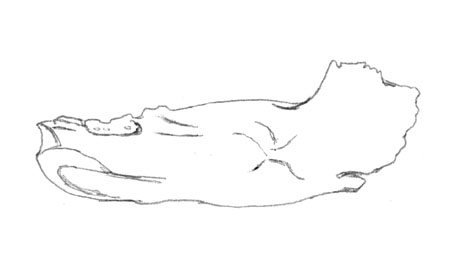

Discovery and naming
The fossil that serves as the holotype was collected from Late Cretaceous strata and later described under the name Notoceratops. The fragmentary nature of the specimen — a partial dentary or jawbone — has limited detailed anatomical comparison. Over time the original material has been difficult to locate or study, which has contributed to ongoing uncertainty about the taxon's precise relationships and validity.
Anatomy and inferred characteristics
From the jaw fragment researchers inferred several general traits typical of ceratopsians and other beaked herbivores:
- a robust lower jaw with teeth adapted to processing plant matter;
- evidence for a beak at the front of the mouth, often described as parrot-like in comparative texts;
- a body plan that, if typical ceratopsian affinities hold, would include a stocky, quadrupedal stance, a large skull with a short frill, and rows of cheek teeth.
These inferred features are general and based on comparisons with better-known ceratopsians rather than on direct preservation of those parts in the Notoceratops specimen.
Classification and scientific debate
Notoceratops is traditionally placed among the ceratopsians, a diverse group of herbivorous dinosaurs that includes familiar taxa such as Triceratops. However, ceratopsians are primarily known from the northern continents (Laurasia), and the idea of a bona fide southern ceratopsian raises biogeographic questions. Because the name is founded on a single fragmentary jaw from the Late Cretaceous, many specialists regard its assignment as tentative. Some authors consider the genus indeterminate until additional, diagnostic material is found.
Paleoecology and significance
If Notoceratops represents a valid southern ceratopsian, it would have implications for the distribution and evolution of horned dinosaurs, suggesting either wider dispersal or convergent evolution of beaked herbivores in Gondwana. Even as a fragmentary and debated taxon, Notoceratops is frequently cited in discussions about Cretaceous faunal interchange and the limits of fossil evidence in reconstructing ancient ecosystems.
Notable facts and research prospects
Because the holotype is limited and its status uncertain, future fieldwork that uncovers more complete material from the same region is the only realistic path to clarifying Notoceratops' relationships. Until then, it remains an intriguing but unresolved name in the history of dinosaur paleontology, illustrating how single fossils can provoke long-term scientific discussion.
Related articles
Author
AlegsaOnline.com Notoceratops — a disputed southern horned dinosaur Leandro Alegsa
URL: https://en.alegsaonline.com/art/71171