
Noshaq — highest peak of Afghanistan and a prominent Hindu Kush summit
Noshaq is a 7,492 m peak on the Afghanistan–Pakistan border, the highest in Afghanistan and the westernmost 7,000 m mountain in the world, notable in mountaineering, geography and glaciology.
Noshaq is the highest mountain in Afghanistan and one of the principal summits of the Hindu Kush. The summit reaches about 7,492 metres above sea level and occupies a strategic position on the international boundary known as the Durand Line, with its northern and western slopes in Afghanistan and its southern and eastern flanks in Pakistan.
Image gallery
2 Images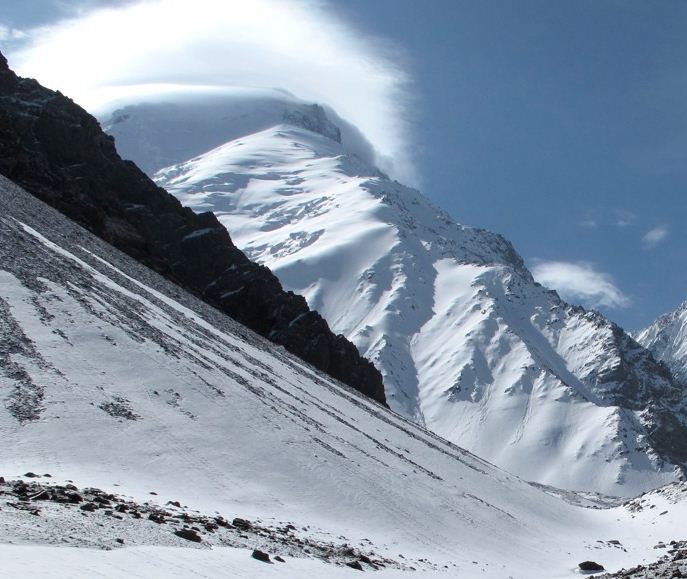

Geography and significance
Noshaq holds the distinction of being the westernmost 7,000‑metre class peak on Earth, a fact often noted in regional geography and mountaineering literature. The massif forms a prominent landmark for local communities and a watershed between high mountain valleys. Because of its elevation, Noshaq contributes to local river systems through snowmelt and small glaciers that persist on its higher faces.
Geology and climate
Like other ranges of the Hindu Kush, Noshaq is a product of the ongoing collision between the Indian and Eurasian tectonic plates. Uplift and folding have produced steep relief, fractured rock, and seismic activity in the broader region. Climatically, the mountain experiences arctic‑alpine conditions: long, cold winters, a short climbing season in summer and autumn, and persistent snowfields and glaciers at altitude.
Climbing, routes and access
Noshaq has attracted mountaineers since the mid‑twentieth century but remains less frequented than many Himalayan peaks because of its remote approaches and the complexities of operating near an international border. Typical access for foreign expeditions has often been staged from Chitral on the Pakistani side for logistical reasons, while approaches from Afghan valleys are possible depending on permits and local security. Routes involve mixed snow, ice and rock climbing, with crevasse and avalanche hazards on glaciered sections; experience in high‑altitude mountaineering is essential.
Conservation, research and local importance
Noshaq and its environs are of interest to glaciologists and climate scientists because the small glaciers and perennial snowfields respond to regional climate variation. Changes in snow cover and glacier extent influence downstream water supply for mountain communities. Access to the area and to scientific work can be affected by political and security conditions, and conservation efforts are often coordinated with local stakeholders.
Further reading and related topics
- Mountain classification and high‑altitude mountaineering principles.
- Regional context: the Hindu Kush and neighbouring ranges (Hindu Kush).
- Comparison with nearby major peaks such as Tirich Mir, the highest of the range.
- Political geography and borderlands of Afghanistan and adjacent Pakistan.
Noshaq remains an important subject for those studying mountain ecosystems, high‑altitude culture and the challenges of mountaineering in politically complex border regions.
Related articles
Author
AlegsaOnline.com Noshaq — highest peak of Afghanistan and a prominent Hindu Kush summit Leandro Alegsa
URL: https://en.alegsaonline.com/art/71140