
Northern hawk-owl (Surnia ulula)
A medium-sized, diurnal owl of the boreal zone, the northern hawk-owl is noted for its hawk-like shape, daytime hunting, and resident populations across northern North America and Eurasia.
The northern hawk-owl (Surnia ulula) is a distinctive boreal raptor that combines owl traits with a hawk-like silhouette and habits. Often called the Hudsonian owl in older literature, it is primarily a resident species of northern forests and open woodlands. Unlike many owl species that are nocturnal, this species is frequently active by day and at dusk and may be seen perched prominently while scanning for prey.
Image gallery
7 Images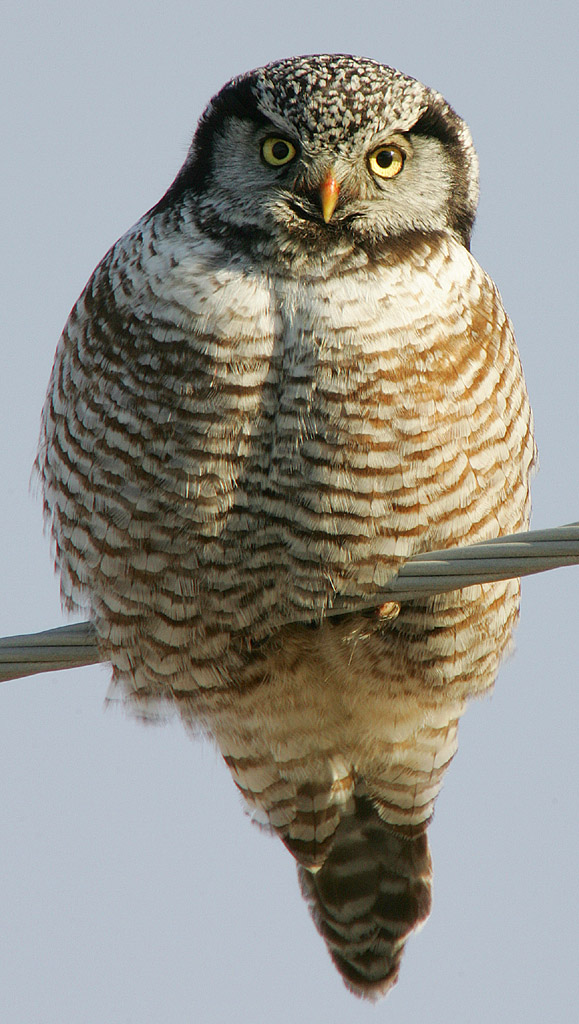


Identification and behavior
Adult northern hawk-owls have a long tail, rounded head without ear tufts, and streaked plumage that provides camouflage against tree trunks. Their yellow eyes and sharp bill give them a raptor-like appearance. They hunt from exposed perches, using a combination of quick sallies and direct flight rather than the hovering often associated with some owls. Vocalizations include clear, repetitive notes used in territorial and breeding contexts.
Habitat and distribution
This species occupies northern coniferous forests (the boreal zone) and adjacent open areas across parts of Canada, Alaska, northern Europe and Asia. Populations tend to be tied to suitable nesting sites and local prey abundance; most birds are year-round residents but some populations show irregular north–south movements when food resources fluctuate. For basic species information see Northern hawk-owl and references on its breeding ecology at breeding areas.
Diet and reproduction
The hawk-owl feeds mainly on small mammals such as voles and shrews and will also take small birds and insects. It locates prey visually and by sound, often making rapid flights to capture targets on the ground. Nesting typically occurs in tree cavities, old nests of other large birds, or sheltered platforms; pairs raise a single brood each year and lay a clutch of several eggs when conditions are favorable.
Conservation and notable facts
Overall the northern hawk-owl is not considered globally threatened and is classified as stable in many parts of its range, but local population size can fluctuate with prey cycles and habitat change. It is the sole living member of the genus Surnia, a fact that highlights its distinct evolutionary position among owls. Naturalists value it for its uncommon combination of diurnal habits and boreal specialization.
- Key traits: diurnal activity, long tail, hawk-like flight.
- Habitat: boreal forest and open woodland edges.
- Behavioral note: irruptive movements tied to prey abundance.
Related articles
Author
AlegsaOnline.com Northern hawk-owl (Surnia ulula) Leandro Alegsa
URL: https://en.alegsaonline.com/art/71024
Sources
- iucnredlist.org : "Surnia ulula"
- books.google.com : Oology and Ralph's Talking Eggs: Bird Conservation Comes Out of Its Shell