
North Central Florida
A regional description of North Central Florida centered on Gainesville, its counties, landscape, history, economy, and cultural and ecological features.
North Central Florida is a loosely defined portion of the U.S. state Florida situated inland from the Gulf Coast and extending across the middle of the state's northern tier. It is often considered part of broader North Florida and includes a mix of small cities, towns and rural landscapes. The region's largest city is Gainesville, home to the flagship campus of the state university system, the University of Florida. For some descriptions the area is described as a distinct subregion of the U.S. state because of its topography and climate, which contrast with Florida's coastal and peninsular lowlands.
Image gallery
3 Images

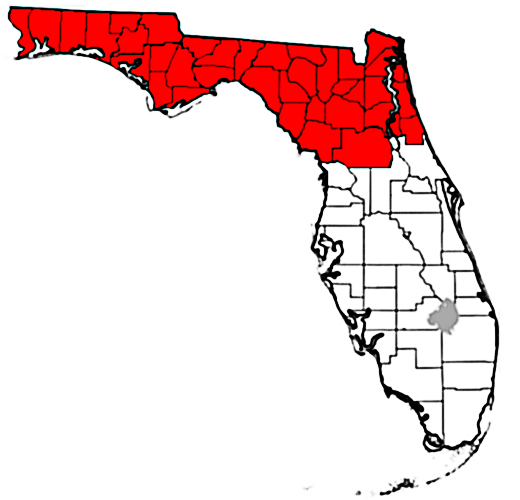
Counties
- Alachua County
- Bradford County
- Columbia County
- Dixie County
- Gilchrist County
- Hamilton County
- Lafayette County
- Levy County
- Madison County
- Suwannee County
- Taylor County
- Union County
Geography and ecology
The region sits on higher ground than Florida's coastal plains, featuring gently rolling hills, karst springs and numerous waterways that feed rivers such as the Suwannee. Upland pine forests, mixed hardwoods and stands of magnolia and live oak with Spanish moss create a landscape more typical of the southeastern interior than of the state's tropical fringe. Soils vary from sandy ridges to fertile river valleys and limestone outcrops, which support a diversity of herbs, shrubs and wildlife.
History and development
Human habitation in North Central Florida stretches back to indigenous peoples whose settlements clustered near springs and rivers. During the nineteenth century the area developed through agriculture, timber and small-town commerce. The arrival and growth of the University of Florida in Gainesville transformed the local economy and cultural life, increasing population, research activity and regional connections.
Economy, culture and uses
Today the region combines higher-education institutions and health-care centers with agriculture, forestry and tourism tied to natural springs, paddling rivers and historic towns. The University-driven sectors provide research and employment, while local festivals, museums and outdoor recreation sustain cultural identity and attract visitors. Many communities emphasize conservation of springs, rivers and native habitats as part of economic planning.
Notable distinctions
North Central Florida is notable for its transition zone character: it bridges the subtropical lowlands of peninsular Florida and the temperate environments of the southeastern United States. That mix shapes local climate, flora and land use, and explains why the region is often referenced separately from Florida's coastal metropolitan corridors in planning, conservation and tourism materials.
Further information and local resources can be found through municipal and county pages as well as educational institutions serving the area.
Related articles
Author
AlegsaOnline.com North Central Florida Leandro Alegsa
URL: https://en.alegsaonline.com/art/70847