
North America Nebula (NGC 7000)
An H II emission nebula in Cygnus whose outline resembles the North American continent. Catalogued as NGC 7000 / Caldwell 20, it lies roughly 1,600 light-years away and is an active star-forming region.
Overview
The North America Nebula, catalogued as NGC 7000 and listed in amateur guides as Caldwell 20, is a bright emission nebula in the direction of the Cygnus constellation. Its glowing hydrogen gas and intervening dark dust give the complex a distinctive silhouette that many observers liken to the shape of the continent of North America; this resemblance is the origin of its common name. The nebula lies at a distance commonly quoted as about 1,600 light-years from Earth and occupies a large area of sky, making it a frequent subject for wide-field astrophotography.
Image gallery
5 Images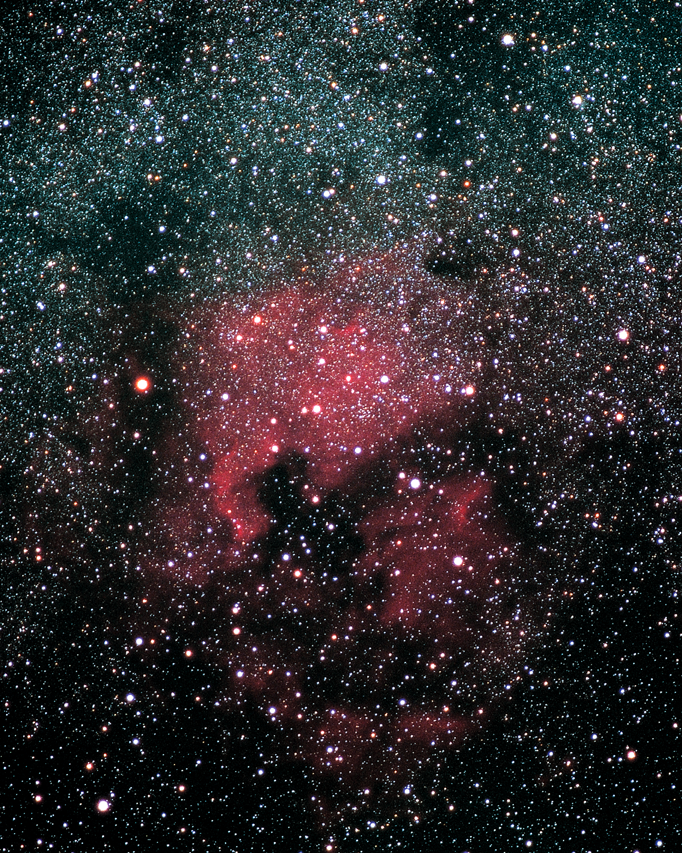




Structure and composition
NGC 7000 is an H II region—clouds of ionized hydrogen that shine primarily through hydrogen-alpha emission. Embedded within the emission are dark, dusty lanes that sculpt the apparent outline and create the separate dark gulf that helps form the recognizable "continent" shape. Adjacent to the main North America outline is the related Pelican Nebula (IC 5070), separated by a narrow, obscuring band of dust. The region contains young stars, protostellar objects and compact clusters; ultraviolet light from hot, massive stars ionizes the surrounding gas and produces the nebula's visible glow.
Observation and imaging
Although the nebula is large and relatively faint, it is accessible to amateur astronomers. Under dark skies it can be detected with binoculars and is a popular wide-field target for small telescopes and camera lenses. Narrowband filters, such as hydrogen-alpha, greatly enhance contrast and reveal fine structure. The bright star Deneb lies nearby and serves as a convenient guidepost for locating the nebula, but Deneb itself is not the primary ionizing source for the cloud; that role is attributed to hotter, more embedded stars within the complex. For practical guidance on viewing and framing the object, see typical observing notes and finder charts used by hobbyists near Deneb and in summer sky lists.
Scientific importance
The North America Nebula is of interest to professional astronomers because it illustrates processes of star formation and the interaction between young massive stars and the interstellar medium. Studies across optical, infrared and radio wavelengths reveal the embedded stellar populations, the distribution of dust, and the kinematics of the ionized gas. These multiwavelength observations help characterize how stellar winds and radiation shape molecular clouds and trigger or inhibit further star formation.
History, cataloging and notable facts
- Catalog names: NGC 7000 (New General Catalogue) and Caldwell 20 in popular observing lists; it is often imaged together with IC 5070 (the Pelican Nebula).
- Appearance: the striking continental outline is produced by contrast between emission and dark dust lanes; this visual likeness has driven public interest and outreach.
- Visibility: while generally too faint to be seen as a discrete object with the naked eye from typical suburban skies, it becomes evident under dark rural skies or with photographic techniques; amateur and educational programs frequently image it to demonstrate H II-region morphology and star formation.
For introductory summaries and observing tips about emission nebulae and specific targets like NGC 7000, consult outreach pages and observing guides about emission nebulae, local star charts showing the nebula's shape, and resources that place it in context among Cygnus objects near Deneb. Additional data and images can be found in professional survey archives and amateur image galleries covering the region and in community observing notes on its distance and structure.
Related articles
Author
AlegsaOnline.com North America Nebula (NGC 7000) Leandro Alegsa
URL: https://en.alegsaonline.com/art/70802