
Cygnus — the Swan: a northern constellation with the Northern Cross
Cygnus is a prominent northern constellation shaped like a swan and home to Deneb, the Northern Cross asterism, rich Milky Way fields, notable nebulae, and the famous X-ray source Cygnus X-1.
Overview
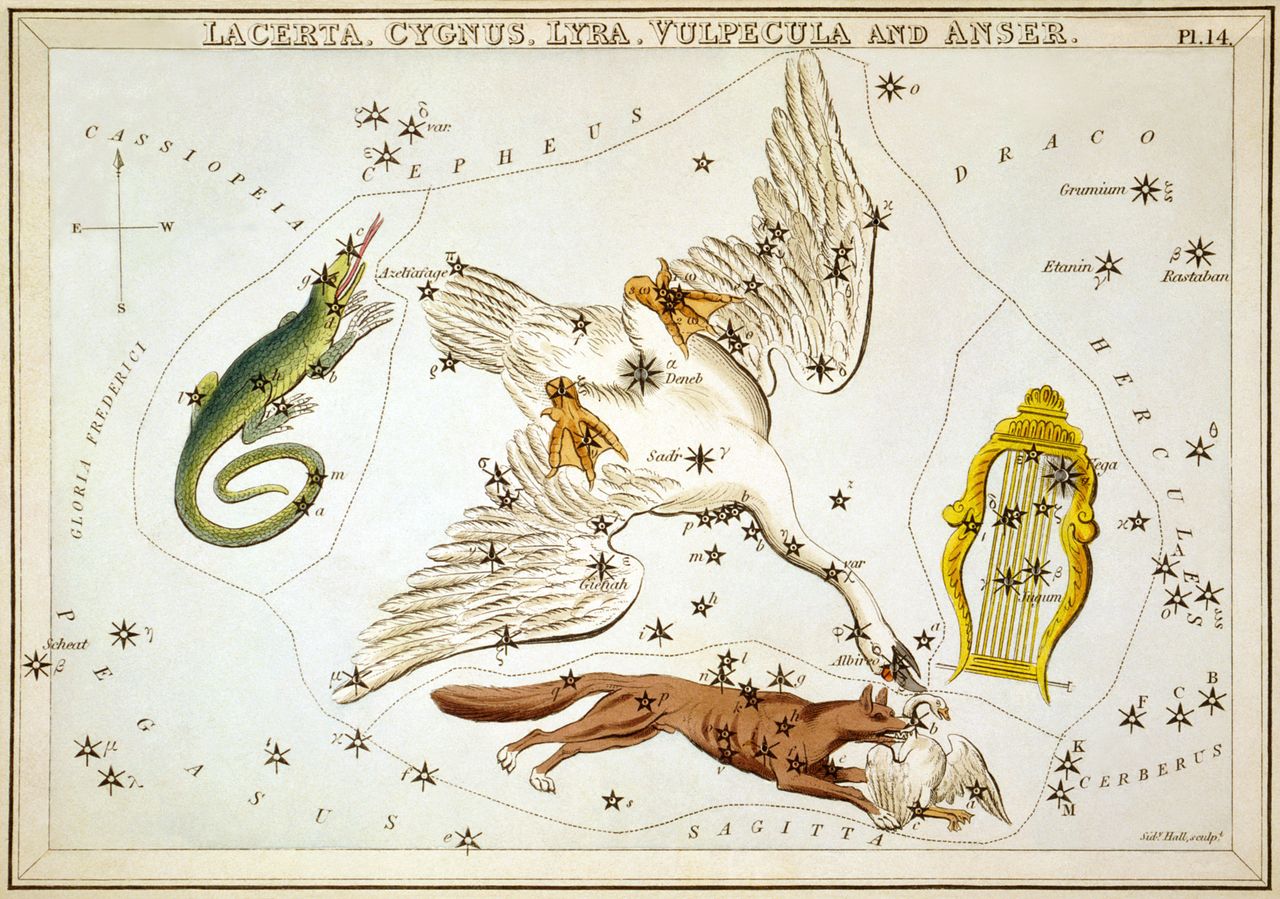
Cygnus is a conspicuous constellation of the northern sky whose name comes from the Greek word for "swan." It contains a distinctive line of bright stars that form the familiar asterism known as the Northern Cross, which is often used by observers to identify Cygnus on summer nights. The constellation lies along the band of the Milky Way, making it rich in stars and deep-sky objects. It was one of the constellations listed by the ancient astronomer Ptolemy.
For general reference and maps see constellation charts. Additional resources on the pattern and identification are available at star guides.
Image gallery
10 Images






Notable stars and deep-sky objects
Cygnus is dominated by several well-known stars and nebulae. Deneb, the brightest star in the constellation, forms one corner of the Summer Triangle asterism together with Vega and Altair. Albireo, another celebrated star of Cygnus, appears as a striking double to small telescopes, with contrasting colors. The constellation also hosts a variety of nebulae and radio/X-ray sources, including large emission nebulae often likened to geographic shapes.
- Deneb — luminous supergiant and one corner of the Summer Triangle.
- Albireo — colorful double star popular with amateur telescopes.
- North America and Pelican Nebulae — bright emission regions in the Milky Way.
- Veil Nebula — the visible remains of a supernova, rich in filamentary structure.
- Cygnus X region — a complex of radio and X-ray sources that includes the famous black hole candidate Cygnus X-1.
For catalogs and imagery consult deep-sky databases and observational lists at astronomy resources.
History and mythology
In classical mythology Cygnus is associated with several tales, most commonly with transformations into a swan. Myths link the figure to stories of love and disguise, and different cultures assigned varied identities to the pattern of stars. Astronomical records show the constellation was recognized in antiquity; Ptolemy included it in his catalog of fixed stars and constellations.
Observation and significance
Cygnus is best seen from mid-northern latitudes during the summer and autumn months, when it rises high in the evening sky. Because it lies along the Milky Way, the region offers rich fields of stars and nebulae for binoculars and telescopes. The Northern Cross asterism provides a convenient way for skywatchers to orient themselves and locate nearby objects. For cultural context and observing tips see observer guides.
As a constellation, Cygnus combines easy naked-eye recognition with scientifically important targets: from bright variable and binary stars to remnants of exploded stars and compact X-ray sources. It remains a favorite area of the sky for both casual stargazers and professional astronomers investigating star formation and high-energy phenomena.
Related articles
Author
AlegsaOnline.com Cygnus — the Swan: a northern constellation with the Northern Cross Leandro Alegsa
URL: https://en.alegsaonline.com/art/24888
Sources
- chandra.harvard.edu : "Cygnus (swan) also (modern) Northern Cross"