
Nova: sudden stellar brightening from thermonuclear surface explosions
A nova is a sudden, dramatic brightening of a white dwarf in a close binary caused by a surface thermonuclear runaway. This article explains mechanisms, observable properties, examples, frequency, and scientific importance.
A nova is a sudden, large increase in the brightness of a star that occurs when a white dwarf in a close binary system accumulates enough material on its surface to ignite a thermonuclear runaway. The underlying cause is a powerful surface explosion rather than a disruption of the entire star; in other words, a nova is a surface nuclear explosion on a white dwarf that leaves the compact star intact. Novae are distinct from supernovae, which typically destroy or radically transform the progenitor star and can outshine whole galaxies for short periods. Most novae are produced in a close binary system where mass transfer is ongoing.
Image gallery
7 Images
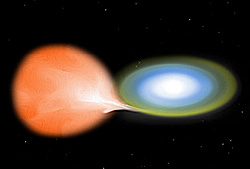





How novae form and what they eject
The basic mechanism begins when hydrogen-rich gas is pulled from the companion star and settles on the white dwarf. Over time this accreted layer is compressed and heated until thermonuclear fusion reactions ignite in a runaway manner across the surface. The sudden release of energy ejects a small fraction of the outer layers at high speed while dramatically increasing the star's luminosity. Typical ejected masses are small compared with the white dwarf — on the order of 10−4 solar masses (about one ten-thousandth of a solar mass) — yet the kinetic energies and peak brightnesses are substantial. Ejecta velocities often reach thousands of kilometres per second and the system can brighten by many orders of magnitude for days to months.
Types, recurrence, and long-term evolution
Not all novae are identical. Classical novae are observed to erupt only once in recorded history, while recurrent novae undergo repeated outbursts separated by years to decades. A well-known recurrent system is RS Ophiuchi, which has produced multiple recorded eruptions. Recurrent novae occur when accretion resumes after each outburst and the white dwarf steadily regains material. If the white dwarf gradually approaches the Chandrasekhar limit through repeated accretion, it may eventually undergo a different fate, such as a type Ia supernova, although many accreting systems never reach that threshold.
Observable behaviour and notable examples
Some novae become bright enough to be seen without optical aid when they occur nearby. Historical and modern examples include Nova Cygni 1975 and more recent bright events like V1280 Scorpii (2007), Nova Delphini (2013) and Nova Centauri (2013). Nova Cygni 1975 appeared in the constellation Cygnus, near the star Deneb, and reached naked-eye visibility. Observations across the electromagnetic spectrum — from radio to X-ray and, in surprising cases, gamma-rays — provide information about ejecta mass, velocity, clumping, and shocks between fast and slow material.
Frequency, detection, and scientific importance
Astronomers estimate that our galaxy, the Milky Way, experiences on the order of a few dozen novae per year (commonly quoted ranges are roughly 30 to 60 per year), though only a fraction are discovered because many occur in obscured or crowded regions. External galaxies such as Andromeda also yield dozens of detectable novae annually when monitored systematically. Novae serve several scientific roles: they are laboratories for thermonuclear physics under degenerate conditions, they return processed material to the interstellar medium, and their well-studied light curves and spectra help calibrate distance indicators and improve understanding of close binary evolution.
Quick reference: typical nova properties
- Progenitor: accreting white dwarf in a close binary (white dwarf, binary system).
- Trigger: accumulation of hydrogen and surface thermonuclear fusion ignition.
- Ejected mass: around 10−4 to 10−5 solar masses.
- Ejecta speeds: typically hundreds to several thousand km/s.
- Recurrence: single events (classical) or repeated eruptions (recurrent).
- Galactic rate: a few dozen per year in the Milky Way, fewer actually discovered.
Because novae are comparatively common, relatively nearby when they are discovered, and observable across wavelengths, they remain important targets for professional and amateur astronomers alike. Their study connects stellar evolution, binary dynamics, explosive nucleosynthesis, and transient survey science, making novae a recurring subject in observational astrophysics and theoretical modeling.
Questions and answers
Q: What is a nova?
A: A nova is a huge nuclear explosion on a white dwarf star that causes the star to suddenly brighten.
Q: How much material is ejected in a nova?
A: The amount of material ejected in a Nova is usually only about 1/10,000 of a solar mass, which is quite small relative to the mass of the white dwarf.
Q: How fast does the ejecta from a Nova travel?
A: The ejecta from a Nova can travel as fast as several thousand kilometers per second, or even higher for some Novae.
Q: How bright can Novae become?
A: Novae can become up to 50,000-100,000 times brighter than the sun.
Q: What was the brightest recent example of a Nova?
A: The brightest recent example of a Nova was Nova Cygni 1975 which appeared on 29 August 1975 and reached magnitude 2.0 (nearly as bright as Deneb).
Q: How many Novae are estimated to occur in the Milky Way each year?
A: Astronomers estimate that there are roughly 30-60 Novae occurring in the Milky Way each year with an average rate of 40.
Q: How many Novae are discovered in other galaxies such as Andromeda each year?
A: Approximately 25 Novae brighter than magnitude 20 are discovered in Andromeda Galaxy each year and smaller numbers are seen in other nearby galaxies.
Related articles
Author
AlegsaOnline.com Nova: sudden stellar brightening from thermonuclear surface explosions Leandro Alegsa
URL: https://en.alegsaonline.com/art/71220
Sources
- iopscience.iop.org : iopscience.iop.org/article/10.1088/0004-637X/746/1/61
- phys.org : phys.org/news/2010-08-fermi-supernova-cousin.html
- cbat.eps.harvard.edu : "CBAT List of Novae in the Milky Way"
- cbat.eps.harvard.edu : "M31 (Apparent) Novae Page"