
Oberon (moon)
Oberon is the outermost major moon of Uranus, about half ice and half rock. Discovered in 1787, it is heavily cratered, tidally locked, and was imaged by Voyager 2 during its 1986 flyby.
Overview
Oberon is the most distant of Uranus's five large moons and the planet's second-largest satellite by radius, with a mean radius of roughly 760 km (mean radius). It orbits Uranus at greater distance than the inner moons and completes one orbit in about 13.4 days. Like the other major Uranian satellites, Oberon is believed to be tidally locked, keeping the same face toward the planet over long timescales.
Image gallery
10 Images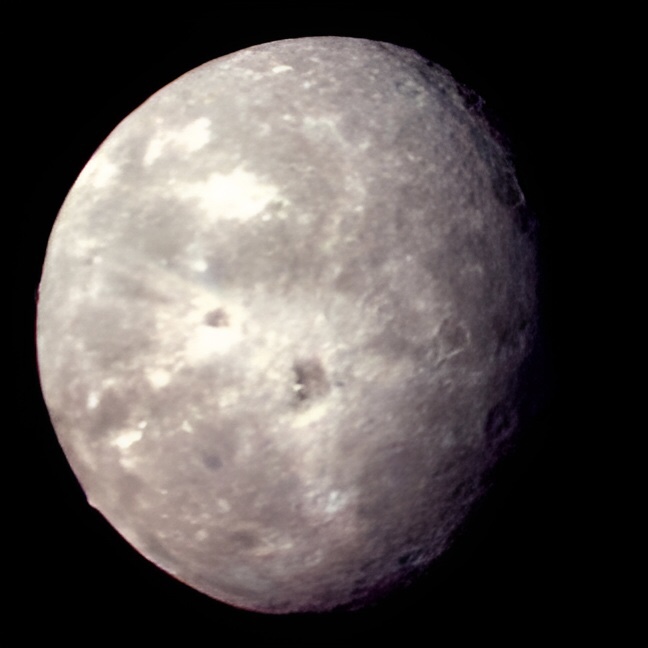





Composition and internal structure
Observations and density estimates indicate that Oberon is composed of a mixture of water ice and rocky material in approximately comparable proportions. The internal structure is thought to be partially differentiated, with a denser, rock-rich interior and a less dense icy mantle. Because of its size and temperature, any internal heat today is small, and there is no clear evidence for widespread present-day geological activity.
Surface features and geology
The surface of Oberon is dark and heavily cratered, consistent with an old and relatively inactive world. Large impact basins and numerous craters dominate the landscape; some craters exhibit brighter ejecta rays that stand out against darker background material (craters). In Voyager 2 imagery, isolated elevated landforms and rugged rims were visible, and preliminary height estimates for some peaks have been suggested to reach values on the order of tens of kilometres, though such estimates remain uncertain (height estimate; mile conversion).
Coloration and surface processes
Parts of Oberon's surface appear slightly redder in color relative to other regions; this reddening is commonly attributed to space weathering processes or the deposition of dark, radiation-processed material. The satellite lies within Uranus's magnetosphere for part of its orbit, and interactions with charged particles may contribute to chemical alterations on the surface over geologic time. Overall, the lack of extensive resurfacing means ancient impact records are well preserved.
Orbit, rotation and relationships
Oberon orbits beyond the brighter inner moons of Uranus and lies well outside the planet's main ring system. Its orbit and synchronous rotation place it among the classical Uranian satellites (Miranda, Ariel, Umbriel, Titania, Oberon). The orbital dynamics of these moons are influenced primarily by Uranus's gravity, and their relative isolation reduces the likelihood of frequent resurfacing caused by tidal heating.
Discovery and name
Oberon was discovered by William Herschel on 11 January 1787 (William Herschel), in the same year he reported finding the moon Titania (Titania) as part of his telescopic surveys. The name Oberon was later adopted from the king of the fairies in William Shakespeare's play A Midsummer Night's Dream, and the naming of Uranian satellites generally draws on characters from Shakespeare and other English literature; the association with William Shakespeare is reflected in many feature names.
Exploration and observations
The principal source of direct imaging and close-up data for Oberon is the NASA Voyager 2 spacecraft, which flew past Uranus in 1986 and obtained the only detailed close-range photographs of the moon to date (Voyager 2; spacecraft data). Voyager 2’s brief encounter allowed partial mapping of Oberon's surface and provided the basis for most morphological interpretations. Since the flyby, Earth-based telescopes and more recent instruments have provided additional photometric and spectral measurements, but no dedicated orbiter or lander has visited Oberon.
Possible interior and thermal history
Models of thermal evolution for mid-sized icy satellites suggest that Oberon likely cooled relatively early in Solar System history. If any internal ocean ever existed, it would now be frozen inmost models; however, small amounts of past heating, impacts, or radiogenic decay could have produced transient alterations in its interior. Current data do not firmly establish the presence of a present-day subsurface ocean.
Naming conventions and surface feature nomenclature
Features on Oberon follow the established convention for Uranian satellites, which generally uses names drawn from works of William Shakespeare and, in some cases, the poet Alexander Pope. Crater and basin names, as catalogued by planetary nomenclature authorities, reflect these literary sources and aid in consistent scientific communication.
Scientific importance and future study
Oberon serves as an example of a cold, ancient icy world in the outer Solar System. Its preserved crater record provides insights into impact processes at large heliocentric distances and into the collisional environment of the early Solar System. Many basic questions about Oberon—such as detailed composition, the full extent of topography, and any subtle tectonic features—remain open. Improved telescopic observations and, especially, a future Uranus orbiter mission would be required to map the moon thoroughly and to study its interior and surface in greater detail.
Quick facts
- Location: outer system of Uranus; outermost of the five major classical moons.
- Composition: roughly equal parts water ice and rock by mass.
- Mean radius: about 760 km (mean radius).
- Orbital period: ~13.4 days around Uranus (orbit data).
- Discovery: 11 January 1787 by William Herschel (same year as Titania).
- Exploration: imaged by Voyager 2 during its 1986 flyby (mission data).
For technical summaries, orbital elements, and mission archives consult available datasets and mission pages (orbit data; size estimates; spacecraft). For specific surface feature discussions and the nomenclature scheme see databases of planetary feature names and related literature (craters; Voyager 2).
Questions and answers
Q: What is Oberon?
A: Oberon is the farthest big moon of the planet Uranus.
Q: What is the composition of Oberon?
A: Oberon is made of about half ice and half rock.
Q: How big is Oberon?
A: With a mean radius of about 760 km, Oberon is the second biggest moon of Uranus's 27 moons.
Q: Who discovered Oberon?
A: Oberon was found on January 11, 1787 by William Herschel, who also found Titania in the same year.
Q: What is Oberon named after?
A: Oberon is named after a character in William Shakespeare's play A Midsummer Night's Dream- King Oberon, who is the king of the fairies in the play.
Q: What is the orbital period of Oberon?
A: Oberon orbits Uranus about every 13.4 days.
Q: What have scientists discovered about Oberon?
A: Scientists have discovered several large impact craters on Oberon where it has been hit by meteorites and also believe there is a mountain that could be 20 km (12 mi) high on the moon. These were photographed by the Voyager 2 spacecraft in 1986 as it flew passed.
Related articles
Author
AlegsaOnline.com Oberon (moon) Leandro Alegsa
URL: https://en.alegsaonline.com/art/71724
Sources
- apod.nasa.gov : "APOD: April 8, 1996 - Uranus's Moon Oberon: Impact World"
- solarviews.com : "Oberon, A Moon Of Uranus"
- solarsystem.nasa.gov : "Solar System Exploration: Planets: Comparison Chart"
- planetary.org : "Uranus' Moon Oberon - Explore the Cosmos"
- planetary.org : The Planetary Society
- ui.adsabs.harvard.edu : 1987LPI....18..964S
- planetarynames.wr.usgs.gov : "Oberon Nomenclature Table Of Contents"