
Nitrous acid (HNO2) — properties, preparation, reactions, and uses
Nitrous acid (HNO2) is a weak, unstable acid that exists mainly in aqueous solution; important in organic nitrosation, diazotization, and atmospheric nitrogen oxide chemistry.
Overview
Nitrous acid is the inorganic compound with formula HNO2. It is a weak, unstable oxyacid of nitrogen that cannot be isolated in pure form under ordinary conditions and is encountered primarily as a dilute aqueous solution. In solution it is in equilibrium with the nitrite ion (NO2−) and a proton, and many of its reactions proceed via nitrite or related nitrogen oxide species. For a concise summary see basic description.
Image gallery
3 Images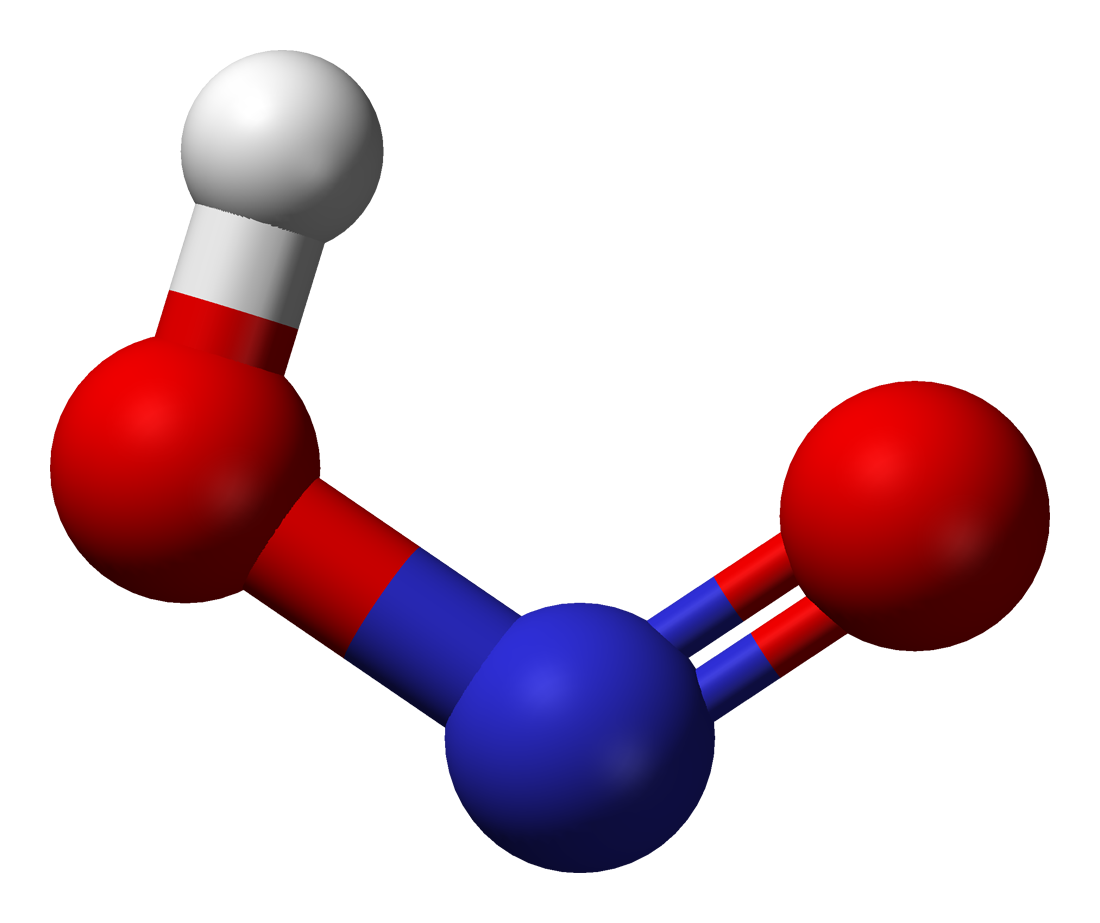

Structure and properties
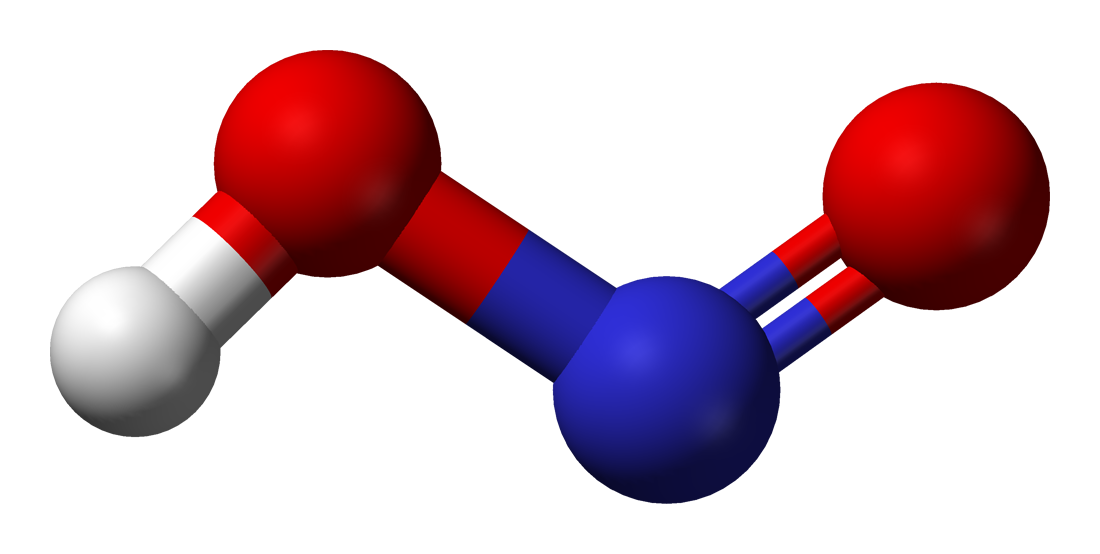
The molecule is bent and has resonance-stabilized bonding between the nitrogen, oxygen and hydrogen atoms. As a Brønsted acid it dissociates according to HNO2 ⇌ H+ + NO2−, so its aqueous behaviour is closely tied to nitrite chemistry. Fresh solutions of HNO2 are often described as pale blue, a coloration that can arise from dissolved nitrogen oxide decomposition products.
Preparation and main reactions
Nitrous acid is commonly generated in situ by acidifying aqueous solutions of nitrite salts. Typical laboratory preparation involves adding a strong acid to sodium nitrite; details and safety notes are available at preparation guide. It is chemically unstable: concentrated or warm solutions decompose to a mixture of nitrogen oxides and water. For example, decomposition produces nitric oxide and nitrogen dioxide; for further information on nitric oxide see NO resources and on nitrogen dioxide see NO2 resources. Nitrogen dioxide can hydrolyze to give mixtures containing both nitrous and nitric acids, a connection discussed in related chemistry.
Typical reactions and applications
- Diazotization: conversion of aromatic primary amines into diazonium salts, a key step in dye and coupling chemistry.
- Nitrosation: formation of nitroso compounds from amines and other nucleophiles; important in organic synthesis and in formation of some food contaminants.
- Analytical use: generation of gaseous nitrogen oxides for test reactions and detection of nitrite.
Because it is generated and consumed in many rapid equilibria, practical uses almost always rely on producing HNO2 in situ rather than isolating it.
Environmental and safety notes
Nitrous acid (often termed HONO in atmospheric chemistry) plays a role in daylight air chemistry by releasing radicals that affect ozone and oxidation capacity of the lower atmosphere. In the laboratory, HNO2 and its decomposition gases are toxic and corrosive; work should be done in a fume hood with appropriate precautions. As a general rule, chemists use nitrite salts rather than attempting to store nitrous acid itself.
Related articles
Author
AlegsaOnline.com Nitrous acid (HNO2) — properties, preparation, reactions, and uses Leandro Alegsa
URL: https://en.alegsaonline.com/art/70385