
Novichok — Soviet-era family of nerve agents
Novichok is a name for a family of nerve agents developed in the Soviet Union from the 1970s. These organophosphate compounds are often binary, highly toxic, and implicated in several high-profile poisonings.
Overview
Novichok refers to a group of related chemical compounds developed as military nerve agents. Broadly described in open sources as organophosphate-based, the Novichok agents were created with the stated goal of producing substances that could defeat protective measures and evade contemporary detection methods. Public information about their exact chemical structures is limited and some details remain classified or disputed.
Image gallery
3 Images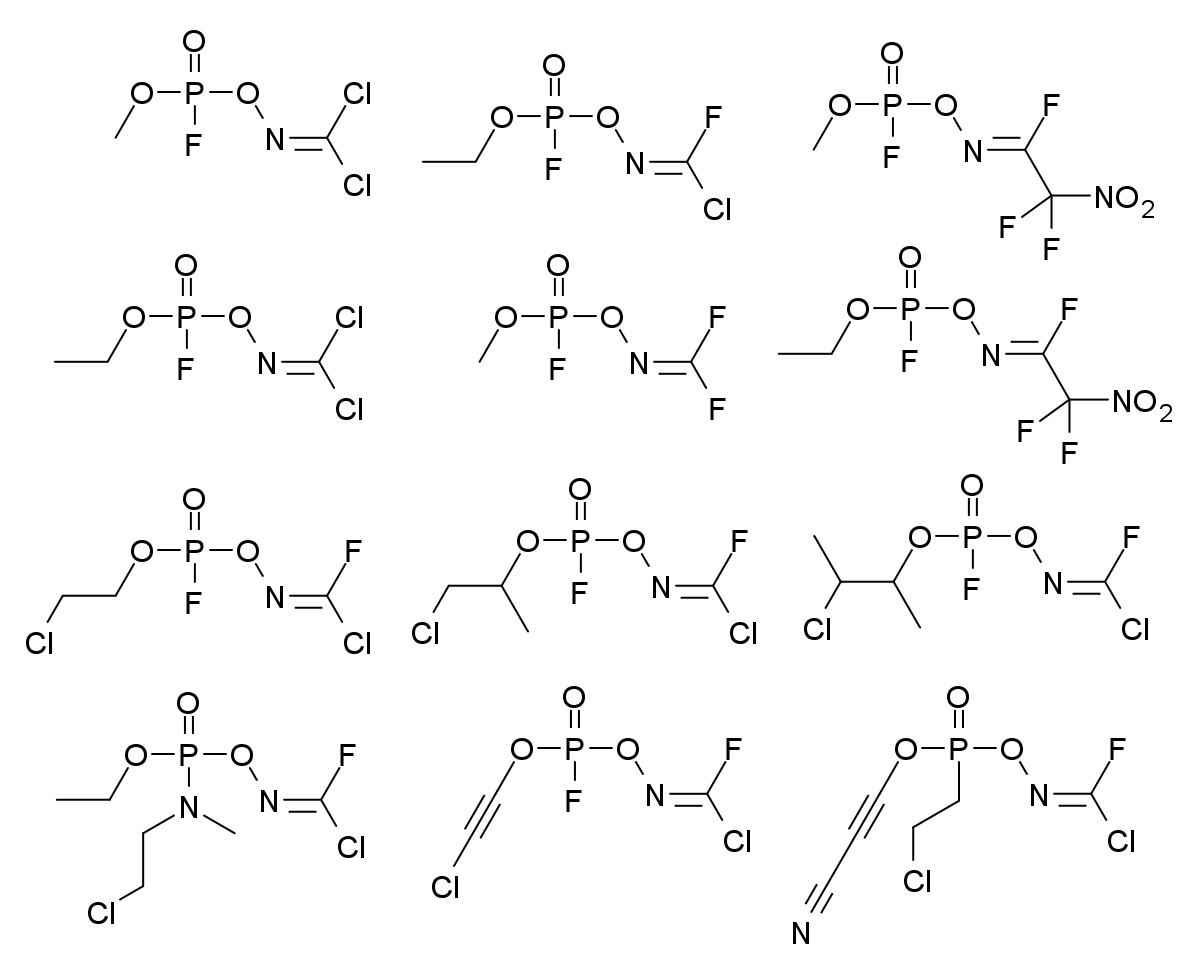


Characteristics and mechanism
Like other nerve agents, Novichok compounds act primarily by inhibiting the enzyme acetylcholinesterase, producing an accumulation of the neurotransmitter acetylcholine and triggering a cholinergic crisis. Symptoms can include salivation, sweating, muscle twitching, respiratory difficulty and, in severe cases, convulsions and death. Medical responses commonly described for organophosphate poisoning—such as administration of atropine and oxime antidotes, respiratory support, and decontamination—apply to suspected Novichok exposure.
- Binary formulation: Several reports indicate some Novichok agents were designed as binary systems, made from two less-toxic precursors that become lethal once mixed. This reduces risk during transport and complicates detection prior to activation.
- Potency and persistence: Sources suggest variable volatility and persistence across different compounds in the family; some are reportedly highly potent and may remain active on surfaces for extended periods, while others are more volatile.
- Analytical challenges: Novel chemical structures and unusual precursors can make laboratory identification and forensic attribution more difficult than for classic agents such as sarin or VX.
History and notable incidents
Open-source reporting places development of Novichok-type agents within a Soviet-era program beginning in the 1970s and continuing into the late 20th century. The program is frequently referenced under names used in investigative literature. Novichok entered international public attention following several high-profile poisoning incidents. In 2018, former intelligence officer Sergei Skripal and his daughter were poisoned in the United Kingdom with a substance identified by authorities as Novichok, and that same year a related incident occurred in Amesbury. Later investigations and analyses also implicated a Novichok-class agent in the poisoning of opposition politician Alexei Navalny in 2020.
Legal status and international response
The use of such nerve agents is prohibited under the Chemical Weapons Convention. International bodies and national laboratories have worked to develop analytical methods to detect and attribute exposures. Because Novichok agents and their precursors were not always publicly cataloged, several governments have urged expanded monitoring and added certain precursors to control lists to close regulatory gaps.
Importance and practical implications
Novichok remains significant for several reasons: its association with targeted assassinations and attempted assassinations has raised geopolitical tensions; its reported binary design highlights risks in trafficking and covert use; and its novel chemistry has driven advances in forensic toxicology and emergency response. For civilians and first responders, awareness of signs of nerve agent exposure and rapid decontamination and medical treatment are essential. For researchers and policy makers, ongoing work seeks to improve detection, stockpile antidotes, and strengthen international controls.
For further background on chemical agents and classification, see general references on nerve agents, historical development in the Soviet Union, and materials on binary chemical systems such as some fertilizers and precursors used in industry and agriculture (example entries).
Related articles
Author
AlegsaOnline.com Novichok — Soviet-era family of nerve agents Leandro Alegsa
URL: https://en.alegsaonline.com/art/71271