
Atakora Department (Benin): geography, people, administration
Atakora is Benin's mountainous northwestern department. This article outlines its landscape, climate, peoples, communes, economy, conservation areas and administrative history.
Overview
Atakora is the northwestern department of Benin, occupying the country's most elevated and rugged terrain. It forms a borderland with neighbouring countries and combines a distinctive highland landscape with a long human history. The department is often associated with traditional fortified houses and strong cultural identity in its towns and villages.
Image gallery
3 Images

Geography and landscape
Atakora includes the Atakora Range, a chain of low mountains and plateaus that rises above the surrounding savanna. The region's geology produces rocky outcrops, escarpments and valleys that influence local agriculture and settlement patterns. To the west the department adjoins Togo, and to the north it meets Burkina Faso, giving it an important cross-border position for trade and cultural exchange.
Climate and seasons
The climate is markedly drier than southern Benin. Local calendars distinguish three main seasons: a rainy season from late spring into early autumn, a cool, dry period driven by the Harmattan winds in the late autumn and winter months, and a hot, dry "lean" season in late winter and early spring when rainfall is scarce and food stocks are often low. These seasonal rhythms shape farming cycles and traditional life.
People, culture and architecture
Atakora is home to several ethnic groups with distinct languages, crafts and building traditions. One of the region's best-known cultural features is the fortified, multi-storey earthen architecture of the hill communities (often referred to in tourist literature for their distinctive compounds). Local markets, handicrafts and rituals continue to play a central role in social life.
Administration and communes
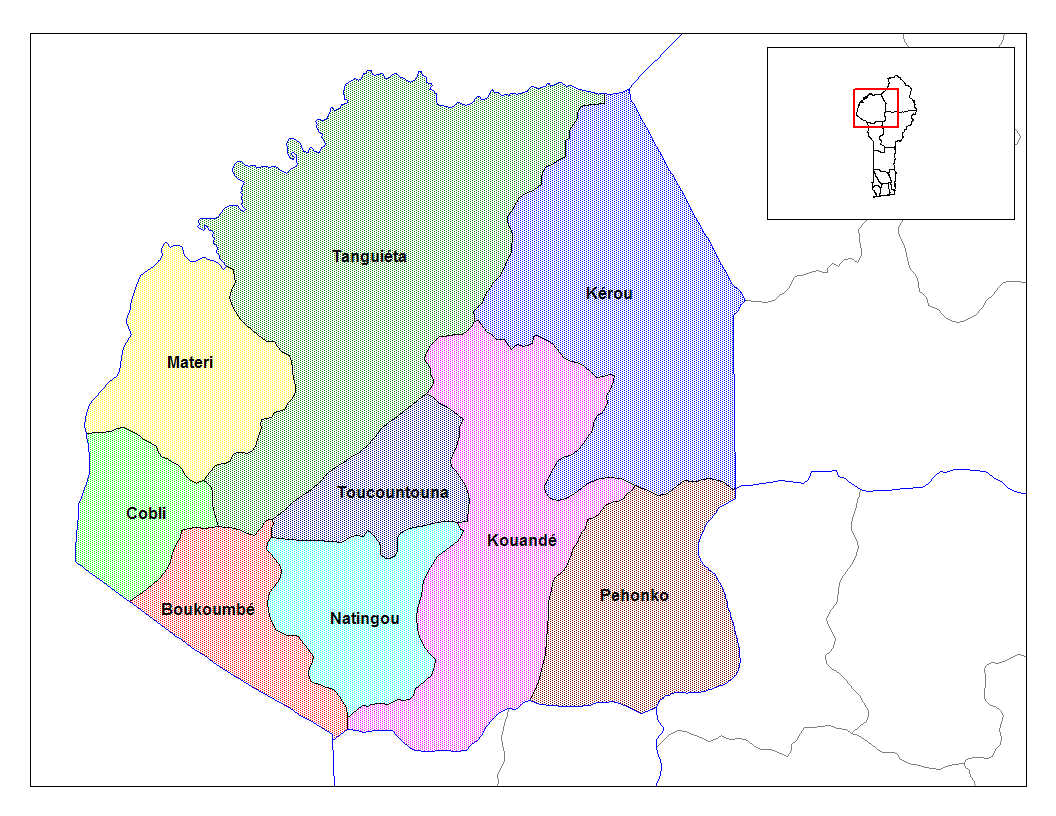
The department is administered from regional towns including Natitingou and Tanguiéta. It is divided into several communes: Boukoumbé, Cobly, Kérou, Kouandé, Matéri, Natitingou, Pehonko, Tanguiéta and Toucountouna. These local governments manage services, agriculture and cross-border liaison in the mountainous area.
History and recent changes
Atakora has long been a crossroads of cultures in the Dahomey/Benin region. In 1999 the department was reduced in size when its southern territory was separated to create the new Donga Department. The department is also notable as the birthplace of former president Mathieu Kérékou, a figure in Benin's modern political history.
Economy, conservation and tourism
Economic life in Atakora is largely rural: subsistence farming, livestock grazing and local trade dominate. The rugged scenery and protected areas attract growing numbers of visitors; nearby reserves and parks support biodiversity and provide opportunities for ecotourism. Conservation efforts aim to balance wildlife protection, pastoralism and agricultural needs while sustaining livelihoods in a seasonally challenging environment.
Notable facts
- Atakora is Benin's most mountainous department and serves as a border zone with Togo and Burkina Faso.
- The region combines traditional architecture and cultural heritage with areas of wildlife interest.
- Its administrative boundaries were altered in 1999 when Donga Department was created.
Related articles
Author
AlegsaOnline.com Atakora Department (Benin): geography, people, administration Leandro Alegsa
URL: https://en.alegsaonline.com/art/6882