
Mitre (ecclesiastical headdress)
A mitre is a ceremonial headdress worn by bishops and some other clergy in Western and Eastern Christian traditions; it has distinctive peaks and lappets and varies by rite and historical era.
Overview: The mitre is the traditional liturgical headdress of certain bishops and senior clergy in many Christian churches. In Western Christianity it is most commonly associated with Roman Catholic, Anglican and some Lutheran bishops; similar but distinct forms appear in Eastern Orthodox and Eastern Catholic practice. The term comes from Latin and Greek words for a band or head-covering and has long served as a visible sign of episcopal authority. Liturgical headwear and its uses are described in many ritual manuals and church documents (see ecumenical context).
Image gallery
10 Images


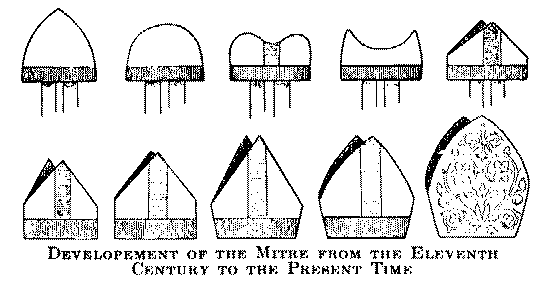
Design and components
A typical Western mitre is a tall, pointed cap with two triangular peaks: one facing forward and one backward. From the back hang two cloth strips called lappets or infulae. The stiffened sides are often made of textile over a supportive core and may be plain, embroidered, or jeweled. Western forms are sometimes classified as the plain mitre (mitra simplex) and the ornate mitre (mitra pretiosa), depending on materials and decoration. Bishops and archbishops wear it in paired liturgical contexts when vested in full ceremonial dress.
History and origin
The mitre evolved over centuries from earlier head coverings and imperial or ceremonial caps seen in Late Antiquity and the Byzantine world. By the early Middle Ages its shape had become distinctive in the Latin Church; styles continued to change with regional tastes and textile technology. Important moments in its development are discussed in studies of medieval liturgy and clerical dress (historical studies).
Use, symbolism and occasions
The mitre symbolizes the office of teaching and governing entrusted to a bishop. It is normally worn during liturgical ceremonies such as Mass, processions, ordinations and other solemn rites; it is removed during certain prayers and sacraments as prescribed by local custom. Typical occasions include:
- Consecrations and ordinations
- Solemn masses and liturgical processions
- Public blessings and official functions
Not every cleric who serves a high office wears a mitre; some monastic superiors and abbots use simplified forms. Protestant traditions that retained episcopal structures, notably Anglican and some Lutheran churches, also use the mitre in comparable contexts (Anglican practice, Lutheran examples).
Variations, Eastern practice and heraldry
In Eastern churches the mitre often has a rounded, crown-like appearance and may be adorned with icons and crosses; it developed under different cultural influences from the Western pointed form. In heraldry a mitre placed above a coat of arms indicates episcopal rank and has regulated forms in ecclesiastical heraldic tradition (heraldic rules). For further reading and images consult liturgical reference works and museum catalogues (resource collections).
Related articles
Author
AlegsaOnline.com Mitre (ecclesiastical headdress) Leandro Alegsa
URL: https://en.alegsaonline.com/art/65560