
Mira (Omicron Ceti) — the pulsating red giant and its companion
Mira (Omicron Ceti) is a nearby binary in Cetus whose red giant primary is the prototype of Mira-type variables, pulsating with a cycle of roughly 330 days while a compact companion accretes lost material.
Overview
Mira, traditionally catalogued as Omicron Ceti, is a nearby and well studied binary star system in the constellation Cetus. Its bright primary, Mira A, is a cool luminous red giant whose dramatic, regular changes in visual brightness made it the prototype of the class known as Mira variables. Astronomers commonly place the system at a distance of a few hundred light-years, with a best estimate that lies in a broad range based on different methods.
Image gallery
9 Images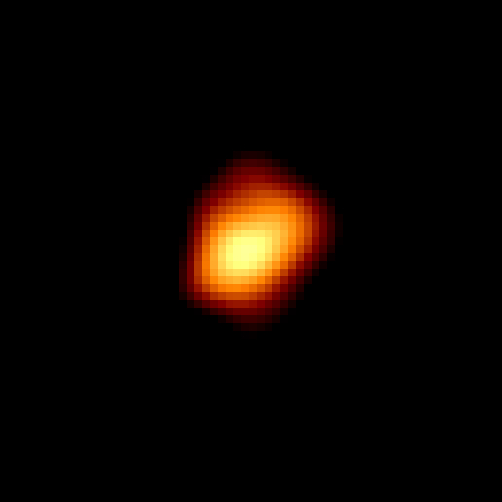





Components
The system comprises Mira A, an evolved red giant on the asymptotic giant branch, and Mira B (also designated VZ Ceti), which is generally identified as a compact companion often described as a white dwarf. Mira A is expanding and losing mass in a slow, dense stellar wind; some of that material is captured by Mira B, producing localized heating, ultraviolet and X-ray emission and sometimes an accretion structure around the companion.
Variability and pulsation
Mira A is the namesake of Mira-type variables — long-period, large-amplitude pulsating red giants. Its visual brightness varies strongly over a regular cycle of roughly 330 days, as the star's outer layers alternately expand and contract. Pulsation changes the star's radius and surface temperature and, together with episodic dust formation, causes the large swings in observed magnitude that made Mira visible to early observers and remain of interest to variable-star researchers.
Circumstellar environment and interactions
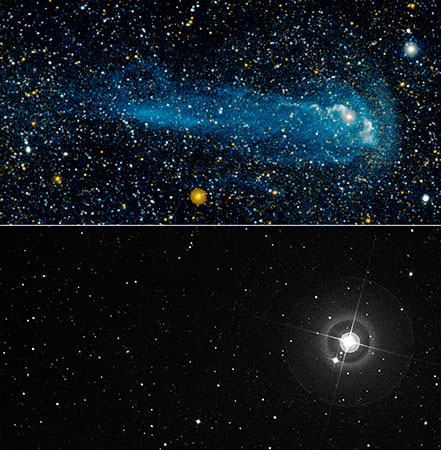
Mass loss from Mira A has created an extended circumstellar envelope of gas and dust. Observations with space- and ground-based telescopes have revealed complex structures: dust shells, molecular gas, and a long gaseous wake trailing the system produced as the binary moves through the interstellar medium. The interaction between the giant's wind and the compact companion leads to asymmetries in the surrounding material and provides a nearby laboratory for studying accretion from a stellar wind.
History and observations
Mira's variability was noticed by observers in the late 16th and early 17th centuries and has been monitored continuously since. Modern instruments, including high-resolution imaging and ultraviolet observations, have resolved the binary and traced the flow of material between the stars. These data help to constrain models of pulsation, mass loss, dust formation and binary interaction for evolved stars.
Scientific importance
Mira is important in multiple areas of stellar astrophysics: it illustrates late-stage evolution on the asymptotic giant branch, informs theories of radial pulsation and dust production, and demonstrates how a compact companion alters circumstellar chemistry and dynamics through accretion. Mira-type variables also follow period–luminosity relations in the infrared that are useful for distance studies of nearby stellar populations.
- Prototype of the Mira variable class and a benchmark for pulsation theory.
- Nearby example of wind accretion onto a compact companion with observable high-energy signatures.
- Offers an accessible case for studying mass loss, dust formation and the shaping of circumstellar material.
As a relatively nearby and bright system, Mira continues to be a focal point for observations that link historical visual records with modern spectroscopy, imaging and multiwavelength monitoring. Continued study of Mira and similar systems refines our understanding of how stars like the Sun end their lives and return material to the interstellar medium.
Related articles
Author
AlegsaOnline.com Mira (Omicron Ceti) — the pulsating red giant and its companion Leandro Alegsa
URL: https://en.alegsaonline.com/art/65340
Sources
- aanda.org : "Interferometric observations of the Mira star o Ceti with the VLTI/VINCI instrument in the near-infrared"
- doi.org : 10.1051/0004-6361:20035826
- aanda.org : "Probing the mass-loss history of AGB and red supergiant stars from CO rotational line profiles - II. CO line survey of evolved stars: derivation of mass-loss rate formulae"
- doi.org : 10.1051/0004-6361/200913771