
Monoceros — the Unicorn Constellation
Monoceros is a faint equatorial constellation whose name means “unicorn.” Introduced in the 17th century, it lies near Orion and contains a number of interesting stars, nebulae and clusters.
Overview
Monoceros is a relatively dim constellation that straddles the celestial equator. Its modern name comes from the Greek word for a single-horned animal, often translated as "unicorn"; the original Greek form is noted as Μονόκερως. It is classed among the 88 modern constellations and is best known for containing several faint stars and a number of notable deep-sky objects rather than any very bright individual star. For a general reference to its classification and boundaries see constellation resources and maps.
Image gallery
4 Images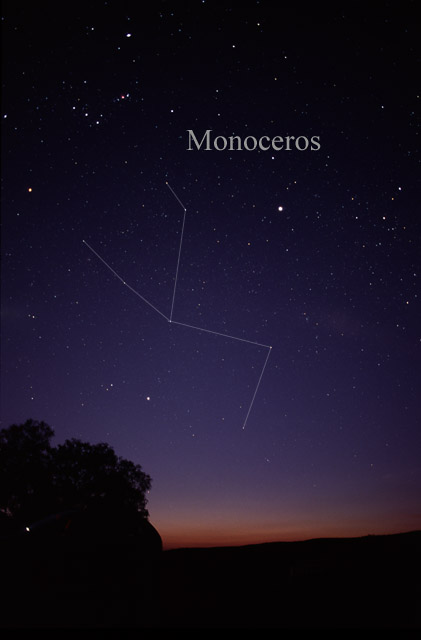



Location and neighboring constellations
Monoceros lies on the plane of the sky near the center of the winter Milky Way in the northern hemisphere. It crosses the celestial equator, which makes it visible from much of Earth at certain seasons. The name itself reflects a mythic creature, the unicorn, and star charts show Monoceros tucked among several well-known constellations.
- West: Orion
- North: Gemini
- South: Canis Major
- East: Hydra
- Also bordering: Canis Minor, Lepus, Puppis
Notable stars and deep-sky objects
Monoceros contains no first-magnitude stars, so it is not immediately obvious to casual observers, but it hosts a variety of astrophysical targets. Observers and amateur astronomers point telescopes here for emission and reflection nebulae and open clusters lying along the Milky Way.
- Bright and multiple stars: Monoceros has several mid-brightness stars and multiple systems that interest stellar observers and double-star enthusiasts.
- Nebulae and clusters: The region includes emission nebulae, young stellar clusters and visually striking areas of nebulosity that are popular photographic targets.
- Variable and peculiar objects: Some variable stars, X-ray sources and other scientifically interesting objects are cataloged within Monoceros.
History and naming
The constellation in its modern form was introduced in the early 17th century by mapmakers and astronomers working to fill gaps in star charts. The Dutch cartographer and globe-maker Petrus Plancius is often credited with formalizing Monoceros on celestial globes and atlases. While not rooted in classical Greek or Roman star lore as a distinct figure, the unicorn theme draws on broader mythological and symbolic traditions.
Observing Monoceros
Monoceros is best observed during the winter months in northern latitudes when it climbs high in the evening sky. Because it is faint overall, dark skies and modest optical aid improve the view significantly; binoculars and small telescopes reveal clusters and nebulae that are mostly invisible to the unaided eye. The constellation is of particular interest to astrophotographers and amateur observers searching for extended nebulae and star-forming regions rather than bright navigational stars.
Notable facts and distinctions
Though not prominent in ancient lore, Monoceros is a useful area of the sky for locating a number of catalogued deep-sky objects and for projects surveying the Milky Way plane. Its position between several bright constellations makes it easy to find once a nearby landmark—such as Orion or Gemini—is identified. For additional star maps, cultural notes, and observing guides consult general constellation references and atlases that cover equatorial and winter sky regions.
Questions and answers
Q: What is Monoceros?
A: Monoceros is a constellation located on the celestial equator.
Q: What does the name Monoceros mean?
A: The name Monoceros means "unicorn" in Greek.
Q: Who described Monoceros?
A: Monoceros was described by 17th-century Dutch cartographer Petrus Plancius.
Q: What constellations are surrounding Monoceros?
A: Canis Minor, Lepus, and Puppis are the constellations that are next to Monoceros. Orion is to the west, Gemini is to the north, Canis Major is to the south, and Hydra is to the east.
Q: Where is Monoceros located relative to Orion?
A: Monoceros is located to the west of Orion.
Q: What is the meaning of the name of the constellation Canis Minor?
A: The constellation Canis Minor means "little dog" in Latin.
Q: Which cartographer described the constellation Monoceros?
A: The Dutch cartographer Petrus Plancius described the constellation Monoceros.
Related articles
Author
AlegsaOnline.com Monoceros — the Unicorn Constellation Leandro Alegsa
URL: https://en.alegsaonline.com/art/66094