
Cetus (constellation)
Cetus is a large northern constellation traditionally depicted as a sea monster. It contains the famous variable star Mira, bright stars such as Deneb Kaitos, and deep-sky objects like Messier 77.
Cetus is a prominent constellation in the northern celestial hemisphere traditionally portrayed as a whale or sea monster. It ranks among the larger constellations visible from mid- and high northern latitudes and crosses a broad band of the sky near the celestial equator. Because of its extent, parts of Cetus are visible from both hemispheres at different times of year.
Image gallery
8 Images





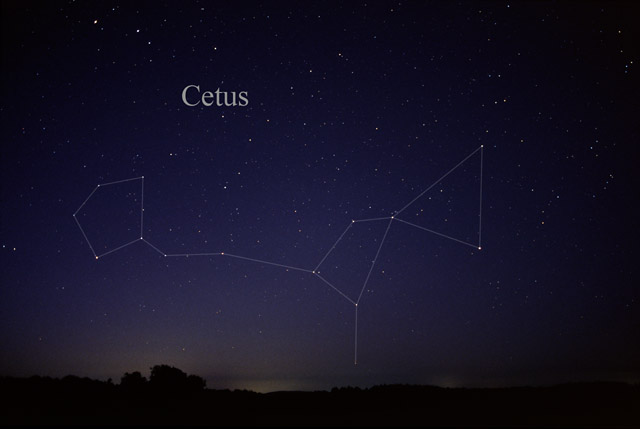
Characteristics and position
Cetus lies among several well-known constellations: it borders Pisces and Aquarius to the north and east, and is adjacent to Eridanus and Taurus in other directions. It contains a mix of naked-eye stars of moderate brightness and fainter objects that require a telescope. The constellation does not contain many very bright first-magnitude stars, so its outline is less obvious than some neighboring figures.
Notable stars and deep-sky objects
- Mira (Omicron Ceti): a famous long-period variable star and prototype of the Mira class. Mira is a cool, luminous red giant that pulsates and changes brightness dramatically over months, sometimes becoming visible to the unaided eye.
- Beta Ceti (Deneb Kaitos or Diphda): one of the brighter stars in Cetus and a useful navigation marker for amateur observers.
- Tau Ceti: a nearby, Sun-like star of interest to studies of planetary systems and stellar astrophysics.
- Messier 77: a bright barred spiral galaxy in Cetus noted for its active galactic nucleus (a Seyfert galaxy) and a common target for small- to medium-sized telescopes.
- Several fainter galaxies and a local dwarf galaxy named for Cetus are catalogued within the constellation's boundaries, along with planetary nebulae that appeal to deep-sky observers.
These targets show that Cetus is valuable both for stellar astronomy—through its notable variable and Sun-like stars—and for extragalactic observations, since its fields include interesting galaxies and active nuclei.
History and mythology
The figure of Cetus traces to ancient star lore and was included among the classical constellations cataloged by early astronomers. In Greek myth, Cetus represents the sea monster sent to threaten the kingdom of Aethiopia; the creature is associated with the Perseus–Andromeda cycle of stories. Over centuries astronomers refined the constellation’s boundaries and names; its common star names reflect Arabic and Latin traditions that have been adopted into modern usage.
For observers today, Cetus offers a mix of historical interest and practical observing opportunities: its memorable variable Mira, bright and nearby stars, and deep-sky galaxies make it a rewarding region to study both with binoculars and with larger instruments.
Related articles
Author
AlegsaOnline.com Cetus (constellation) Leandro Alegsa
URL: https://en.alegsaonline.com/art/18268
Sources
- iau.org : "Cetus, constellation boundary"