
Marta Harnecker: Chilean sociologist, writer, and activist
Profile of Marta Harnecker (1937–2019), a Chilean sociologist and political writer known for accessible Marxist works, involvement with Latin American left movements, exile after 1973 coup, and influence on political education.
Marta Harnecker (1937 – 15 June 2019) was a Chilean intellectual known for her extensive writing on Marxism, social movements and Latin American politics. Trained as a sociologist and active as a journalist and organizer, she aimed to make political theory accessible to activists and students across the region. Her books, many translated into Spanish and other languages, became textbooks for political education and popular study groups.
Image gallery
1 Image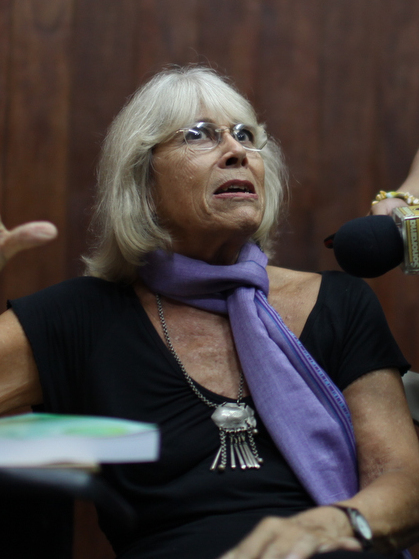
Life and career
Born in 1937 into a family of Austrian ancestry, Harnecker studied social sciences in Chile and began publishing in the 1960s. Her early encounter with the Cuban revolution — she visited Cuba in 1960 — shaped much of her outlook, and she later married Cuban revolutionary Manuel Piñeiro. She supported the Unidad Popular government and Salvador Allende; after the 1973 fall of President Salvador Allende and the military coup (coup d'état) led by Augusto Pinochet, Harnecker was forced into exile. In later years she married the economist Michael A. Lebowitz and continued writing and advising left-wing organizations internationally.
Ideas and influence
Harnecker’s work combines theoretical exposition and practical guidance. She wrote introductory manuals on Marxist theory, analyses of popular power and strategies for social movements, and case studies of revolutionary processes. Her aim was pedagogical: to translate dense theory into tools usable by trade unions, peasant organizations and student groups. This pragmatic emphasis increased her influence among grassroots activists and political parties across Latin America.
Her approach was sympathetic to the Cuban revolutionary model and to efforts at building socialist institutions in the region, which earned both admirers who praised her clarity and critics who argued she sometimes downplayed authoritarian tendencies in allied governments. Nonetheless, her books remained widely read as resources for political education and organizing.
Selected works and legacy
- Conceptos Elementales del Materialismo Histórico (1969)
- Cuba: ¿dictadura o democracia? (1975)
- Pueblos en armas (1983)
- ¿Qué es la sociedad? (1986)
- América Latina: Izquierda y crisis actual (1990)
- A World to Build (2015)
Over her lifetime Harnecker published more than eighty books and numerous articles. She is remembered as a prolific educator of the left who emphasized accessible theory, organization and strategy. She died in Canada on 15 June 2019 at the age of 82.
For readers seeking primary texts or further study, many of her works and interviews are cited in academic and activist bibliographies; online collections and translated editions are commonly used for study groups and courses. She remains a reference point for discussions on political pedagogy, Latin American socialism and the relationship between intellectuals and popular movements. For general biographical overviews, see entries by academic presses and reputable social science compendia (see links and resources under sociologist and related categories).
Her personal journey — from Chilean academic to international organizer, through exile and transnational collaboration — illustrates broader patterns of 20th‑century Latin American political history and the continuing debates over strategy, democracy and socialism in the region.
Related articles
Author
AlegsaOnline.com Marta Harnecker: Chilean sociologist, writer, and activist Leandro Alegsa
URL: https://en.alegsaonline.com/art/62300
Sources
- insurgente.org : "Falleció la compañera Marta Harnecker, destacada pensadora marxista"
- wikidata.org : wikidata.org/wiki/Q452797
- authority.bibsys.no : 90130950
- catalogo.bne.es : XX963191
- catalogue.bnf.fr : cb12056435p
- data.bnf.fr : (data)
- d-nb.info : 1056492953
- isni.org : 0000 0001 0915 2738
- id.loc.gov : n79100591
- id.ndl.go.jp : 01077061
- aleph.nkp.cz : vse2008445731
- uli.nli.org.il : 000422747
- data.bibliotheken.nl : 070261601
- idref.fr : 028803698
- viaf.org : 73873286