
Malayan tapir (Tapirus indicus): appearance, habitat, behavior and conservation
The Malayan tapir (Tapirus indicus) is the only Asian tapir and the largest of five tapir species. This article summarizes its appearance, behavior, distribution, ecological role, threats and conservation measures.
Overview
The Malayan tapir (Tapirus indicus), also called the Asian or piebald tapir, is the sole tapir species native to Asia and the largest living member of the family Tapiridae. Tapirs are odd-toed ungulates (order Perissodactyla) related to horses and rhinoceroses and represent a relict lineage with a deep fossil history. The Malayan tapir's distinctive black-and-white coloring makes it one of the most easily recognized of the five extant tapir species; the others occur in the Americas (other tapir species, Central and South America).
Image gallery
9 Images


Physical characteristics
This species has a compact, barrel-shaped body, a short prehensile snout used to grasp foliage, and relatively short, sturdy legs. Adults display a contrasting pattern: a pale saddle-shaped patch covering the mid-body and rear that contrasts with a dark head and forequarters. This countershading is widely interpreted as disruptive camouflage in dappled forest light. Calves are born with brown coats marked by lighter spots and stripes that provide concealment and fade as the animal matures. Other features include rounded ears often rimmed with white, coarse hair, thick skin on parts of the body, and feet adapted for moving quietly on soft ground.
Distribution and habitat
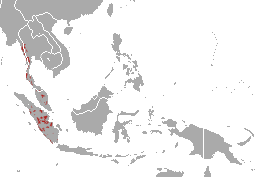
The Malayan tapir historically inhabited lowland tropical rainforests across mainland Southeast Asia and the Greater Sunda islands. Today its range is fragmented and primarily includes the Malay Peninsula (Peninsular Malaysia), parts of southern Thailand and the island of Sumatra. It favours dense, moist forests and forest edges with abundant understory and ready access to water. Tapirs are proficient swimmers and commonly use rivers, marshes and flooded areas for feeding, cooling and movement.
Behavior and diet
Typically solitary, Malayan tapirs are most active at night or during crepuscular hours. They are herbivorous browsers, feeding on leaves, twigs, shoots, fruits and aquatic plants. The prehensile snout allows selective foraging. Tapirs are important seed dispersers: by consuming fruit and defecating seeds in different locations they contribute to forest regeneration and plant diversity.
Reproduction and life history
Tapirs have a relatively slow reproductive rate compared with many other mammals. Females generally give birth to a single calf after a long gestation and invest in maternal care until the young are able to fend for themselves. Young are well developed at birth and rely on their cryptic juvenile coat for protection during early months. Adults interact mainly for mating and parental care.
Conservation status and threats
The Malayan tapir is assessed as Endangered by major conservation organizations due to continuing habitat loss, fragmentation and hunting pressure. Large-scale conversion of forest to agriculture and plantation crops, road construction that increases mortality from vehicle collisions, and localized hunting are the principal threats. Small, isolated populations face additional risks including genetic isolation and reduced resilience.
Conservation measures
Conservation actions include protecting remaining forest habitats through reserves and national parks, creating and maintaining habitat corridors to reduce fragmentation, mitigating roadkill with wildlife crossings and fencing, enforcing anti-poaching laws, and supporting captive-breeding programs to preserve genetic diversity. Research, monitoring and community engagement are important elements of effective long-term conservation.
Ecological and cultural significance
As the only Asian representative of its family, the Malayan tapir has particular scientific interest for studies of biogeography and evolution. Ecologically, its role as a seed disperser helps maintain forest structure and plant diversity. The species also appears in local languages and folklore; in Malay it is known by names such as cipan, tenuk or badak tampong (local names) and its presence can be an indicator of relatively intact forest ecosystems. For broader context on regional biodiversity and conservation priorities see an overview of Asian wildlife (Asia overview).
Research and public awareness
Ongoing research addresses ecology, population status, genetic diversity and the effects of habitat fragmentation. Public education and cross-border collaboration are important to improve protection of remaining populations and the forests they inhabit. Conserving the Malayan tapir contributes to preserving Southeast Asian forest biodiversity and the ecological services these systems provide.
Related articles
Author
AlegsaOnline.com Malayan tapir (Tapirus indicus): appearance, habitat, behavior and conservation Leandro Alegsa
URL: https://en.alegsaonline.com/art/60966