
Long Island: geography, population, history and regional divisions
Overview of Long Island, New York: its geography, political divisions, geology, population, transport role, cultural highlights, and notable distinctions.
Long Island sits off the southeastern coast of New York State and is one of the most densely inhabited islands in the United States. It stretches eastward from the bounds of New York City into the Atlantic, forming a distinct metropolitan and suburban region. Today it combines large urban neighborhoods, extensive suburbs and rural stretches, and plays an important role in the economy, recreation and transportation of the greater New York area.
Image gallery
10 Images





Geography and natural features
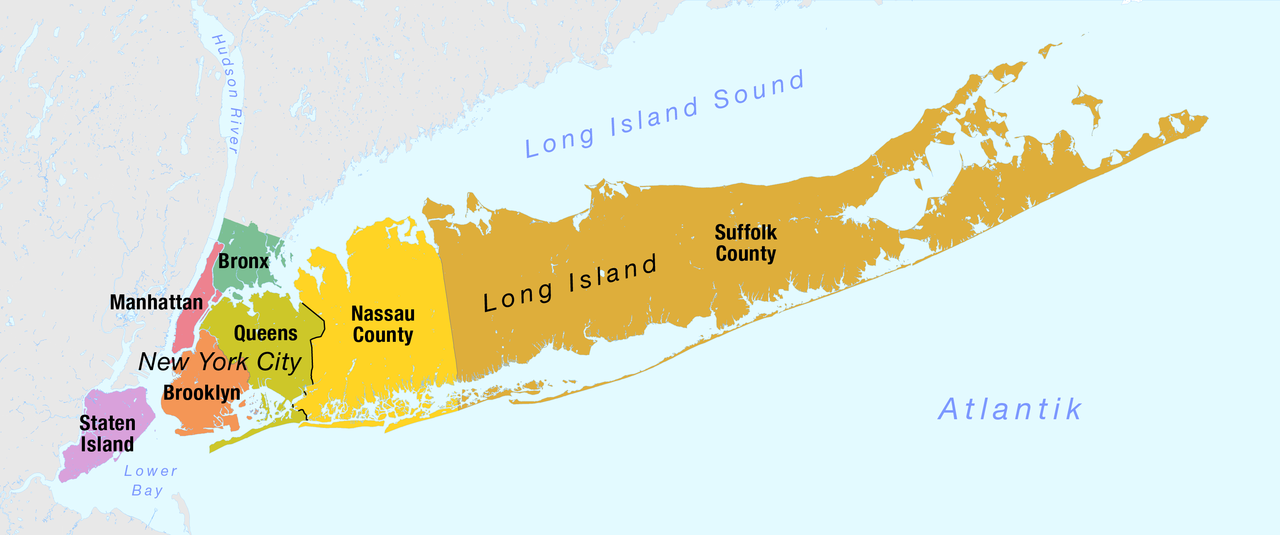
Long Island is bounded to the north by the Long Island Sound and to the south by the Atlantic Ocean. The western edge of the island meets New York City across waterways: the East River separates Long Island from Manhattan and the Bronx, while The Narrows lies between Brooklyn and Staten Island. Geologically, the island is largely a terminal moraine left by glacial action during the ice ages, a formation often described as a terminal moraine that accounts for its rolling hills, kettle ponds and sandy beaches.
Political divisions and population
Administratively Long Island is commonly described in two ways: the western end includes the New York City boroughs of Brooklyn and Queens, both part of New York City. East of the city lie the suburban counties of Nassau County and Suffolk County. Together these areas are home to more than seven million residents; the 2000 U.S. Census counted approximately 7.45 million people on the island, making it the most populous island in the United States.
Communities, economy and transport
Long Island contains nearly two hundred incorporated towns, villages and hamlets that range from dense urban neighborhoods to low-density suburban developments and agricultural or protected open space. The region supports diverse economic activity: retail and service sectors near the city, professional and industrial employment in suburban centers, maritime commerce, tourism at beaches and the well-known summer communities in the eastern towns, and agriculture including vineyards on the East End. Transportation links include major highways, extensive commuter rail service and ferries that connect to Manhattan and other shorelines; these connections make Long Island a major commuter and recreational corridor for the greater metropolitan region.
History and development
Long Island's earliest human history is the domain of Indigenous peoples who inhabited the island for millennia before European contact. During the colonial era and into the 19th and 20th centuries, settlement patterns changed as farmland, villages and resort areas developed and transportation improvements—especially railroads and later roads—encouraged suburban growth. Over the 20th century, the western end became integrated into New York City's urban fabric while central and eastern sections evolved into suburban and resort areas.
Notable facts and distinctions
- It is often referred to in different senses: some people mean only the suburban counties of Nassau and Suffolk when they say "Long Island," excluding the city boroughs.
- By population the island surpasses several sovereign island nations; for comparison the population exceeds that of Ireland and Jamaica in raw numbers.
- Long Island lies in the Eastern Time Zone and remains an influential region for culture, commuting, beaches and maritime activities for the northeastern United States.
For readers seeking more detailed maps, demographic statistics or geological studies, consult regional planning agencies and authoritative state or federal resources for up-to-date figures and specialized reports.
Related articles
Author
AlegsaOnline.com Long Island: geography, population, history and regional divisions Leandro Alegsa
URL: https://en.alegsaonline.com/art/59096
Sources
- concise.britannica.com : "Long Island"