
Lipopolysaccharide (LPS): structure, function, and medical importance
Lipopolysaccharides are complex molecules on Gram-negative bacterial outer membranes that provoke innate immune responses; they are central to endotoxin activity, vaccine design, and pyrogen testing.
Overview
Lipopolysaccharides (LPS), sometimes called lipoglycans, are large amphipathic molecules composed of a lipid portion and a polysaccharide portion joined by a covalent linkage. They are a principal component of the outer leaflet of the outer membrane in Gram-negative bacteria and serve both structural and biological roles. Because LPS are recognized by the animal innate immune system, they are commonly referred to as endotoxins when released from bacteria.
Image gallery
2 Images
Structure and major parts
Typical LPS molecules have three regions:
- Lipid A — the membrane-anchoring lipid that largely determines endotoxic activity; (lipid).
- Core oligosaccharide — a short sugar chain attached to lipid A that stabilizes the molecule and can include unusual sugars.
- O-antigen (O-polysaccharide) — a repeating polysaccharide chain exposed on the cell surface that varies between strains and affects antigenicity; (polysaccharide).
These parts are connected by a covalent bond, creating a single macromolecule embedded in the outer membrane.
Biological recognition and immune effects
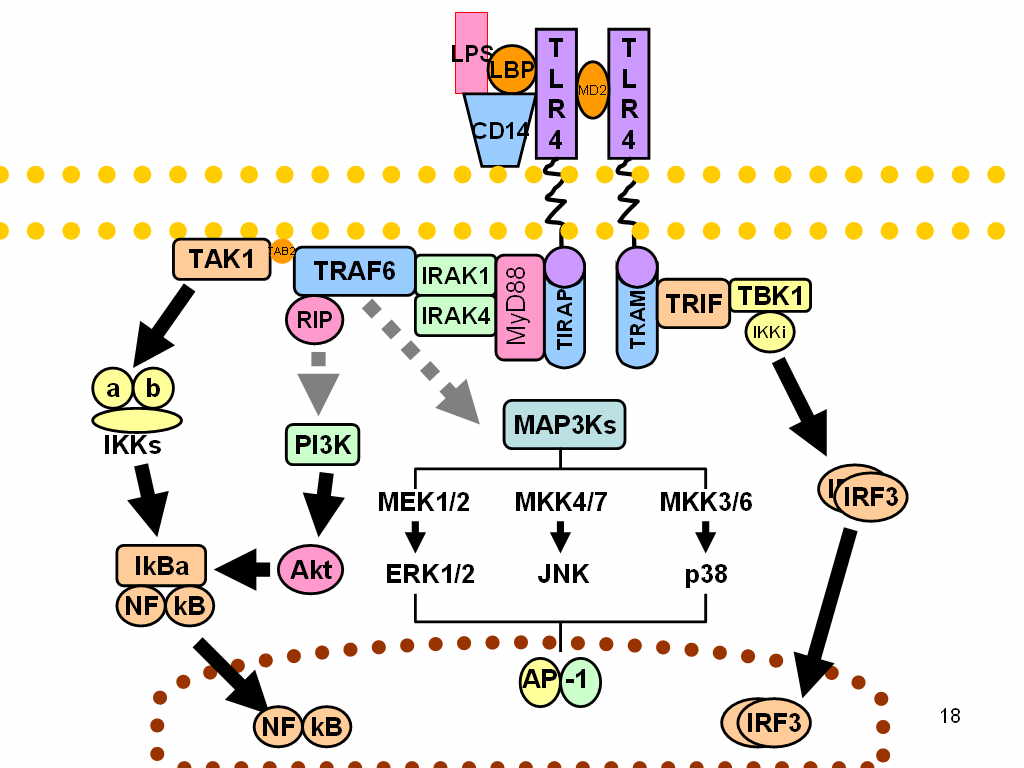
Animals detect LPS as a sign of Gram-negative infection. LPS is sensed by pattern-recognition receptors of the innate immune system, most notably the toll-like receptors (the TLR4–MD-2 complex in mammals) on cells such as dendritic cells. Engagement of these receptors triggers inflammatory signaling pathways and release of cytokines and chemokines. While this response helps clear infection, excessive systemic activation by LPS can produce harmful effects including fever, inflammation and, in severe cases, septic shock.
Roles, applications and clinical relevance
LPS contributes to bacterial survival by forming a permeability barrier and by mediating interactions with the host immune system. Its variability in the O-antigen is important for immune evasion and for epidemiological typing of strains. In medicine and research, LPS is significant in several ways:
- As a potent immunostimulant used experimentally to activate immune cells.
- As the basis for pyrogen and endotoxin testing of pharmaceuticals and medical devices (e.g., the Limulus amebocyte lysate assay).
- In vaccine design, derivative forms of lipid A with reduced toxicity are used as adjuvants.
- As a factor in septic complications when bacteria lyse and release LPS into the circulation.
History and notable distinctions
The biologically active properties of bacterial LPS were recognized historically under the term "endotoxin". LPS should be distinguished from the surface molecules of Gram-positive organisms, which lack an outer membrane and LPS. Because of its strong immune effects, careful control of endotoxin contamination is a major concern in biopharmaceutical production and laboratory work.
For further technical details on molecular structure and receptor interactions see structure, background on the lipid component and the polysaccharide portion, chemical linkage information at covalent bond, and immunological contexts via innate immune system, toll-like receptors, and cellular sensing by dendritic cells.
Related articles
Author
AlegsaOnline.com Lipopolysaccharide (LPS): structure, function, and medical importance Leandro Alegsa
URL: https://en.alegsaonline.com/art/58360