
Polysaccharide: structure, classification, functions and examples
Polysaccharides are large carbohydrate polymers composed of monosaccharides. This article explains their structures, types (homo- and heteropolysaccharides), properties, biological roles, examples, and practical uses.
Overview
A polysaccharide is a large carbohydrate formed by the covalent linking of many simple sugars. In biochemical terms a polysaccharide can be described as a long-chain complex carbohydrate built from repeating sugar units. These macromolecules serve diverse roles in living organisms, from energy storage to forming structural frameworks.
Image gallery
4 Images

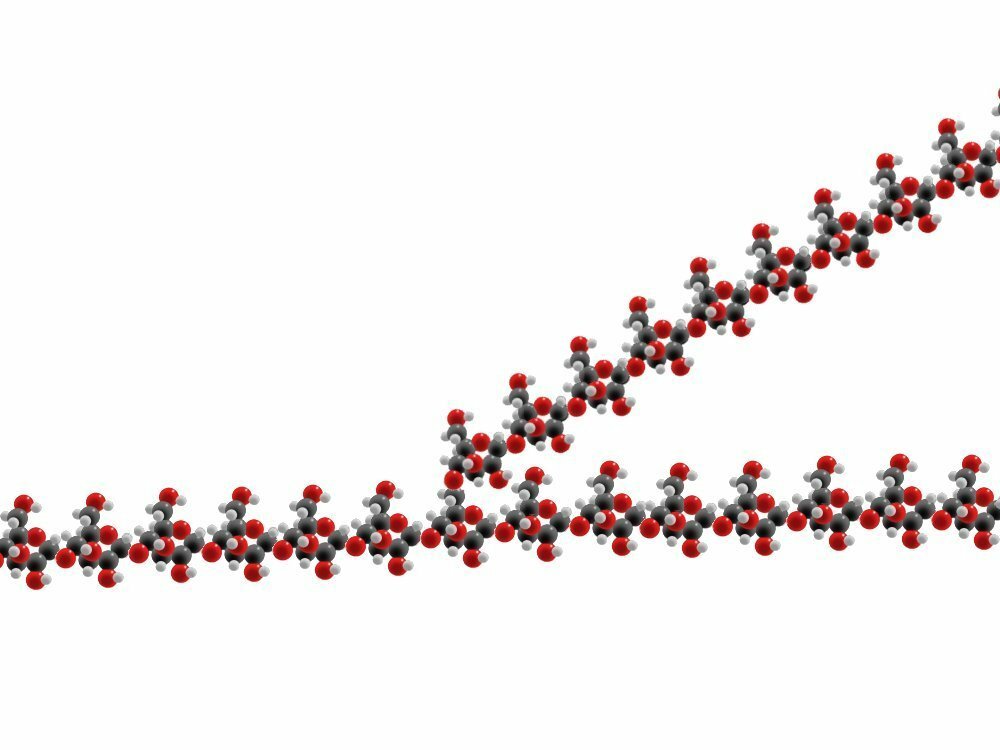

Structure and classification
Polysaccharides are true polymers: long chains of saccharide units joined by glycosidic bonds, so the general concept can be tied to the idea of a polymer. Their building blocks are individual monosaccharides such as glucose, galactose or N-acetylglucosamine. When all of the sugar residues are the same the polymer is called a homopolysaccharide; when two or more different types of monosaccharide are present it is a heteropolysaccharide. The sequence, type of linkage and degree of branching determine the molecule's three-dimensional shape and biological behaviour, and even short changes to linkages can produce very different properties in otherwise similar chains (molecular context).
Physical characteristics vary widely. Some polysaccharides form rigid, fibrous networks useful for support, while others are compact and highly branched for rapid mobilization of glucose. Many are high-molecular-weight, often lack crystalline order and can be amorphous in bulk. Solubility depends on composition and branching: several common polysaccharides are effectively insoluble in water, contributing to their structural roles.
Biological roles and common examples
Polysaccharides fall broadly into two functional categories: storage and structural. Storage polysaccharides provide a reservoir of sugars that organisms can mobilize when needed; familiar examples include starch in plants and glycogen in animals. Structural polysaccharides form strong extracellular or cell wall matrices—prominent examples are plant cellulose and the arthropod exoskeleton component chitin. These differences illustrate how simple sugar building blocks can be arranged into materials with very different mechanical and metabolic properties.
History, applications and notable facts
The study of polysaccharides grew with advances in chemistry and microscopy in the 19th and 20th centuries, revealing their importance beyond nutrition: they are used as thickeners, gelling agents, fibers and biodegradable materials in industry. In medicine and biotechnology, derivatives and modified polysaccharides serve in drug delivery, tissue engineering and as anticoagulants. Distinguishing polysaccharides from simple sugars is easy by taste (they are not sweet) and by their function; distinguishing homopolysaccharides from heteropolysaccharides rests on composition, while functional classification hinges on role rather than chemistry alone.
Questions and answers
Q: What is a polysaccharide?
A: A polysaccharide is a complex carbohydrate made up of many monosaccharides.
Q: What are the characteristics of polysaccharides?
A: Polysaccharides tend to be very large, often branched, amorphous, insoluble in water, and have no sweet taste.
Q: What are homopolysaccharides?
A: Homopolysaccharides are polysaccharides in which all the constituent monosaccharides are of the same type.
Q: What are heteropolysaccharides?
A: Heteropolysaccharides are polysaccharides in which more than one type of monosaccharide is present.
Q: What are examples of storage polysaccharides?
A: Examples of storage polysaccharides include starch and glycogen.
Q: What are examples of structural polysaccharides?
A: Examples of structural polysaccharides include cellulose and chitin.
Q: Are polysaccharides soluble in water?
A: No, polysaccharides are insoluble in water.
Author
AlegsaOnline.com Polysaccharide: structure, classification, functions and examples Leandro Alegsa
URL: https://en.alegsaonline.com/art/77882