
Larissa (Neptune moon)
Larissa (Neptune VII) is an inner satellite of Neptune discovered by ground-based occultation in 1981 and imaged by Voyager 2 in 1989. It is irregular, heavily cratered, and shows no signs of geologic activity.
Larissa, also designated Neptune VII, is a small inner moon of the planet Neptune. It orbits relatively close to the planet and lies among Neptune's system of inner satellites and rings. Larissa is irregular in shape and shows a heavily cratered surface, which indicates an old, battered crust with little or no recent internal activity.
Image gallery
10 Images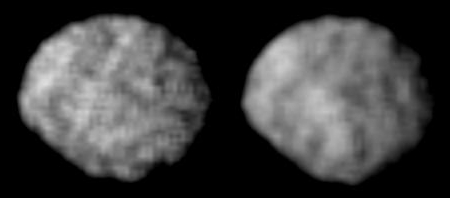




Discovery and naming
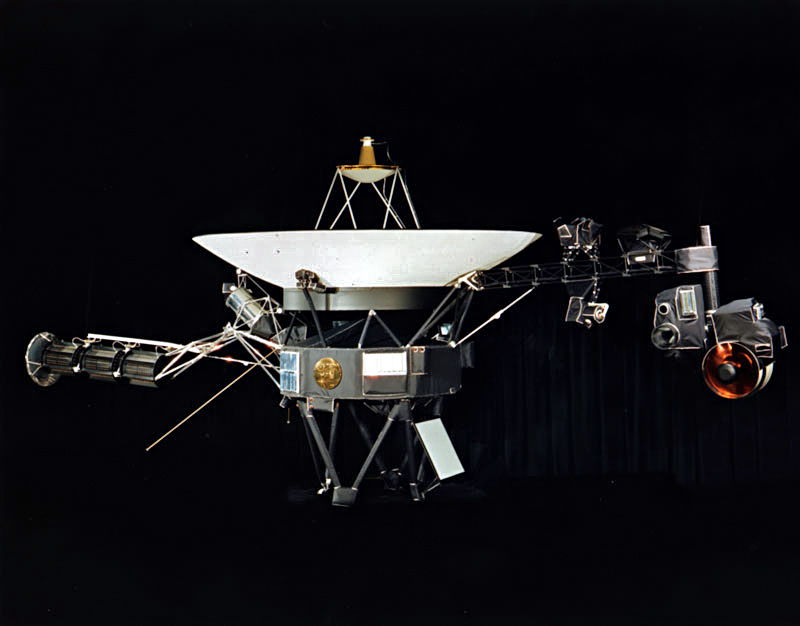
The object now known as Larissa was first detected from Earth through stellar occultation observations carried out on May 24, 1981. The discovery team reported a brief dimming of a star as the unseen satellite passed in front of it; this led to an initial provisional designation. Nearly a decade later, images returned by the spacecraft Voyager 2 during its 1989 flyby of the Neptunian system confirmed the presence of the moon and allowed astronomers to identify it unambiguously among nearby objects. The name "Larissa" comes from a figure associated with Poseidon (the Greek counterpart of Neptune) in Greek mythology, following the convention of naming Neptune's satellites after mythological sea-related characters.
Physical characteristics
Larissa is not spherical; rather, it has an elongated, irregular profile consistent with small bodies whose gravity is too weak to pull them into a round shape. Ground and spacecraft observations show a heavily cratered terrain, with little evidence for tectonics, volcanism, or surface renewal. The surface color and brightness suggest a mixture of water ice and darker, rockier material common to many small outer solar system moons. Its low mass and weak gravity mean it cannot retain any significant atmosphere.
Orbit and dynamics
As an inner satellite, Larissa orbits relatively close to Neptune compared with more distant moons. Its proximity places it within a dynamically active region influenced by Neptune's gravity, the planet's rings, and interactions with neighboring moons. Like many close-in satellites, Larissa is expected to be tidally locked, showing the same face toward the planet over long periods. The moon's orbital behavior and interactions contribute to the broader architecture of Neptune's inner system.
Surface and geology
Voyager 2 images revealed a cratered surface with no obvious signs of recent geological resurfacing. The appearance of numerous impact scars indicates an ancient surface age. Scientists infer that Larissa has experienced little internal heating, so volcanic or tectonic processes are unlikely to have modified its appearance in recent geological time. Observers describe the satellite as being "non-spherical" in form and "cratered" in texture in published summaries of the flyby data, reflecting these key observations (non-spherical, cratered).
Scientific importance and limitations
Larissa is of scientific interest as a representative of small, irregular satellites around the giant planets. Studying such bodies helps researchers understand accretion and collisional history in the outer Solar System, the distribution of ice and rock in satellite populations, and how tidal and collisional processes shape small moons. Knowledge of Larissa remains limited because detailed observations are sparse: only a handful of images and measurements were obtained by Voyager 2, and ground-based data are constrained by the faintness and proximity of the moon to Neptune. Future telescopic or spacecraft missions would improve understanding of its composition, internal structure, and precise orbital relationships.
Notable facts
- Larissa was first detected via stellar occultation from Earth observations and later confirmed by a spacecraft flyby.
- It is an inner, irregular satellite with a heavily cratered surface and no detectable atmosphere.
- Its name follows the convention of Neptune's moons being named after sea-related figures from myth and classical lore.
Because many details—such as exact internal composition and fine-scale surface geology—remain uncertain, descriptions of Larissa emphasize the broad conclusions supported by available imagery and occultation data: it is small, irregular, ancient, and shaped primarily by impacts and orbital dynamics rather than active geology.
Related articles
Author
AlegsaOnline.com Larissa (Neptune moon) Leandro Alegsa
URL: https://en.alegsaonline.com/art/56038