
Lenticular galaxy (S0): intermediate disk galaxies between spirals and ellipticals
Lenticular galaxies (S0) are disk systems with a central bulge, little cold gas, and weak star formation; they occupy an intermediate position between spiral and elliptical galaxies and illuminate evolutionary pathways.
Lenticular galaxies, designated S0 in the Hubble morphological sequence, are disk galaxies that present a smooth, lens-like appearance. They combine a prominent central bulge with a flattened stellar disk, but typically lack the well-defined spiral arms and abundant cold interstellar medium found in classical spiral galaxies. Because their light is dominated by older, redder stars and because they show little ongoing star formation, S0s are often described as intermediate or transitional objects between spirals and ellipticals.
Image gallery
10 Images


Key characteristics
Lenticular galaxies share observational properties that set them apart from pure spirals and pure ellipticals. Typical features include:
- Disk plus bulge morphology: a flattened stellar disk surrounding a central bulge and producing a smooth surface-brightness profile rather than bright, knotty arms.
- Low gas and dust content: little cold atomic or molecular gas and a deficiency of dust lanes, so regions of recent star formation are rare or weak.
- Older stellar populations: spectra dominated by absorption lines from older stars and redder integrated colors similar to elliptical galaxies.
- Residual structures: bars, rings, lenses, or faint spiral relics may be visible in deeper images, indicating a disk origin.
Classification and examples
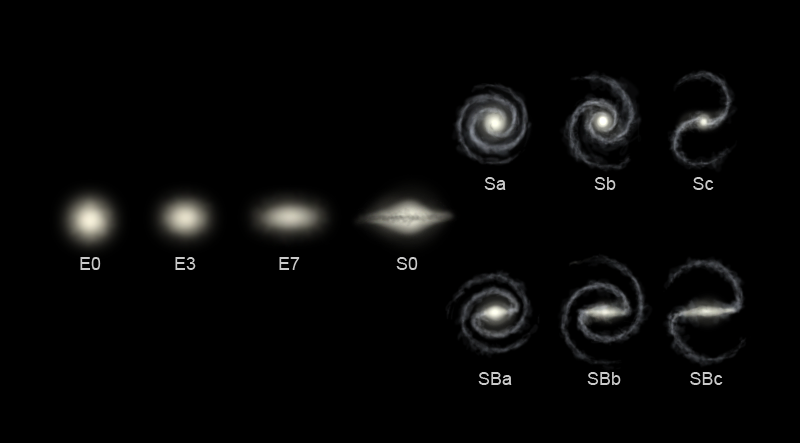
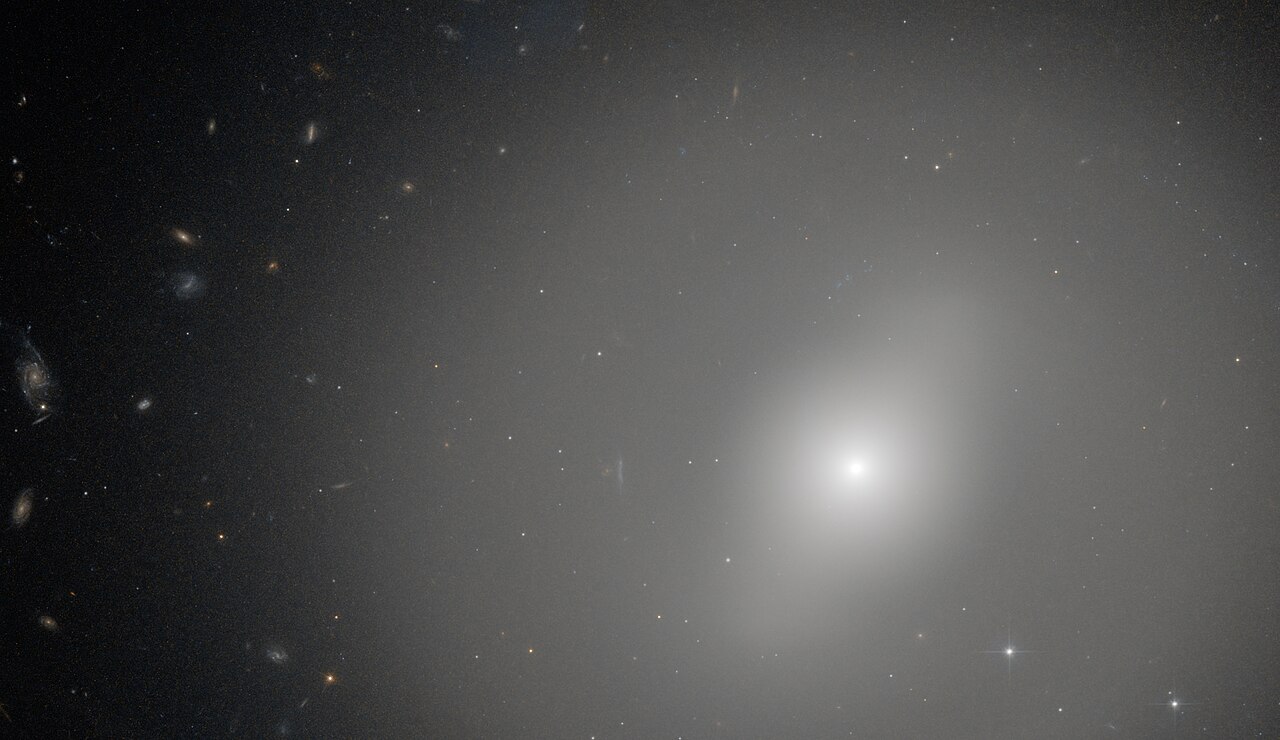
In the Hubble tuning-fork diagram, lenticulars occupy the junction between elliptical (E) and spiral (Sa, Sb, Sc) classes and are often subdivided (S0-, S0, S0+) to reflect gradations in bulge prominence and residual disk structure. Well-studied examples include NGC 3115 and NGC 5866; other cataloged S0s such as NGC 4479 are useful for comparative studies. For general overviews and photographic catalogs consult introductory classification guides and online collections: classification resources and image and catalog archives.
Origins and evolutionary pathways
There is no single formation channel for lenticular galaxies; rather, multiple pathways appear to produce S0 morphology. One widely discussed route is the transformation of a formerly gas-rich spiral into an S0 through removal or exhaustion of cold gas, for example by ram-pressure stripping in dense environments, tidal interactions with other galaxies, or repeated high-speed encounters in clusters. Alternative channels include galaxy mergers that heat or redistribute disk material, and secular processes — internal, slow rearrangements of stars and gas driven by bars or instabilities — that grow the bulge and reduce star formation. Reviews of these scenarios and comparative observational evidence are summarized in evolutionary literature: formation and evolution reviews.
Observational diagnostics
A combination of imaging and spectroscopy is used to identify S0s and probe their history. Deep optical and near-infrared imaging can reveal faint spiral remnants, rings, or lenses. Spatially resolved spectroscopy and integral-field mapping measure rotation, velocity dispersion, and stellar population ages; many S0s are fast rotators, indicating a dynamically cold disk component, while others show more spheroidal kinematics. Surveys and databanks providing imaging, kinematic maps, and multiwavelength observations are valuable resources: survey databases.
Environment and demographics
Lenticulars are common in galaxy groups and clusters, environments where interactions and gas-removal processes are frequent, but they are also found in the field. Their distribution and properties provide clues to the relative importance of environmental versus internal mechanisms in shutting down star formation and altering morphology. Comparative studies of S0s across environments contribute to our understanding of galaxy population changes with cosmic time.
Scientific importance
S0 galaxies serve as laboratories for studying how star formation ceases and how disk structures fade. Because they preserve both disk geometry and an older stellar population, analyses of their stellar ages, metallicities, rotation, and remaining gas content constrain models of morphological transformation and mass assembly. For theoretical discussions and observational summaries consult broader literature and synthesis articles: research overviews.
Although lenticulars resemble ellipticals in color and spectral signatures, their disk nature and typical rotational support make them a distinct and informative class. Continued progress in deep imaging and spatially resolved spectroscopy is refining our picture of how S0s form and what they reveal about galaxy evolution more generally.
Related articles
Author
AlegsaOnline.com Lenticular galaxy (S0): intermediate disk galaxies between spirals and ellipticals Leandro Alegsa
URL: https://en.alegsaonline.com/art/57164