
Leo (constellation): the Lion of the zodiac
Leo is a prominent zodiac constellation representing a lion, containing the bright star Regulus and several notable galaxies; visible across the northern hemisphere during late winter and spring.
Leo is a well-known constellation of the zodiac. Its Latin name and traditional meaning derive from Latin for lion, and its conventional symbol (♌) evokes a stylized mane and tail. The pattern is easy to pick out in the sky: a distinctive sickle of stars outlines the head and chest while a line marks the tail.

Image gallery
8 Images






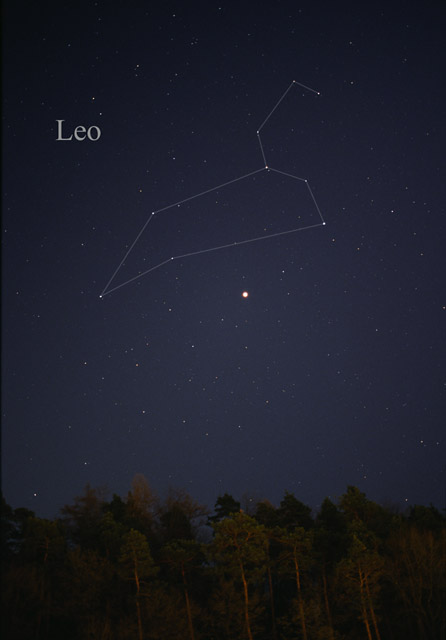
Notable stars and deep-sky objects
Several bright stars form Leo's familiar shape. The most prominent is Regulus, positioned at the lion's heart; Denebola marks the tail; and Algieba forms part of the sickle and is prized by amateur astronomers as a colorful double star. The ecliptic runs through the constellation, so the Sun, Moon and planets regularly travel across it.
- Regulus — bright, multiple star near the lion’s chest.
- Denebola — blue-white star at the tail end.
- Algieba — golden-hued binary favored for small telescopes.
Leo also contains several notable galaxies and groups that are popular targets for observers: the Leo Triplet (a small group of interacting galaxies), the M95–M105 galaxy region, and a handful of dwarf galaxies. These objects are often observed in amateur surveys and astrophotography work.
History and cultural significance
Associations between this star pattern and lions are ancient and cross-cultural. In classical Greek myth the constellation is tied to the Nemean Lion, one of Heracles' labors, and many Near Eastern and Mediterranean civilizations recognized a leonine figure in the same set of stars. Over centuries those identifications led to the constellation’s Latin name and its place among the twelve zodiacal signs.
Observing Leo and practical notes
Leo lies between Cancer to the west and Virgo to the east in the sky. It is most prominent in the late-winter and spring skies of the Northern Hemisphere, when its bright stars are high after sunset; in the Southern Hemisphere it appears lower toward the northern horizon. Because the ecliptic crosses Leo, it is also the apparent source region for annual meteor activity and a common location for planets to appear.
For identification, start with the sickle-shaped asterism that resembles a reversed question mark for the lion’s head, then follow the line of stars to Denebola at the tail. With binoculars or a small telescope, observers can explore the galaxy groups and resolve double stars that make Leo a rewarding constellation for both naked-eye stargazers and amateur astronomers.
See also: introductory star charts, seasonal observing guides, and catalogues of Messier and non-Messier galaxies for further study.
Related links: constellation info, zodiac overview, Latin names, lion symbolism, Cancer, Virgo.
Questions and answers
Q: What is the name of the constellation Leo?
A: The name of the constellation Leo is Latin for lion.
Q: What symbol represents Leo?
A: The symbol that represents Leo is (♌).
Q: Where does Leo lie in relation to other constellations?
A: Leo lies between dim Cancer to the west and Virgo to the east.
Q: Is Leo part of a zodiac constellation?
A: Yes, Leo is one of the constellations of the zodiac.
Q: What does "dim" mean in this context?
A: In this context, "dim" means faint or not very bright.
Q: Are there any other constellations near Leo?
A: Yes, Cancer and Virgo are both located near Leo.
Q: How can you identify a constellation called Leo?
A: You can identify a constellation called Leo by its Latin name for lion and its symbol (♌).
Related articles
Author
AlegsaOnline.com Leo (constellation): the Lion of the zodiac Leandro Alegsa
URL: https://en.alegsaonline.com/art/57180