
Joseph Monier and the development of reinforced concrete
Joseph Monier (1823–1906) was a French gardener and inventor who pioneered embedding iron reinforcement in concrete, creating early reinforced concrete products that influenced later structural practice.
Overview
Joseph Monier (born November 8, 1823, in Saint-Quentin-la-Poterie, died March 13, 1906, in Paris) was a French gardener and practical inventor. Working from horticultural needs, Monier developed the use of iron reinforcement embedded in cement and concrete to make stronger, thinner and more durable tubs, basins and other garden items. He is widely regarded as one of several 19th‑century pioneers who explored combining metal and cement to improve tensile performance (related inventors).
Image gallery
2 Images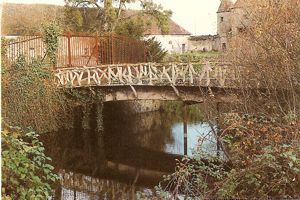

Early life and work
Monier trained as a gardener and worked in private and public gardens, including service for the Duke of Uzès and later in the orchards and orangeries of Paris. His practical work with heavy plant containers and decorative garden furniture motivated him to seek materials and methods that resisted frost, cracking and breakage. The horticultural context gave rise to his experiments in strengthening mortar and concrete.
Experiments and technique
Beginning around 1867 Monier carried out experiments using lengths of iron and woven wire embedded in fresh cement and concrete. These early trials showed that placing metal near zones subject to tension allowed concrete elements to be made thinner without losing load capacity. Monier used meshes, rods and cages of metal to reinforce pots, troughs and basins; his approach combined concrete’s compressive strength with metal’s tensile resistance.
Patents, exhibitions and commercialisation
Monier publicly displayed reinforced concrete work at the 1867 Paris exposition (Exposition Universelle), which brought wider attention to his methods. He secured legal protection for aspects of his system and later licensed or promoted manufacture of prefabricated garden articles, pipes and structural elements. While Monier’s name became associated with specific early systems and patent families, the broader technical idea was also explored independently by other engineers and builders.
Applications and examples
Monier’s reinforced pieces were first used for garden furniture, planters and troughs but the same principles were adapted to beams, pipes, small bridges and precast slabs as industry interest grew. Workshops and builders used prefabricated reinforced units to speed construction and to produce standardized components for municipal and private projects.
Influence and legacy
Although Monier did not single‑handedly invent modern reinforced concrete, his practical demonstrations, patents and public exhibits helped popularize reinforcement as a constructive technique. Subsequent engineers formalized reinforcement layouts, improved steel quality and developed the calculation methods and codes that turn the concept into the engineered material used worldwide today. Histories of civil engineering commonly cite Monier among the key early contributors to reinforced concrete technology (reinforced concrete).
Assessment and historical context
Monier’s work illustrates how solutions to everyday problems—here, durable garden containers—can drive material innovation. His practice bridged craft, horticulture and early industrial manufacture; it also shows how inventions often emerge in parallel, with multiple practitioners adapting similar ideas for different applications. For technical comparison and broader context see summaries of his recorded experiments and contemporary engineering accounts.
Further reading and resources
- Biographical and local history material on Monier’s birthplace and early years.
- Municipal archives and Paris collections describing his work in the Tuileries and Paris gardens.
- Comparative studies of 19th‑century innovators and patent histories (similar inventors).
- General treatments of the material and practice of reinforced concrete, and technical notes on iron, wire, cement and concrete.
- Exhibition catalogues and contemporary press reports on the 1867 exposition and subsequent displays.
Monier’s career is a reminder that engineering advances often grow from modest, practical beginnings. His experiments with metal reinforcement in cement anticipated large‑scale structural use and contributed to the transition from masonry and wrought iron to modern reinforced concrete construction.
Related articles
Author
AlegsaOnline.com Joseph Monier and the development of reinforced concrete Leandro Alegsa
URL: https://en.alegsaonline.com/art/51238
Sources
- britannica.com : "Joseph Monier (French inventor) -- Britannica Online Encyclopedia"