
James Webb Space Telescope (JWST)
Overview of the James Webb Space Telescope: design, instruments, mission history, orbit and key scientific goals, with links to authoritative resources and explanations of its differences from Hubble.
Overview
The James Webb Space Telescope (JWST) is a large, space-based observatory launched on 25 December 2021 that is optimized for infrared astronomy. Operating near the Sun–Earth L2 libration point, JWST was designed to study the formation of the first stars and galaxies, the physics of star and planet formation, and the atmospheres of extrasolar planets. NASA released JWST's first full-color images and scientific data in July 2022, which demonstrated the telescope's sensitivity at wavelengths longward of visible light. For general mission material see mission overview and comparisons with the Hubble Space Telescope.
Image gallery
10 Images





Design and main components
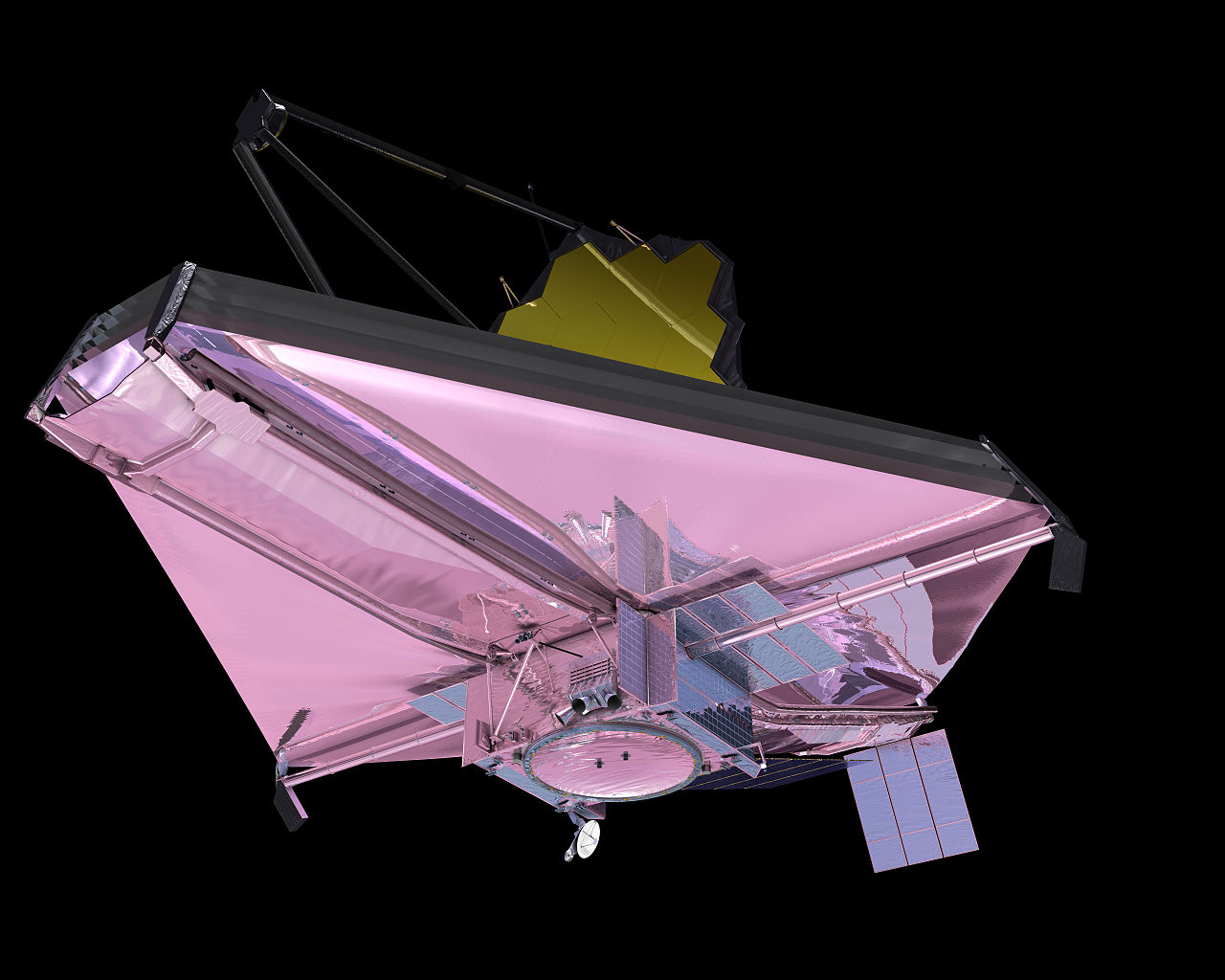
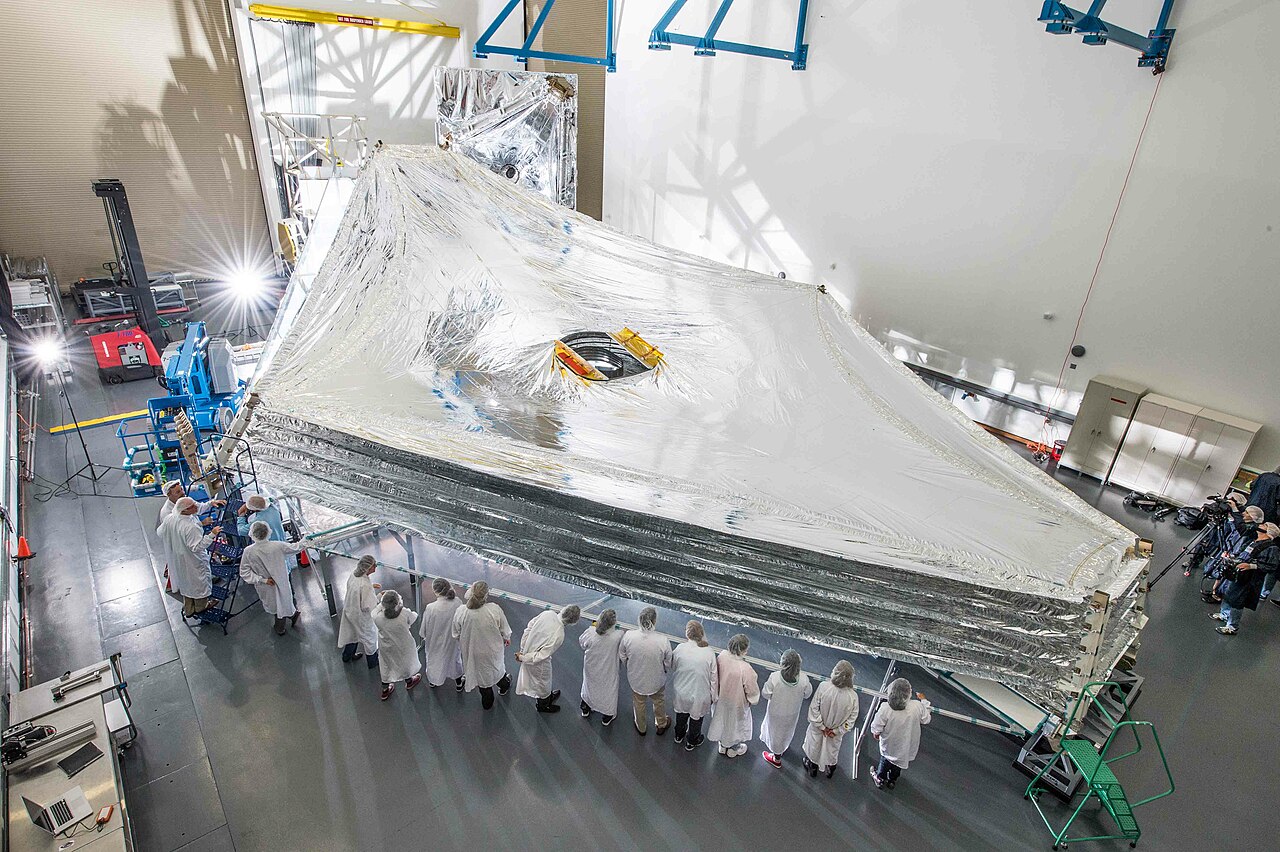
JWST's primary mirror is 6.5 metres across and consists of 18 hexagonal segments that unfolded and were aligned after launch. The segments are coated with a thin layer of gold to improve reflection at infrared wavelengths. To achieve low detector temperatures, the observatory uses a five-layer sunshield roughly the size of a tennis court to block sunlight and thermal emission from the Sun, Earth and Moon; technical descriptions of its thermal design are available from sunshield and deployment resources.
Instruments and capabilities
The observatory carries several scientific instruments covering the near- and mid-infrared: imaging cameras and spectrographs that perform high-resolution imaging, spectroscopy, coronagraphy and time-series observations. These instruments enable studies of faint, redshifted galaxies, the interiors of dusty star-forming regions, and the chemical composition of exoplanet atmospheres. For introductory material on infrared techniques see sources about infrared astronomy and why some astronomical images are shown in false color.
Launch, deployment and commissioning
Launched on an Ariane 5 rocket, JWST underwent a complex multi-week deployment that included unfolding its mirror segments and sunshield, cooling to operating temperatures, and precise mirror alignment. The commissioning phase resulted in calibrated instruments and the release of the first science-quality images in 2022. Operational details and mission timelines are summarized at official program pages such as NASA publications.
Orbit and operations
JWST operates in a halo orbit around the Sun–Earth L2 point, about 1.5 million kilometres from Earth. This orbit provides a stable, cold environment and a continuous view of much of the sky while allowing communications with Earth. Because JWST is not in low Earth orbit, routine astronaut servicing like that performed on Hubble is not feasible, so the mission emphasizes autonomous reliability.
Science goals and early discoveries
Major science goals include detecting the first luminous objects after the Big Bang, tracing galaxy assembly, studying star and planet formation in dust-obscured regions, and measuring atmospheric properties of exoplanets. Early JWST observations have produced deep-field images, resolved previously obscured star-forming structures, and provided spectra that probe molecular signatures in distant targets, advancing models across multiple fields of astronomy.
How JWST differs from Hubble
While Hubble observes primarily at ultraviolet and visible wavelengths, JWST is optimized for infrared light. JWST's larger segmented mirror and infrared sensitivity make it better suited for observing high-redshift galaxies and dust-enshrouded regions. The two observatories are complementary: multiwavelength studies often combine Hubble's shorter-wavelength images with JWST's infrared data to build a fuller picture.
Practical notes on data and image presentation
Infrared detectors record wavelengths that the human eye cannot see, so processed images often map infrared bands to visible colors (representative or false-color rendering) to convey scientific information. Analogies to thermal or night-vision systems can help explain how astronomers translate heat or longer-wavelength signals into interpretable images; see general explanations at night-vision analogies and infrared observation resources.
History and naming
The telescope is named for James E. Webb, who served as NASA administrator in the 1960s during the early human spaceflight era. The project evolved over several decades with contributions from international partners and extensive testing before launch. Historical context and related program information are discussed in materials about Apollo-era programs and institutional histories available from NASA.
Further resources
- JWST overview and mission pages
- Hubble Space Telescope comparison
- NASA mission and program information
- Historical context: Apollo-era programs
- Infrared astronomy basics
- Image processing and false-color explanation
- Why gold is used on infrared mirrors
- Infrared observations and their applications
- Analogy: thermal and night-vision systems
- Sunshield design and thermal management
Note: This article summarizes widely reported facts about JWST and points to official resources for technical details and up-to-date scientific results.
Questions and answers
Q: What is the James Webb Space Telescope (JWST)?
A: JWST is a telescope that was launched on 25 December 2021, and it is a replacement for the Hubble Space Telescope.
Q: Who is James E. Webb?
A: James E. Webb is a director at NASA who created the Apollo program that put astronauts on the moon, and he is the one that the telescope is named after.
Q: How wide is the main mirror of JWST?
A: The main mirror of JWST is 6.5 metres (21 feet) wide, which is 6 times larger in area than the Hubble Space Telescope.
Q: How is the main mirror of JWST made?
A: The main mirror of JWST is made in 18 pieces that fold together during the launch, so that it can fit into a rocket.
Q: What kind of telescope is JWST?
A: JWST is mainly an infrared telescope but also works in the red part of the visible light.
Q: Why is JWST plated with gold?
A: JWST is plated with gold because gold reflects infrared very well.
Q: How does JWST keep itself cool?
A: JWST is protected by a large sunshield the size of a tennis court to keep it cool and dark, and it must be kept as cool as possible because infrared vision can be used to see heat radiation.
Related articles
Author
AlegsaOnline.com James Webb Space Telescope (JWST) Leandro Alegsa
URL: https://en.alegsaonline.com/art/49298
Sources
- jwst.nasa.gov : "James Webb Space Telescope"
- nasa.gov : "Webb Telescope mirrors: Stepping stones to the cosmos"
- npr.org : "Interview on JWST"
- wikidata.org : wikidata.org/wiki/Q186447
- authority.bibsys.no : 97039445
- id.loc.gov : nr97043411
- viaf.org : 129468073
- worldcat.org : lccn-nr97043411