
Jarnsaxa (Saturnian moon)
Jarnsaxa is a small, distant irregular moon of Saturn discovered in 2006; roughly 6 km across, retrograde and part of the Norse group with a highly inclined, eccentric orbit.
Jarnsaxa is a small natural satellite of the planet Saturn. It belongs to the family of distant, irregular moons that orbit far from the planet and follow retrograde, inclined paths. Because of its size and shape it is classified among the minor, non-spherical bodies that populate Saturn's outer satellite system; these objects offer clues to the planet's capture and collisional history. The name Jarnsaxa comes from Norse myth and was assigned after the moon's orbit and uniqueness were established.
Image gallery
3 Images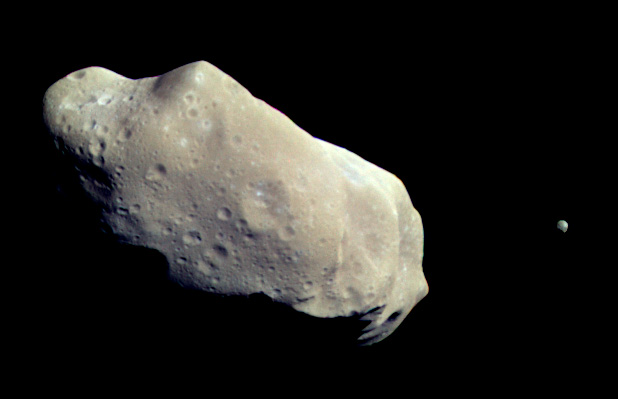


Discovery
The object was first identified from ground-based CCD images taken during early 2006 and its discovery was announced on 26 June 2006. The announcement credited observers including Scott S. Sheppard and David C. Jewitt, among others. Initial detections were followed by further observations to confirm the orbit and distinguish the object from background stars and asteroids. Like many small outer moons, Jarnsaxa required multiple images spanning several months to determine a reliable orbit.
Orbital and physical characteristics
Jarnsaxa is a compact, irregular satellite with modest physical dimensions and a remote orbit. Its basic measured properties include:
- Diameter: about 6 kilometres.
- Average orbital distance from Saturn: approximately 18,556,900 kilometres.
- Orbital period: roughly 943.8 days (nearly 2.6 Earth years).
- Orbital inclination: about 162.9° to the ecliptic (around 164.1° relative to Saturn's equator), indicating a strongly tilted, retrograde path.
- Eccentricity: approximately 0.1918, a measure of how elongated the orbit is; see eccentricity for context.
These values place Jarnsaxa among the distant, irregular satellites: small, non-spherical bodies whose orbits are typically eccentric and inclined compared with the regular moons close to Saturn. The irregular shapes and sizes suggest that such moons are likely fragments from past collisions or captured objects rather than bodies that formed in situ around Saturn.
Group membership and naming
Jarnsaxa is assigned to the so-called Norse group of Saturnian moons. Members of this group share broadly similar retrograde motions and ranges of orbital distance and inclination, implying a possible common origin or similar capture mechanism. The term "non-spherical" describes their irregular contours and modest gravity, which are insufficient to pull them into round shapes; more on related terminology can be found at non-spherical references.
The name itself, Járnsaxa (rendered Jarnsaxa), is taken from Norse mythology, where it denotes a giantess. Assigning mythological names to outer satellites follows long-standing astronomical naming conventions and helps group-related moons under thematic categories.
Observational notes and scientific importance
Jarnsaxa is faint and observable only with large telescopes or long-exposure imaging; it is not resolved into a disk by current ground-based facilities, so size estimates rely on assumed reflectivity and brightness. Studies of objects like Jarnsaxa contribute to understanding how giant planets acquire and retain swarms of small satellites, the dynamical evolution of satellite systems, and the collisional processes that shape them. Comparing orbital elements of Norse-group moons can reveal whether some members are fragments of a larger progenitor or independently captured bodies.
- Discovery: announced 26 June 2006; follow-up observations confirmed orbit.
- Nature: small, irregular, retrograde satellite of Saturn.
- Scientific role: informs models of capture, collisional families, and outer satellite dynamics.
For additional general context on satellites, observation techniques and naming conventions, see linked resources and catalogs maintained by planetary astronomy groups and observatories. Natural satellites of the giant planets continue to be discovered as instrumentation and surveys improve, expanding our view of the complex environments around planets like Saturn.
Questions and answers
Q: What is Jarnsaxa?
A: Jarnsaxa is a moon of Saturn.
Q: When was Jarnsaxa discovered?
A: Jarnsaxa was discovered on June 26, 2006.
Q: Who announced the discovery of Jarnsaxa?
A: The discovery of Jarnsaxa was announced by Scott S. Sheppard, David C. Jewitt, Jan Kleyna, and Brian G. Marsden.
Q: What is the average distance of Jarnsaxa from Saturn?
A: The average distance of Jarnsaxa from Saturn is 18,556,900 kilometers (11,530,700 mi).
Q: What is Jarnsaxa's diameter?
A: Jarnsaxa's diameter is about 6 kilometers (3.7 mi).
Q: What is Jarnsaxa's inclination to the ecliptic?
A: Jarnsaxa's inclination to the ecliptic is 162.9°.
Q: Who is Jarnsaxa named after?
A: Jarnsaxa is named after Járnsaxa, a giantess in Norse mythology.
Related articles
Author
AlegsaOnline.com Jarnsaxa (Saturnian moon) Leandro Alegsa
URL: https://en.alegsaonline.com/art/49564
Sources
- ifa.hawaii.edu : Institute for Astronomy Saturn Satellite Data
- cfa-www.harvard.edu : IAUC 8727: Satellites of Saturn
- cfa-www.harvard.edu : MPEC 2006-M45: Eight New Satellites of Saturn
- cfa-www.harvard.edu : MPEC 2007-D79: S/2006 S 6
- cfa-www.harvard.edu : IAUC 8873: Satellites of Saturn