
Janus (moon)
Janus is a small, irregular moon of Saturn notable for sharing its orbit with Epimetheus and for its unusual co-orbital dynamics confirmed by spacecraft observations.
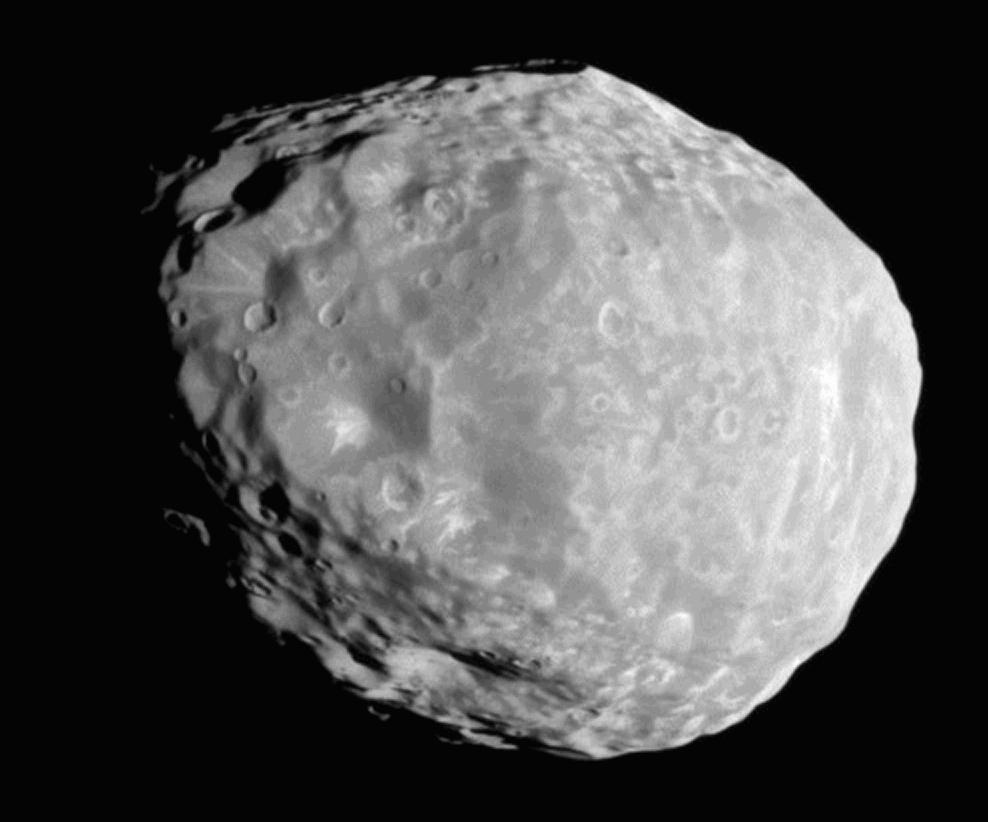
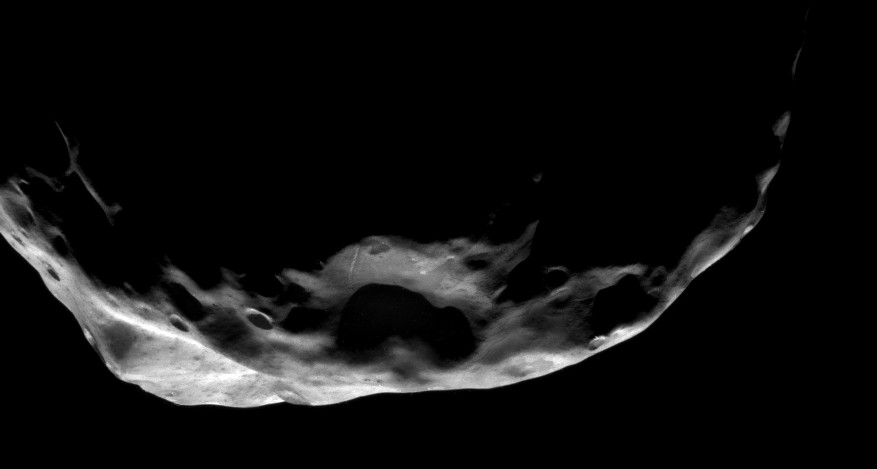
Janus is one of Saturn's inner satellites, notable for its small size, irregular shape and close association with a second moon, Epimetheus. It orbits in the region just outside Saturn's main rings and has a heavily cratered, rocky-icy surface typical of many small moons in the outer Solar System. Janus is large enough to retain a battered, non-spherical profile but is not massive enough to become spherical.
Image gallery
10 Images





Physical characteristics
The surface of Janus shows many impact craters and regions of varied brightness, indicating a mixture of older and younger terrains. Its composition is broadly rock mixed with water ice, giving a relatively bright appearance in visible light. Janus's irregular figure and low gravity mean it lacks a substantial atmosphere and shows geological features shaped mainly by impacts and the weak effects of tidal forces from Saturn.
Orbital dynamics and co-orbital pairing
Janus is famous for sharing essentially the same orbit as the neighboring moon Epimetheus. The two moons execute a rare co-orbital arrangement in which they periodically approach one another and exchange orbital energy, causing them to swap radial positions. This gravitational interaction—often described as a horseshoe or swap orbit—prevents collisions and results in the pair trading orbits on a timescale of a few years. The shared-orbit configuration is a distinctive dynamical phenomenon in planetary systems and has been the subject of theoretical and observational study.
The peculiar nature of the Janus–Epimetheus system was clarified by spacecraft. Ground-based observers initially mistook the two moons for a single object, but images and tracking from the Voyager 1 mission in 1980 confirmed that two distinct moons occupy nearly the same path around Saturn. Later imaging and measurements by the Cassini mission provided higher-resolution views of Janus's shape, surface features and orbital behavior.
- Notable facts: Janus and Epimetheus form one of the few known natural examples of co-orbital moons.
- Ring interactions: Both moons exert gravitational perturbations on nearby ring particles, helping to create waves and edge features in Saturn's rings.
- Exploration: Observations from spacecraft have been essential to resolving their shared-orbit dynamics and detailed surface morphology.
Janus remains of interest to planetary scientists because its co-orbital behavior provides a natural laboratory for studying orbital resonances, migration and the effects of mutual gravity in a multi-body system. Continued Earth-based monitoring and analysis of archival spacecraft data help refine models of how such systems form and evolve. For further context on its companion and the confirming spacecraft, see references to Epimetheus, Voyager 1 and studies of orbit sharing at related resources.
Related articles
Author
AlegsaOnline.com Janus (moon) Leandro Alegsa
URL: https://en.alegsaonline.com/art/49482