
Tennis court: dimensions, surfaces, layout and history
An overview of the tennis court: standard dimensions, lines and parts, surface types, historical development, common uses and notable differences between court surfaces.
Overview
A tennis court is the rectangular playing area used for the sport of tennis. It is divided down the middle by a net and marked with a series of lines that define service areas, boundaries for singles and doubles play, and other features. The court is the basic element of every match, whether played by a single player on each side or by pairs in doubles. For general information on the sport and rules one may refer to governing bodies such as the International Tennis Federation.
Image gallery
10 Images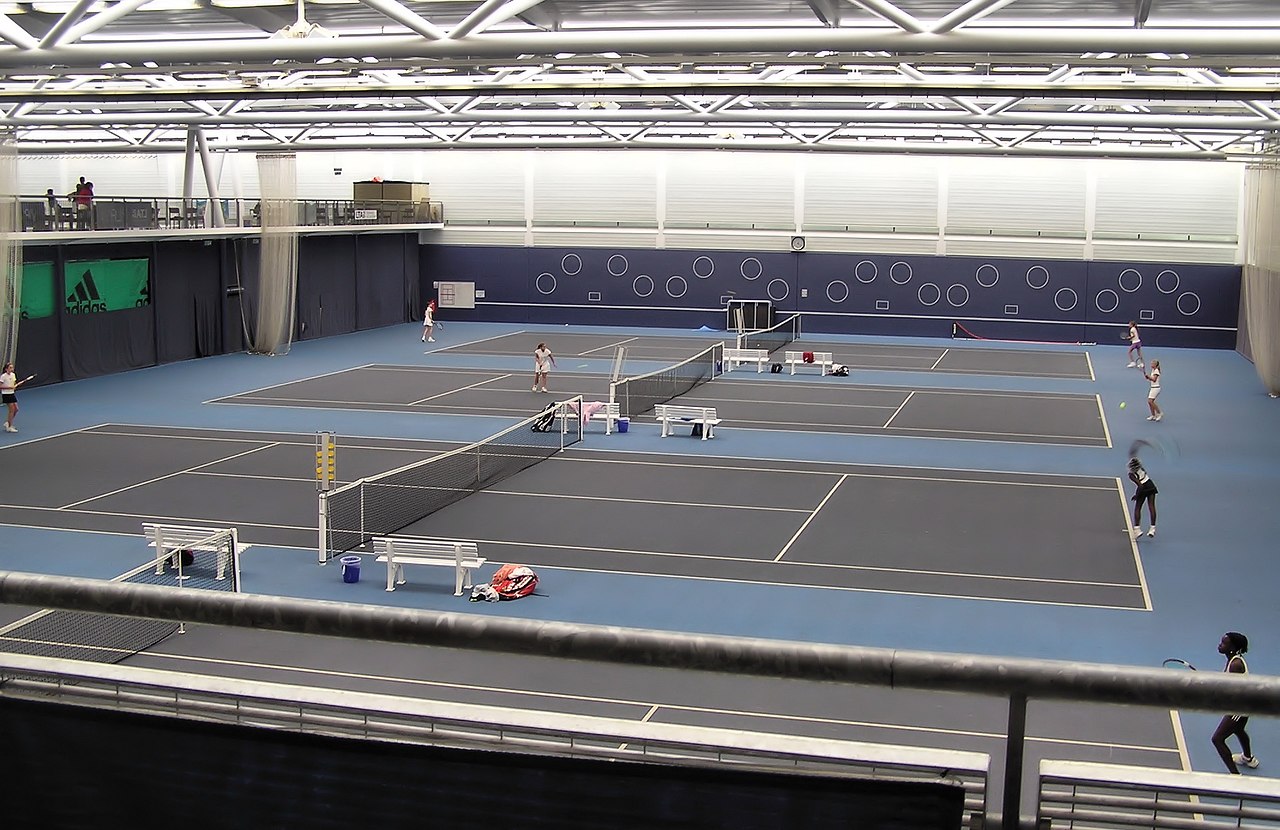


Layout and measurements
Modern lawn tennis courts follow standardized measurements. The playing rectangle is 78 feet (23.77 m) long. The width differs by match type: 27 feet (8.23 m) for singles and 36 feet (10.97 m) when the doubles alleys are included. A net stretches across the center; its height at the center is about 3 feet (0.91 m). The service line lies approximately 21 feet (6.40 m) from the net, creating the service boxes. Other marked lines include the baseline at each end, the center service line that divides the service boxes, and the singles and doubles sidelines. The area between the singles and doubles sidelines is commonly called the doubles alley and is only in play during doubles matches.
Principal parts and markings
- Baseline: the back boundary line behind which players often stand to serve and rally.
- Service line and service boxes: the service line plus the center service line create two boxes on each side into which serves must land.
- Singles and doubles sidelines: define the in-play width for singles and doubles respectively.
- Net: divides the court and is supported by posts; it governs the height over which the ball must pass.
Surfaces and playing qualities
Tennis is played on several principal surface types, each affecting ball bounce and player movement. Traditional grass courts produce a lower, often faster bounce and are associated with the oldest tournaments; clay courts slow the ball and allow higher bounces that favor longer rallies and baseline play; hard courts (various asphalt or concrete bases finished with acrylic or other coatings) offer a balance between speed and bounce and are widely used for public and professional venues. Indoor courts may use synthetic materials or carpet-like coverings. Surface choice influences strategy, maintenance needs and how the game is staged; prominent tournaments are associated with particular surfaces, which shapes playing styles and equipment choices.
History and development
The modern tennis court evolved from late 19th-century lawn tennis, which was played outdoors on grass. As the sport internationalized, governing bodies standardized court dimensions and markings so that play would be consistent across venues; those rules are maintained and published by authorities such as the ITF rules. Over time, materials and construction techniques diversified, giving rise to durable hard courts, specialized clay compositions, and indoor options that permit year-round play.
Uses, maintenance and notable facts
Tennis courts serve recreational, educational and professional functions: public parks, clubs, schools and stadiums all host play and practice. Proper construction considers orientation to the sun, drainage, shock absorption and surface friction. Maintenance varies widely—grass requires frequent cutting and repair, clay needs regular rolling and watering, and hard courts need periodic resurfacing. Some notable tournament associations with surfaces include the grass championships at Wimbledon, the clay of the French championships, and hard courts used at other major events, illustrating how surface type can shape both match play and tournament identity. For further technical guidance on construction and regulations see resources like the official rules or facility manuals available from national and international organizations (court standards, construction guidance).
Related articles
Author
AlegsaOnline.com Tennis court: dimensions, surfaces, layout and history Leandro Alegsa
URL: https://en.alegsaonline.com/art/96999