
Irrational number
A real number that cannot be expressed as a ratio of two integers; its decimal expansion is nonterminating and nonrepeating. Examples include √2, π and e. Distinctions: algebraic vs transcendental, cardinality, history.
Overview
In mathematics a number is called irrational when it cannot be written as a ratio of two integers. Put differently, an irrational number is a real number that is not a rational number. This idea appears in many parts of arithmetic and analysis and is often introduced alongside the notions of number systems and real numbers. The phrase "ratio" or "fraction" is commonly used to stress that there exist no integers p and q (with q nonzero) such that the irrational number equals p/q; see a basic description at ratio and the related notion of integers.
Image gallery
1 Image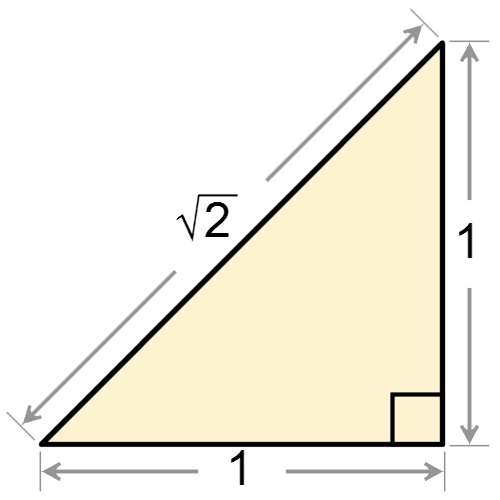
Key properties
Irrational numbers have characteristic features that distinguish them from rationals. Most commonly cited properties are:
- Decimal expansion: an irrational number has an infinite, nonrepeating decimal expansion (it never terminates nor falls into a repeating block); see decimal expansions.
- Base-independence: the nonrepeating, nonterminating behavior persists in any integer base greater than 1, so it is not an artifact of base 10; related observations are discussed in introductions to infinite expansions here.
- Approximability: irrational numbers can be approximated arbitrarily well by rationals, yet never exactly matched by any finite fraction; tools such as continued fractions describe the quality of these approximations continued fractions.
Algebraic status and cardinality
Two broad classes exist inside the irrationals. Algebraic irrationals are roots of nonzero polynomials with integer coefficients (for example, √2 is algebraic). Transcendental numbers are not roots of any such polynomial (for example, π and e are transcendental). The distinction is important in number theory and analysis; see material on proofs and classifications at proofs and algebraic numbers. From a set-theoretic viewpoint rational numbers form a countable set, while the set of all irrational numbers is uncountable; the irrationals comprise most real numbers in the sense of cardinality cardinality.
History and origins
The discovery of irrational quantities dates to ancient geometry. Early Greek mathematicians encountered incommensurable lengths when comparing side and diagonal of a square; the classic demonstration that √2 cannot be expressed as a ratio is often attributed to the Pythagoreans and later formalized in Euclidean geometry. Historical discussions and modern expositions about that development can be found at historical sources and introductions to classical proofs at Euclidean proofs. The conceptual shift from only rational measures to allowing irrational magnitudes was a major step in the development of real number theory.
Examples and significance
Concrete examples help fix the idea. The diagonal of a unit square has length √2, an irrational number that cannot be written as p/q; see elementary treatment at square root examples and an illustration of related constants such as π and e below. The constant π is the ratio of a circle's circumference to its diameter and has a nonterminating, nonrepeating decimal expansion; the base of natural logarithms, e, is another important irrational number. Certain constants remain of uncertain status: for instance, whether the Euler–Mascheroni constant is irrational is an open question in number theory; further commentary is available at open problems.
Notable facts and distinctions
Some additional points often emphasized are that irrational numbers are dense among the reals (between any two real numbers there is an irrational), and that algebraic irrationals are countable while transcendental numbers are not only irrational but overwhelmingly numerous (almost all real numbers are transcendental). Methods used to prove irrationality range from elementary parity arguments to deep results in transcendence theory; accessible expositions and further reading appear under the links above.
Related articles
Author
AlegsaOnline.com Irrational number Leandro Alegsa
URL: https://en.alegsaonline.com/art/48252