
InterCity 125 (British Rail High Speed Train)
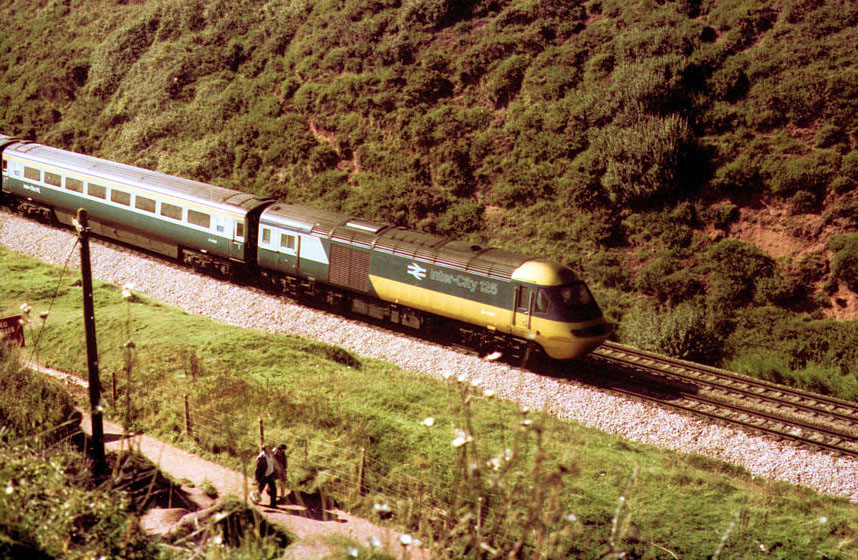
The InterCity 125, or HST, is British Rail’s high-speed diesel train introduced in the 1970s. Formed of two power cars and passenger coaches, it reached 125 mph in service and set a diesel speed record.
The InterCity 125 is the marketing name applied to British Rail's High Speed Train (HST) fleet, a diesel-powered fixed-formation train designed to provide fast, long-distance intercity services. Introduced into passenger service in the mid-1970s, the HST revolutionized scheduled speeds on the UK network without electrification by using a power car at each end of a rake of Mark 3 coaches. The design combined improved acceleration and a streamlined profile to sustain 125 mph in regular timetables, offering a step change in journey times and comfort from previous diesel services. Its origin and development are closely associated with British Rail and the modernization programs of that era.
Image gallery
10 Images




Design and technical characteristics
An InterCity 125 set consists of two self-contained locomotives mounted at each end of a fixed set of coaching stock. These locomotives, commonly called power cars, provided the traction and most auxiliary services for the adjacent coaches. Early HST power cars were equipped with high-power diesel engines, which over the life of the fleet were subject to upgrade and re-engining programs to improve reliability and reduce emissions. Typical formations used eight or nine Mark 3 coaches between the two power cars, giving a mix of first-class and standard accommodation and a continuous corridor throughout the set.
- Maximum in-service speed: 125 mph (201 km/h) on suitable track
- Record: an absolute top speed of 148 mph (238 km/h) recorded under test conditions
- Composition: two power cars plus fixed set of coaches
- Notable equipment: streamlined nose, Mark 3 bodyshells, upgradeable diesel prime movers
Routes, operators and role
From introduction the InterCity 125 was deployed on the UK’s main long-distance routes, shortening journey times between major cities and regions. It was a familiar sight on the East Coast Main Line and the Great Western Main Line, and was used extensively on cross-country links and services on the Midland Main Line. Typical termini served included London (Paddington and other London terminals, referenced here as London), regional hubs such as Bristol and Edinburgh, and farther destinations at the extremities of the network including Penzance, Aberdeen and Inverness. Operators over the decades adapted HST sets for differing service patterns, refurbishing interiors to contemporary expectations while retaining the basic mechanical layout.
History, upgrades and replacement
The HST concept originated as a cost-effective means to raise speeds without full route electrification. Early trials and prototypes led to series production and widespread deployment from the late 1970s. Throughout its working life the fleet underwent multiple refurbishment and re-engining programs to extend operational life, reduce fuel consumption and meet evolving regulatory standards. The train's diesel performance was highlighted when an HST reached 148 mph during a test run, establishing a world record for a diesel-powered train. From the late 2010s newer bi-mode and electric multiple-unit fleets, notably the Class 800 series and other modern units, began to displace HSTs on many principal routes; nonetheless, several HSTs continued in service after refurbishment and selective redeployment.
Importance and notable facts
The InterCity 125 had a substantial impact on rail travel in Britain: it cut journey times, improved reliability compared with older rolling stock, and became an enduring symbol of intercity rail. It demonstrated that well-matched traction, coaching stock and aerodynamics could deliver sustained high speeds on non-electrified lines. The model’s combination of high top speed in regular operation and long service life underpinned its reputation, while the 148 mph test record remains a standout achievement that emphasized the capabilities of diesel traction in the pre-electrification era. For further technical and historical detail consult archived material from industry sources and preserved HST collections associated with locomotive records and heritage groups (speed record documentation and preservation projects).
Today, when reading timetables or visiting heritage displays, the InterCity 125 is often described as both a technological milestone and a practical solution that served Britain for decades. Its influence can be seen in subsequent high-speed and intercity rolling stock design and in the continuing efforts to balance speed, efficiency and route availability across mixed electrified and non-electrified networks.
Further reading and operator information is available from contemporary sources and operator pages linked here: operator history, main termini, and technical histories linked at regional records and preservation sites (Edinburgh depot histories, Cornwall services, northern routes, Highland services).
Questions and answers
Q: What is the InterCity 125?
A: The InterCity 125 is the brand name of British Rail's High Speed Train (HST) fleet.
Q: How is the InterCity 125 train made up?
A: The InterCity 125 train is made up of two locomotives, one at each end of a fixed formation of carriages.
Q: What is the speed capability of the InterCity 125 train?
A: The InterCity 125 train is capable of 125 mph in regular service.
Q: Where did British Rail initially use the InterCity 125 fleet?
A: British Rail initially used the InterCity 125 fleet on the Great Western Main Line, on the East Coast Main Line, on the Cross Country Route and latterly on the Midland Main Line.
Q: What destinations did the InterCity 125 serve?
A: The InterCity 125 served destinations such as London, Bristol, Edinburgh, as far south as Penzance and as far north as Aberdeen and Inverness.
Q: What world record did the InterCity 125 hold?
A: The InterCity 125 took the world record for the fastest diesel-powered train, when it was recorded at an absolute maximum speed of 148 mph (238 km/h) during 1987.
Q: What has replaced most of the InterCity 125 fleet since 2017?
A: Since 2017, most of the InterCity 125 fleet has been replaced by the British Rail Class 800.
Related articles
Author
AlegsaOnline.com InterCity 125 (British Rail High Speed Train) Leandro Alegsa
URL: https://en.alegsaonline.com/art/47572
Sources
- news.bbc.co.uk : "Rail Timeline"
- news.bbc.co.uk : "The little train that could"
- gov.uk : Government gives green light for more state-of-the-art intercity trains