
International Harvester Scout
A compact encyclopedia entry on the International Harvester Scout: its design, development (1960–1980), variants, uses, and legacy as an early American sport-utility/off-road vehicle.
Overview
The International Harvester Scout was a compact off-road vehicle produced by International Harvester from 1960 until 1980. Launched as one of the earliest vehicles in what later became known as the sport-utility category, the Scout combined utilitarian design with options for open-air driving and truck-like utility. The Scout is commonly described as an answer to the Jeep, developed quickly from concept to production to meet the growing demand for versatile, rugged civilian four-wheel-drive vehicles; see contemporary accounts of its origins development timeline and its classification as an off-road vehicle.
Image gallery
10 Images




Design and key features
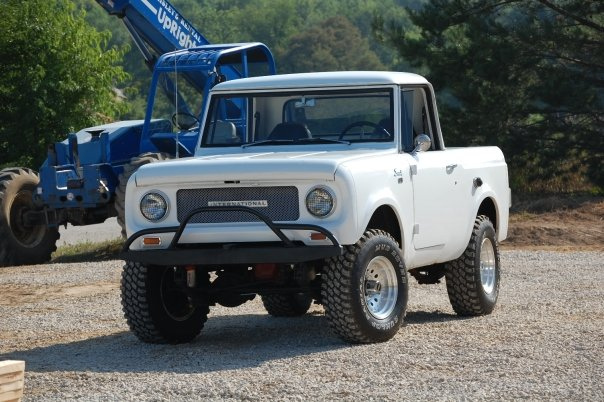
The Scout showed simple, boxy styling with fairly straight panels and a focus on durability. Early examples featured a fold-down windshield that allowed for open-air use and a rugged, flat-hood silhouette; this feature is discussed in period brochures and owner accounts fold-down windshield. The body was available in several configurations: a two-door wagon with removable hard or soft tops, or as a short-bed pickup variant often called a half-cab, which broadened appeal to both recreational drivers and light-duty commercial users pickup options.
Generations and production
Production took place in Fort Wayne, Indiana, where International Harvester built both the original Scout models and the later Scout II series. The vehicle is usually divided into an early generation (often referred to by enthusiasts as Scout 80/800) and the larger, more refined Scout II introduced in the early 1970s. The Scout II remained in production through the end of the program in 1980. For information about production sites and factory history see materials on the Fort Wayne plant production location.
Mechanical layout and options
Scouts were designed around a traditional body-on-frame construction with solid axles, prioritizing off-road capability and serviceability. During its life, the Scout was offered with a range of gasoline engines and driveline options to suit recreational riders and light commercial users; various inline and V-type engines were available at different times, and buyers could choose between two- and four-wheel-drive configurations. This mechanical flexibility helped the Scout compete in a growing market of compact four-wheel-drive vehicles market competition and compared in purpose to earlier Jeep models Jeep counterparts.
Uses, cultural impact, and legacy
The Scout found favor with off-road enthusiasts, small-farm and ranch users, and owners seeking a multi-purpose vehicle that could tow, haul, and serve as a weekend recreational vehicle. Over time the Scout gained a dedicated following; many examples survive in restored or modified form and the model is often cited among early influences on the later mainstream SUV market. Its relatively straightforward construction also makes it a frequent subject for restoration projects and custom builds.
Notable facts and distinctions
- Quick development: the Scout project moved from idea to production rapidly for its era, reflecting International Harvester's experience building rugged vehicles.
- Versatility: produced as both a wagon and a half-cab pickup with removable tops, allowing multiple body styles from a single platform.
- Enduring appeal: Scouts are collected and restored; they are regarded as a representative early American utility 4x4.
For further reading and resources on restoration, original specifications, and enthusiast communities, consult factory literature and specialist sources off-road archives, historical timelines development records, and regional production histories Fort Wayne plant. Additional references and club information can be found via community portals and owner groups original features, market comparisons competitor analyses, and model-specific histories body variants, contemporary Jeep context.
Questions and answers
Q: What was the International Scout?
A: The International Scout was an off-road vehicle made by International Harvester from 1960 to 1980. It was one of the earlier SUVs.
Q: Who created the Scout?
A: The Scout was created as a competitor to the Jeep.
Q: How long did it take for the Scout to go from idea to production?
A: Remarkably, it only took two years for the Scout to go from a basic idea to production.
Q: What kind of styling did the Scout have?
A: The Scout had square utilitarian styling but with cleaner lines than its competitors. It initially featured a fold-down windshield.
Q: Where were Scouts and second generation Scouts produced?
A: Both Scouts and second generation Scouts were produced in Fort Wayne, Indiana as two-door trucks.
Q: What options were available for these vehicles?
A: They had the options of a half cab pickup or removable hard or soft top.
Related articles
Author
AlegsaOnline.com International Harvester Scout Leandro Alegsa
URL: https://en.alegsaonline.com/art/47661
Sources
- 4wheeldrive.about.com : "Little Known Facts About The International Harvester Scout - IH Scout History"
- commons.wikimedia.org : International Harvester Scout