
Annobón: island province of Equatorial Guinea
Annobón is a small volcanic island province of Equatorial Guinea in the Gulf of Guinea, known for its Creole culture, dense forests, fishing economy and the volcanic peak Quioveo.
Overview
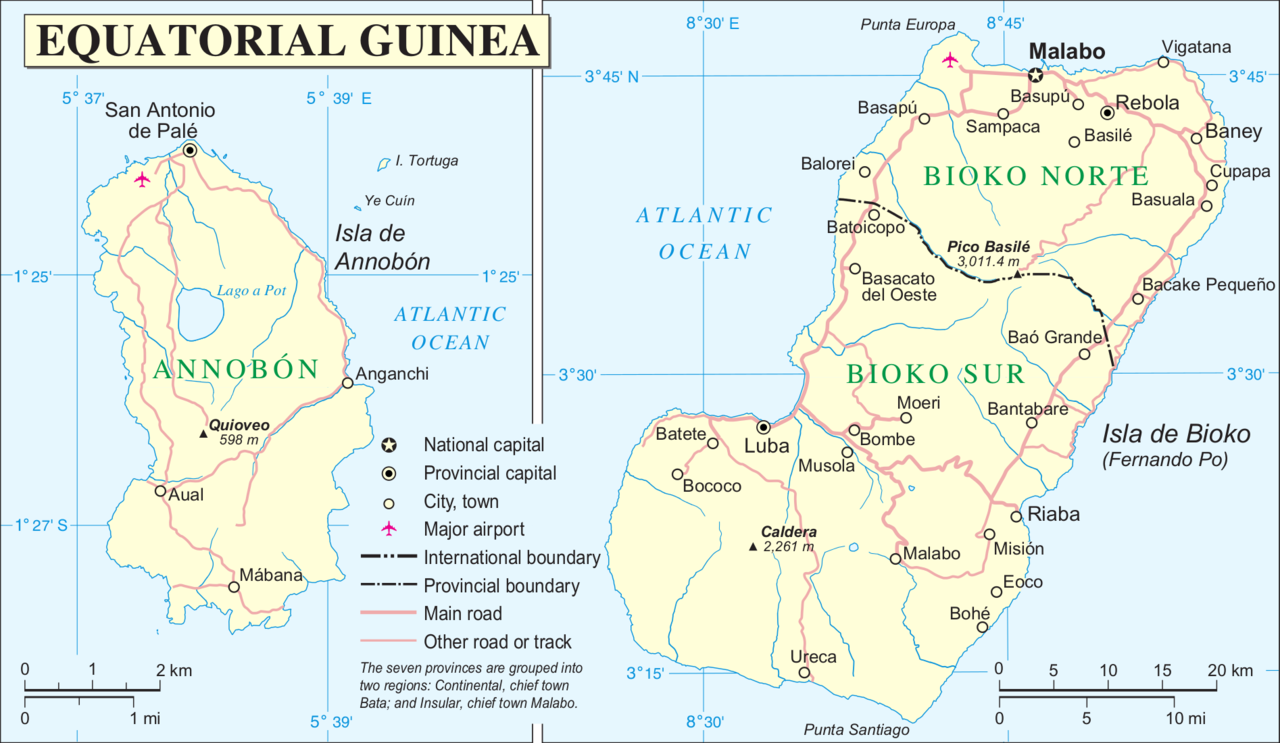
Annobón is a remote island province of Equatorial Guinea, located in the Gulf of Guinea. The province consists of the main island of Annobón and several small offshore islets. Its administrative center is San Antonio de Palé, with the settlement of Mabana as another principal village. The island is noted for its compact size, volcanic terrain and a distinct Creole language and culture.
Image gallery
5 Images


Geography and geology
Annobón is an extinct volcanic island. The main landmass is roughly 6.4 km long by 3.2 km wide, with a rugged interior that rises to the summit of Quioveo at about 598 meters. The island’s coastline alternates between rocky cliffs and small bays. Its location in the Gulf of Guinea gives it a tropical, humid climate with heavy rainfall that supports dense evergreen forests and lush vegetation.
History and language
Annobón was encountered by European sailors during the Age of Discovery and later came under European colonial control. It was incorporated into Spanish colonial holdings and today forms one of the country’s provinces. The island’s population speaks a Portuguese-based creole often referred to as Annobonese (or Fa d’Ambô), alongside Spanish and other languages, reflecting its colonial and maritime past.
Population, culture and society
The island supports a small, close-knit population concentrated in a few settlements. Residents practice a mix of Roman Catholic and local customs; community life revolves around fishing, family, and local traditions. The island’s isolation has helped preserve unique folklore, musical styles and a Creole dialect distinct from the mainland.
Economy, ecology and resources
Local livelihoods depend largely on artisanal fishing and uses of forest resources. The economy is modest and oriented to subsistence and small-scale trade. Annobón’s forests and surrounding seas host diverse flora and fauna, including seabird colonies and marine life; the island’s ecosystems are sensitive and of interest to conservationists.
Administration, access and notable facts
Administratively the island is a province of Equatorial Guinea and is linked to the national government by air and sea routes. Its remoteness has shaped distinctive cultural traits and a degree of administrative autonomy in daily affairs. For reference and navigation see coordinates. The island’s main economic activities are often described as fishing and forestry, and its settlements, geography and history are further documented by regional sources and maps.
- Capital: San Antonio de Palé
- Other town: Mabana
- Highest point: Quioveo (~598 m)
- Sea: Gulf of Guinea
Tags
Related articles
Author
AlegsaOnline.com Annobón: island province of Equatorial Guinea Leandro Alegsa
URL: https://en.alegsaonline.com/art/4474