
Australian Indian Ocean Territories
Overview of the Australian Indian Ocean Territories: the external territories of Christmas Island and the Cocos (Keeling) Islands, their geography, governance, people, economy, ecology and notable distinctions.
Overview
The Australian Indian Ocean Territories (often abbreviated AIOT) is the administrative name applied by the Australian government to two small groups of islands in the eastern Indian Ocean: Christmas Island and the Cocos (Keeling) Islands. These islands are external territories of Australia and are managed under Australian responsibility. They are geographically remote from the mainland and are notable for their distinctive environments, small populations and separate local identities.
Image gallery
6 Images


Geography and natural environment
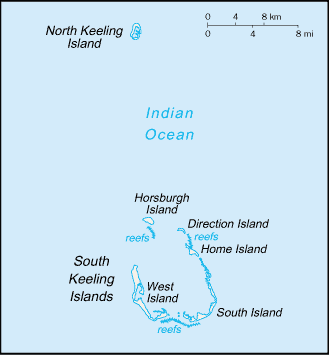
Christmas Island is a single high island of volcanic origin surrounded by coral reefs and steep limestone terraces. It is well known for dense tropical rainforest, dramatic coastal cliffs and a variety of seabird colonies. The Cocos (Keeling) Islands consist of two inhabited islands and a number of smaller uninhabited islets arranged as coral atolls and lagoons. Both island groups support marine ecosystems, including coral reefs and diverse fish populations, and both are recognized for endemic species and important bird habitats.
History and governance
Both island groups have long histories of Indigenous or local habitation and were later charted and claimed during the era of European exploration. In the modern period they came under British administration and were subsequently brought under Australian responsibility in the 20th century. Since the 1990s they have been administered as the Australian Indian Ocean Territories. An Administrator appointed by the Australian government performs executive duties; the Administrator resides on Christmas Island and also has jurisdiction over the Cocos (Keeling) Islands. Local councils or shire governments handle many community services, while federal departments provide broader services and legal frameworks.
People, society and economy
Populations on these islands are small and multiethnic. Christmas Island has communities of Asian, European and Malay background with distinct cultural traditions. The Cocos (Keeling) Islands have a significant Cocos Malay community whose language, religion and customs shape local life. Economies are limited by geography: historically phosphate mining was important on Christmas Island, and today economic activity largely centers on public administration, services, tourism, fishing and small-scale commerce. Infrastructure and services are scaled to small populations and rely on links with mainland Australia for higher-level health, education and specialist services.
Transport, services and conservation
Transport to and between the islands is by air and sea. Each inhabited island has basic port facilities and airstrips that connect to larger regional hubs and to Australia, enabling supplies, travel and emergency access. Conservation is a major focus because of unique flora and fauna; management programs target invasive species, habitat protection and reef health. Both island groups attract scientific interest for their biodiversity and marine environments.
Notable facts and distinctions
- Components: the AIOT comprises two separate island groups administered together for governmental purposes.
- Administration: the Administrator lives on Christmas Island and also administers the Cocos (Keeling) Islands.
- Biodiversity: species and events such as mass migrations and seabird breeding make the islands ecologically significant.
- Legal status: these are Australian external territories; Australian law applies though some local arrangements exist for community governance.
- Separate from subantarctic territories: the AIOT does not include Australian subantarctic possessions such as Heard and McDonald Islands, which are distinct and lie closer to Antarctica.
For further reading and official information consult government and conservation sources linked from the Administrations of Christmas Island and the Cocos (Keeling) Islands.
Tags
Related articles
Author
AlegsaOnline.com Australian Indian Ocean Territories Leandro Alegsa
URL: https://en.alegsaonline.com/art/7492