
Hawking radiation: quantum emission from black holes
Hawking radiation is the quantum thermal emission predicted to arise from black holes. It leads to slow mass loss (evaporation), ties gravity to thermodynamics, and raises questions about information and quantum gravity.
Overview
Hawking radiation is a theoretical prediction that black holes are not perfectly black but emit thermal radiation because of quantum processes near their event horizons. First argued for in 1974 by Stephen Hawking, this effect arises in the framework of quantum field theory in curved spacetime and gives black holes an effective temperature and entropy. The prediction links gravitation, quantum mechanics and statistical physics and is central to modern discussions of black hole thermodynamics.
Image gallery
5 Images


Mechanism and key characteristics
The intuitive picture often used to describe the effect invokes pairs of particles that spontaneously form from the vacuum due to quantum fluctuations. Near an event horizon, one member of such a pair can fall into the hole while the other escapes to infinity as radiation. In formal derivations the escaping flux has a nearly thermal (black-body) spectrum with a temperature inversely related to the black hole mass: smaller black holes are predicted to be hotter. The heuristic picture involving particle pairs and matter and antimatter is useful for building intuition, but the rigorous account treats field modes on a curved background rather than literal particles popping in and out of existence.
Thermodynamic and theoretical implications
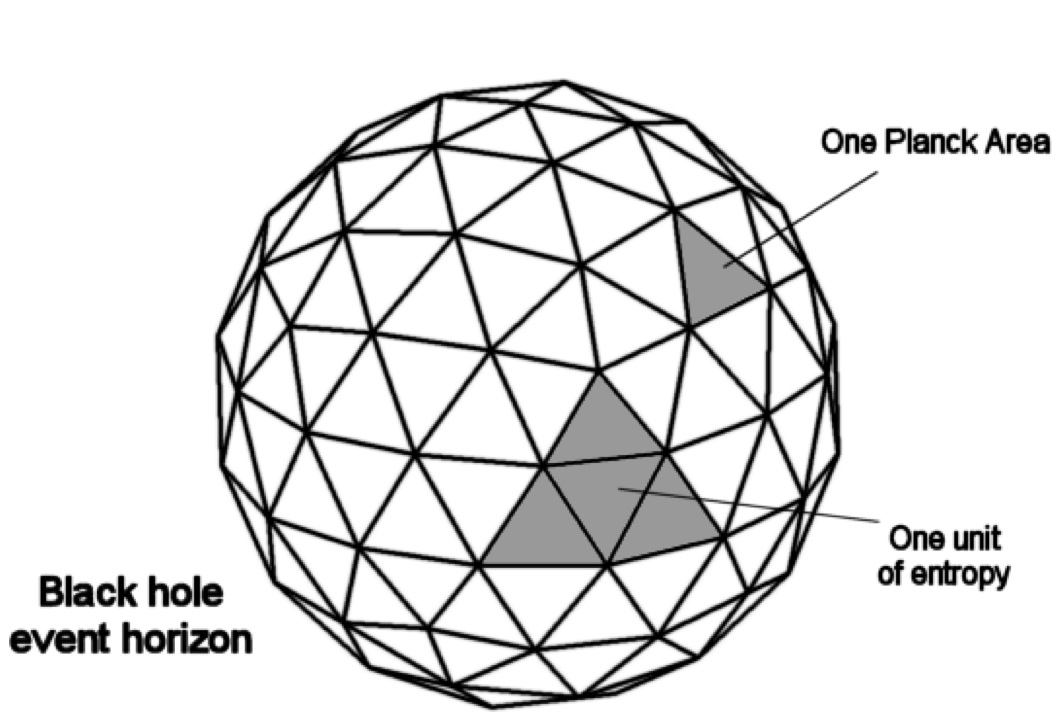
Because emitted quanta carry away energy, Hawking radiation causes isolated black holes to lose mass over time — a process often called black hole evaporation. This result completes a set of parallels between black hole physics and thermodynamics by assigning a temperature and entropy to horizons, and leads to deep conceptual puzzles. One notable issue is the black hole information question: if radiation is strictly thermal it appears to erase information about matter that formed the hole, a conflict with quantum mechanics' unitary evolution. Resolving this tension is a major driver of research into quantum gravity.
History, derivations and caveats
Hawking's original calculation used semiclassical methods, treating gravity classically while quantizing other fields on the black hole background. Subsequent work has reproduced the result in many settings and connected it to ideas such as tunnelling descriptions and anomalies in quantum currents. However, the semiclassical approach neglects backreaction and full quantum gravitational corrections, so final answers about the end stages of evaporation require a theory of quantum gravity.
Observational status and examples
For astrophysical black holes the predicted temperature is minuscule, far below the cosmic microwave background, so direct detection of Hawking radiation from stellar or supermassive black holes is effectively impossible with current technology. Hypothetical small or primordial black holes would be much hotter and could produce observable signatures if they exist and are evaporating today. Searches have looked for bursts of high-energy particles or radiation consistent with such evaporation, and proposed laboratory analogues use condensed-matter systems to mimic horizon-like behavior and probe related quantum effects.
Distinctive facts and further reading
- Not literally particle pairs: the pair heuristic is pedagogical; field-theoretic mode-mixing is the rigorous mechanism.
- Black-body spectrum: the emitted radiation is nearly thermal, characterized by a temperature proportional to the surface gravity of the horizon.
- Evaporation timescale: for ordinary astrophysical holes this timescale greatly exceeds the present age of the universe.
- Theory frontiers: connections to entropy, holography and the information problem make Hawking radiation central to quantum gravity research.
For introductory expositions and technical treatments consult standard reviews and textbooks on quantum field theory in curved spacetime and black hole thermodynamics. See also accessible summaries and historical notes linked to black holes, work of Stephen Hawking, and discussions of quantum fluctuations, matter and antimatter effects and how particle pairs can annihilate or fail to do so near a horizon.
Related articles
Author
AlegsaOnline.com Hawking radiation: quantum emission from black holes Leandro Alegsa
URL: https://en.alegsaonline.com/art/42935
Sources
- charlierose.com : Charlie Rose: A conversation with Dr. Stephen Hawking & Lucy Hawking