
Quantum fluctuation
Short-term variations in energy and fields in quantum systems, manifesting as vacuum fluctuations, virtual particles, and measurable effects like the Casimir effect and Lamb shift.
Overview
In quantum physics, a quantum fluctuation is a fleeting change in the value of a field or in the energy at a point in space. These fluctuations arise from the principles of quantum mechanics, notably the energy–time form of the uncertainty relation commonly associated with Werner Heisenberg. The relation limits how precisely energy and the duration of a state can be known simultaneously, which allows transient departures from a single, sharply defined energy value without long-term violation of conservation laws. For a concise statement of the principle see Heisenberg uncertainty principle.
Image gallery
1 Image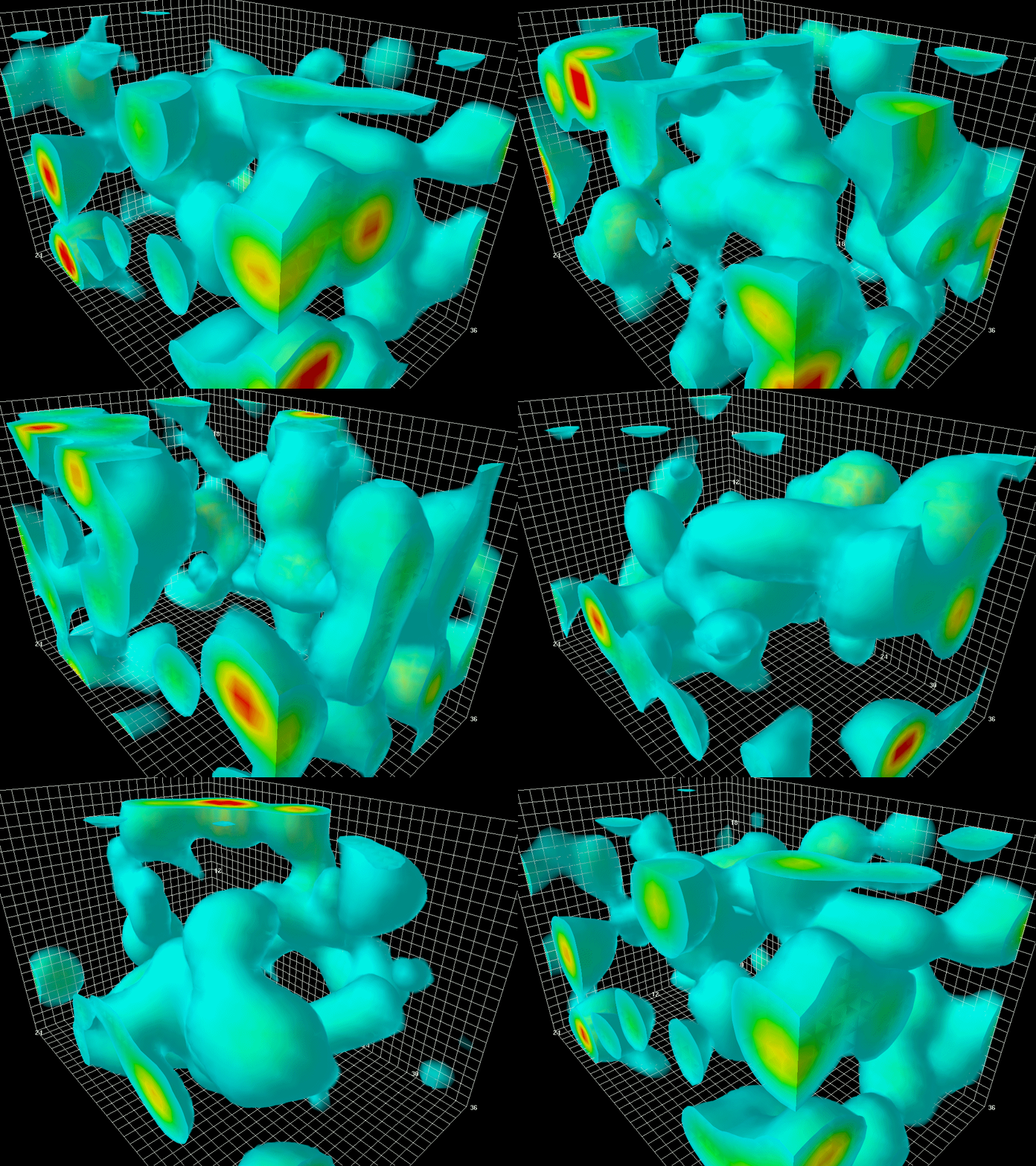
Nature and mechanisms
Quantum fluctuations are most often described in the language of quantum field theory as temporary excitations of quantum fields in what would classically be considered empty space (the vacuum). These excitations are sometimes pictured as the appearance and disappearance of virtual particle pairs, for example virtual electron–positron pairs. Such pairs are bookkeeping devices in perturbative calculations and correspond to internal processes in Feynman diagrams rather than observable free particles. The apparent borrowing of energy for a short time is not a permanent violation of energy conservation; the bookkeeping in a full quantum treatment ensures global conservation is maintained.
Observable consequences
Although virtual particles themselves are not directly observable, quantum fluctuations have measurable consequences. The Casimir effect — an attractive force between closely spaced uncharged metal plates — is routinely attributed to changes in vacuum modes caused by boundary conditions. Shifts in atomic energy levels such as the Lamb shift and effects on spontaneous emission rates also reflect vacuum fluctuations and virtual-photon interactions. These phenomena demonstrate that the vacuum in quantum theory is an active medium, not an inert void.
Importance and common misconceptions
Popular descriptions sometimes imply that virtual particles are identical to real particles or that fluctuations produce usable energy. In truth, virtual particles are a calculational concept and do not appear as isolated, directly detected particles. For example, while normal electrons and positrons are matter and antimatter counterparts and annihilate producing real photons, virtual electron–positron processes mediate forces without producing freely propagating quanta. References to imaginary photons or final nonphysical products are misleading — virtual photons are internal carriers of interaction in the theory and differ from observable photons that interact with matter in detectors and instruments (real photon interactions).
Uses, implications and examples
Quantum fluctuations play a role across physics: they influence atomic structure, seed the tiny inhomogeneities in the early universe that later grew into galaxies, and underlie mechanisms such as Hawking radiation near black hole horizons. Technologically, understanding vacuum effects has improved precision measurements and contributed indirectly to development of quantum devices. Theoretical puzzles also arise: vacuum energy estimated from quantum fluctuations contributes to the cosmological constant problem, a major open question in modern cosmology.
Related concepts and distinctions
- Virtual vs real particles: virtual particles are internal to calculations; real particles can be detected.
- Vacuum fluctuations vs thermal fluctuations: quantum fluctuations persist at absolute zero, unlike thermal noise which vanishes as temperature approaches zero.
- Particle–antiparticle pairs: phenomena involving pairs resemble annihilation of matter and antimatter in some ways but differ in observability and energetics (particle–antiparticle pairs, antimatter).
For further reading on experimental and theoretical aspects, consult specialist texts and reviews that treat quantum field theory and quantum electrodynamics in detail.
Related articles
Author
AlegsaOnline.com Quantum fluctuation Leandro Alegsa
URL: https://en.alegsaonline.com/art/80384
Sources
- nytimes.com : "New direction in physics: back in time"