
Heisenberg's uncertainty principle
A fundamental quantum principle limiting simultaneous precision of certain pairs of observables (notably position and momentum), with broad implications for measurement, technology, and interpretation of nature.
Overview
The uncertainty principle is a central result of quantum mechanics establishing that certain pairs of physical quantities cannot both be known to arbitrary precision at the same time. The most familiar pair is position and momentum: the more precisely a particle's position is specified, the less precisely its momentum can be specified, and vice versa. This is not a technological limitation of instruments but a feature of quantum systems themselves.
Image gallery
10 Images



Formal statement
In its usual mathematical form the principle is expressed in terms of the standard deviations Δx and Δp of position and momentum measurements: Δx Δp ≥ ħ/2, where ħ (h-bar) is the reduced Planck constant. More generally, any two quantum observables represented by noncommuting operators obey a similar inequality. The uncertainties Δ are properties of the probability distributions produced by repeated measurements on identically prepared systems, and they reflect an intrinsic spread in possible outcomes rather than merely experimental noise.
Historical background
Werner Heisenberg formulated the principle in 1927 during the early development of quantum mechanics. It grew out of attempts to reconcile wave and particle descriptions of microscopic objects and to understand limits placed on measurement processes. Prominent contemporaries engaged in debates about its meaning: Albert Einstein argued that quantum theory might be incomplete and that apparent uncertainty could reflect limits in our knowledge, while others, including Niels Bohr, treated uncertainty as a fundamental characteristic of nature.
Physical meaning and analogies
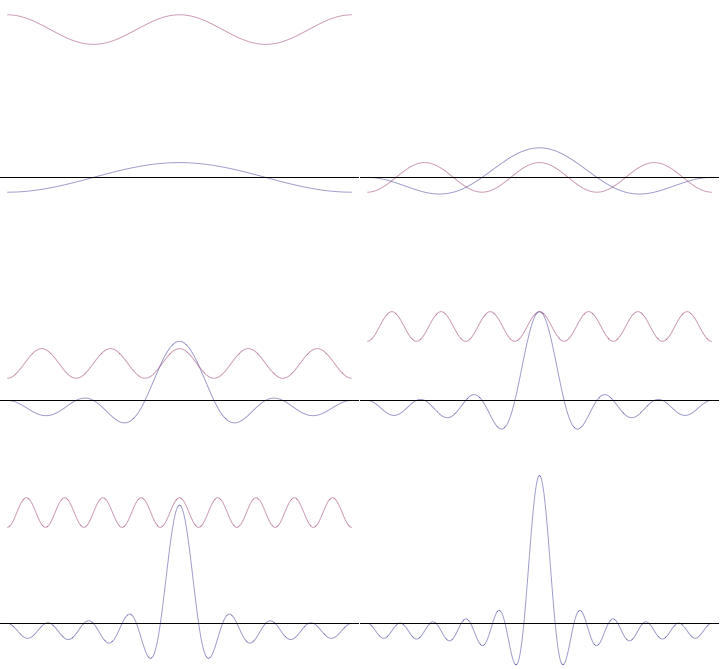
A useful way to think about the effect is that position and momentum behave like a Fourier transform pair: a state localized tightly in space corresponds to a wide distribution of momentum components, and a state narrowly peaked in momentum is extended in space. Popular analogies compare a free insect moving in a large room to one trapped in a jar: confinement improves knowledge of location but produces more erratic motion. The analogy was discussed by educators such as Brian Greene to convey the trade-off intuitively.
Consequences and applications
The uncertainty principle has direct consequences for atomic and solid-state phenomena. It explains why atoms have finite sizes and discrete energy levels, and it underlies effects such as quantum tunneling, where particles like an electron can pass through potential barriers they would not surmount classically. Tunneling enables technologies including tunnel diodes and the scanning tunneling microscope, and it is essential to the operation of many semiconductor devices. The principle also constrains the precision of simultaneous measurements and places fundamental limits on how classical concepts apply to microscopic systems. Photons and other quanta show these features as well: even a single photon exhibits trade-offs between complementary properties.
Common misconceptions and notable distinctions
- Measurement disturbance vs. intrinsic indeterminacy: The uncertainty principle is not merely about disturbing a system by observing it; it describes intrinsic spreads in measurement outcomes predicted by the quantum state.
- Not a statement about all pairs of observables: Only certain pairs (so-called conjugate or noncommuting observables) are subject to these precise lower bounds.
- Does not forbid precise knowledge of a single quantity: One can measure position very precisely or momentum very precisely, but not both simultaneously beyond the bound.
Overall, Heisenberg's uncertainty principle reshaped our understanding of nature at microscopic scales, linking mathematical structure to experimental facts and guiding both technological innovation and philosophical discussion about determinism and knowledge.
Questions and answers
Q: What is Heisenberg's uncertainty principle?
A: Heisenberg's uncertainty principle is a result of twentieth century physics which states that certain pairs of measurements such as the position and momentum of a sub-atomic particle cannot be precisely pinned down.
Q: What did Albert Einstein think about this quantum theory?
A: Albert Einstein thought that this quantum theory could give us only a partial description of nature, but he also thought that there was no "uncertainty" in nature and that the uncertainty exists only in our knowledge about it.
Q: How does Brian Greene explain Heisenberg's idea?
A: Brian Greene explains Heisenberg's idea with an analogy of a moth which flies placidly around in a large closet but who flies frantically back and forth and up and down when placed in a glass jar.
Q: What is quantum tunneling?
A: Quantum tunneling is an interesting uncertainty phenomenon which makes possible many electronic devices. It refers to electrons being able to move through solid walls, something people cannot do in everyday life.
Q: How can we visualize quantum tunneling?
A: We can visualize quantum tunneling by seeing a faint white puff on the right side of the wall after a big puff hits the wall from the left. This dim spot of light represents the photon or other atomic particle which tunnels through the wall.
Related articles
Author
AlegsaOnline.com Heisenberg's uncertainty principle Leandro Alegsa
URL: https://en.alegsaonline.com/art/43301
Sources
- scientificamerican.com : "One thing is certain: Heisenberg's Uncertainty Principle is not dead"
- arxiv.org : quant-ph/0207121
- ui.adsabs.harvard.edu : 2003PhRvA..67d2105O
- doi.org : 10.1103/PhysRevA.67.042105
- youtube.com : youtube.com website