
Guilin — Chinese city famed for karst landscapes and the Li River
Guilin, in northeastern Guangxi, China, is renowned for dramatic karst scenery, clear rivers and caves. This article covers its geography, history, culture, tourism and notable features.
Overview
Guilin is a prefecture-level city in the northeast of the Guangxi Zhuang Autonomous Region of the People’s Republic of China. Its Chinese name means "Forest of Sweet Osmanthus," a reference to the fragrant Osmanthus trees that have long been associated with the city. Guilin sits on the west bank of the Li River and adjoins Hunan province to the north. Administratively the municipality covers a large rural and urban area and had a reported population of about 5.3 million residents within an area of roughly 27,800 square kilometres.
Image gallery
10 Images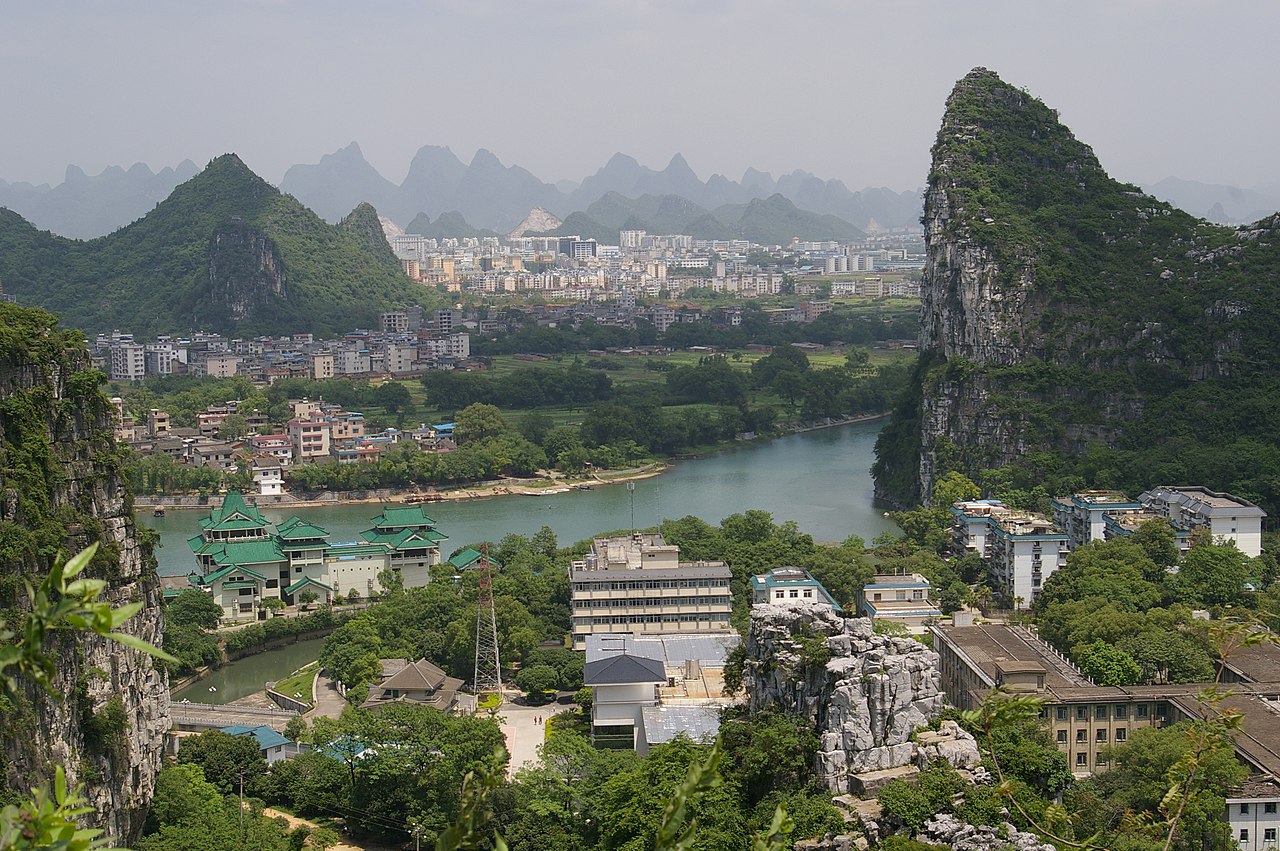


Geography and geology
The region around Guilin is one of the best-known examples of karst topography in the world. Towering limestone hills, caves and sinkholes form a distinctive landscape created over millions of years by the dissolution of soluble rocks. The Li River flows through this terrain and is celebrated for its clear, reflective waters and dramatic scenic vistas. Local geology and hydrology combine to produce numerous caves and underground streams that are important for tourism, scientific study and local hydrology.
History and development
Guilin has a long human history and has been an important regional center since ancient times. Over the centuries it served as an administrative, military and cultural hub for surrounding areas. In the modern era it became one of the first Chinese cities opened to tourism after 1949 and was widely promoted for its natural scenery. Its growth since then has included development of transport, hospitality and cultural facilities while the surrounding countryside remains dominated by rural settlements and agricultural land.
Tourism and cultural significance
Tourism is a central feature of Guilin’s identity. Visitors come to cruise sections of the Li River, photograph the karst peaks, explore showcaves and hike scenic trails. Notable attractions include river cruises that pass between steep limestone peaks, several well-known caves with stalactites and stalagmites, and nearby terraces and minority-community villages. Guilin’s cityscape is also dotted with parks where Sweet Osmanthus trees are planted, and local festivals celebrate flowers, food and river culture.
- Typical attractions: Li River cruises, Reed Flute Cave, Seven-Star Park, Elephant Trunk Hill.
- Activities: photography tours, cave visits, riverboat excursions, hiking and cycling.
- Accessibility: served by rail and road connections to regional centres and by an airport linking to major Chinese cities.
Economy, transport and conservation
Guilin’s economy combines tourism with agriculture, light industry and services. Infrastructure improvements in recent decades have increased visitor numbers while also raising challenges for environmental management. Conservation efforts focus on protecting water quality in the Li River, managing visitor impact in sensitive karst areas, and maintaining traditional land uses that help preserve the landscape’s visual character. Scientific research into karst systems here contributes to broader knowledge of geology, hydrology and biodiversity.
Notable facts and references
Key identifiers and contextual links: Guilin is classified as a prefecture-level administrative unit and commonly described as a city. It lies in the northeast of Guangxi, in the country of China, on the west bank of the Li River. To its north it borders Hunan province and the direction indicated is generally north. The city’s name and many plantings celebrate the Sweet Osmanthus, while its scenic character arises from karst rock formations, clear waters and a network of caves available for exploration. Demographic and area figures are commonly cited; for example, the total population has been reported at approximately 5.3 million people for the municipality.
This entry summarizes geography, history, cultural importance and modern concerns for Guilin, a city whose landscapes have inspired artists and travelers for generations.
Related articles
Author
AlegsaOnline.com Guilin — Chinese city famed for karst landscapes and the Li River Leandro Alegsa
URL: https://en.alegsaonline.com/art/41282
Sources
- travelchinaguide.com : "Guilin Travel Guide"
- discoverchina.com : "Guilin Tours - Best Tour Packages For Guilin, China in 2020"
- lonelyplanet.com : "Guìlín China"
- tripadvisor.com : "Top Private Tours in Guilin"