
Greater Caucasus: geography, ecology, geology and human significance
Major mountain range of the Caucasus stretching from the Black Sea to the Caspian Sea; overview of its geography, ecology, geology, divisions and cultural importance.
The Greater Caucasus is the principal mountain chain of the Caucasus region, forming a prominent physical barrier between the lowlands to its north and the Transcaucasian area to its south. It is known in local languages and literatures by multiple names; for example a Russian designation is referenced here, while Azerbaijani and Georgian forms are recorded here and here respectively. English-language sources sometimes use alternative translations such as "Caucasus Major" or "Big Caucasus." The range extends roughly along a west-northwest to east-southeast axis for about 1,200 kilometres and terminates between two great inland seas.
Image gallery
5 Images


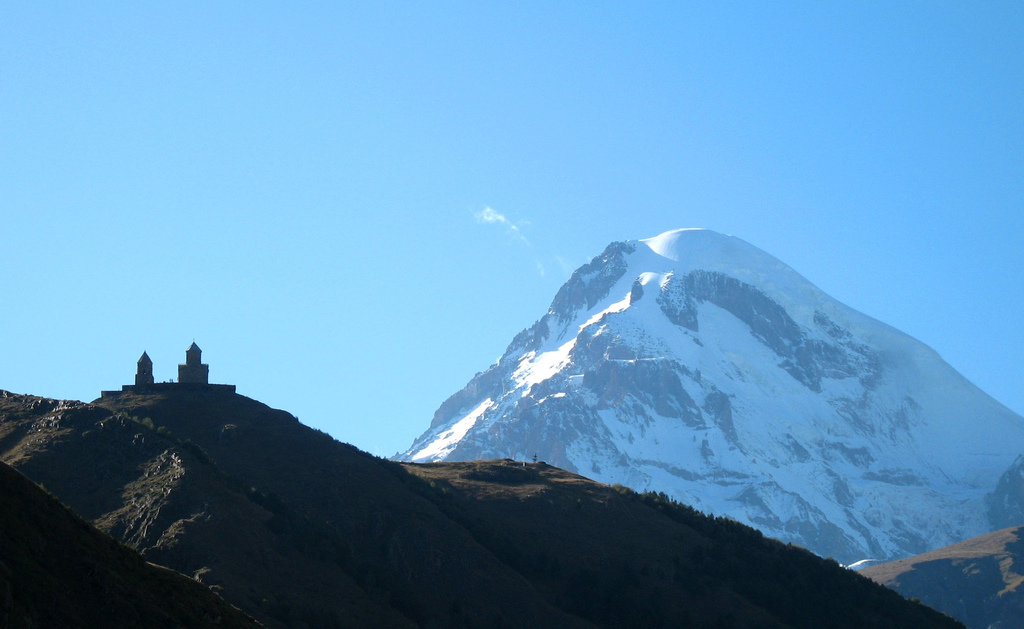
Geography and principal divisions
From its western terminus near the northeastern shore of the Black Sea to its eastern end on the western edge of the Caspian Sea, the Greater Caucasus forms a continuous highland system that defines regional drainage patterns and climates. It is traditionally subdivided into three broad sectors: the Western Caucasus, the Central Caucasus and the Eastern Caucasus. The Western sector reaches toward areas near Sochi, the Central sector contains the highest summits including Mount Elbrus, and the Eastern sector approaches the coastal plain near Baku. These divisions reflect changes in relief, precipitation and vegetation across the chain.
Climate, ecology and landscapes
Climatic conditions vary markedly from west to east. The Western Caucasus receives abundant moisture from the Black Sea, supporting dense woodlands and a layered vegetational structure: broadleaf forests at lower slopes, coniferous stands higher up, and alpine meadows above the natural tree line. In contrast, the Eastern Caucasus lies in a drier continental rain shadow and shows more open, often treeless slopes and steppe-like conditions. These contrasts produce rich biodiversity: the wetter zones harbor temperate forest species, endemic flora and montane fauna, while the eastern slopes sustain drought-adapted communities and isolated ecological niches. Conservation areas and national parks protect many of these habitats and rare species associated with the range.
Geology and formation
The Greater Caucasus is the product of long-term tectonic activity along the boundary between major crustal plates. Uplift and folding associated with the convergence of Eurasian and smaller southern plates created the high peaks, extensive glacier systems and complex faulting that characterize the range. Glacial and fluvial erosion have sculpted deep valleys and sharp ridgelines, while ongoing seismicity is a notable feature of the region. Geologists and geomorphologists study the chain as a prime example of mountain building driven by continental collision and subsequent modification by climate-driven processes.
Human uses and cultural significance
The Greater Caucasus has long influenced human settlement, movement and culture. Mountain passes and corridors have been used historically for trade, seasonal migration and military routes, shaping contacts between peoples to the north and south of the ridge. Today the range supports pastoralism, forestry, hydropower and tourism—especially mountaineering, skiing and nature recreation centered on its high peaks and protected landscapes. Several local communities maintain distinct languages, traditions and land-use practices adapted to montane life.
Distinguishing features and notable facts
- The range is commonly contrasted with the Lesser Caucasus, a lower parallel chain to the south; together they form the broader Caucasus Mountains system.
- Its longitudinal extent links two major bodies of water, the Black Sea and the Caspian Sea, creating important climatic gradients along its length.
- The name and language variants are documented in sources that address regional geography and place names (Russian, Azerbaijani, Georgian).
- Major urban and transport nodes near the range include locations such as Sochi in the west and approaches toward Baku in the east; prominent mountains such as Mount Elbrus dominate the central sector.
The Greater Caucasus remains a subject of scientific interest and cultural importance: its varied climates and ecosystems, active geology and long human history make it a landscape where natural and human processes interact intensely. For further regional and technical information consult specialist links and resources about the range and conservation or travel pages that describe its valleys, refuges and access routes in more detail. Additional educational and mapping resources are available through geographic and geological collections covering alpine environments.
Related articles
Author
AlegsaOnline.com Greater Caucasus: geography, ecology, geology and human significance Leandro Alegsa
URL: https://en.alegsaonline.com/art/40580