
Greater Los Angeles Area
A concise encyclopedic overview of the Greater Los Angeles Area: its geography, components, history, economy, and distinguishing features within Southern California.
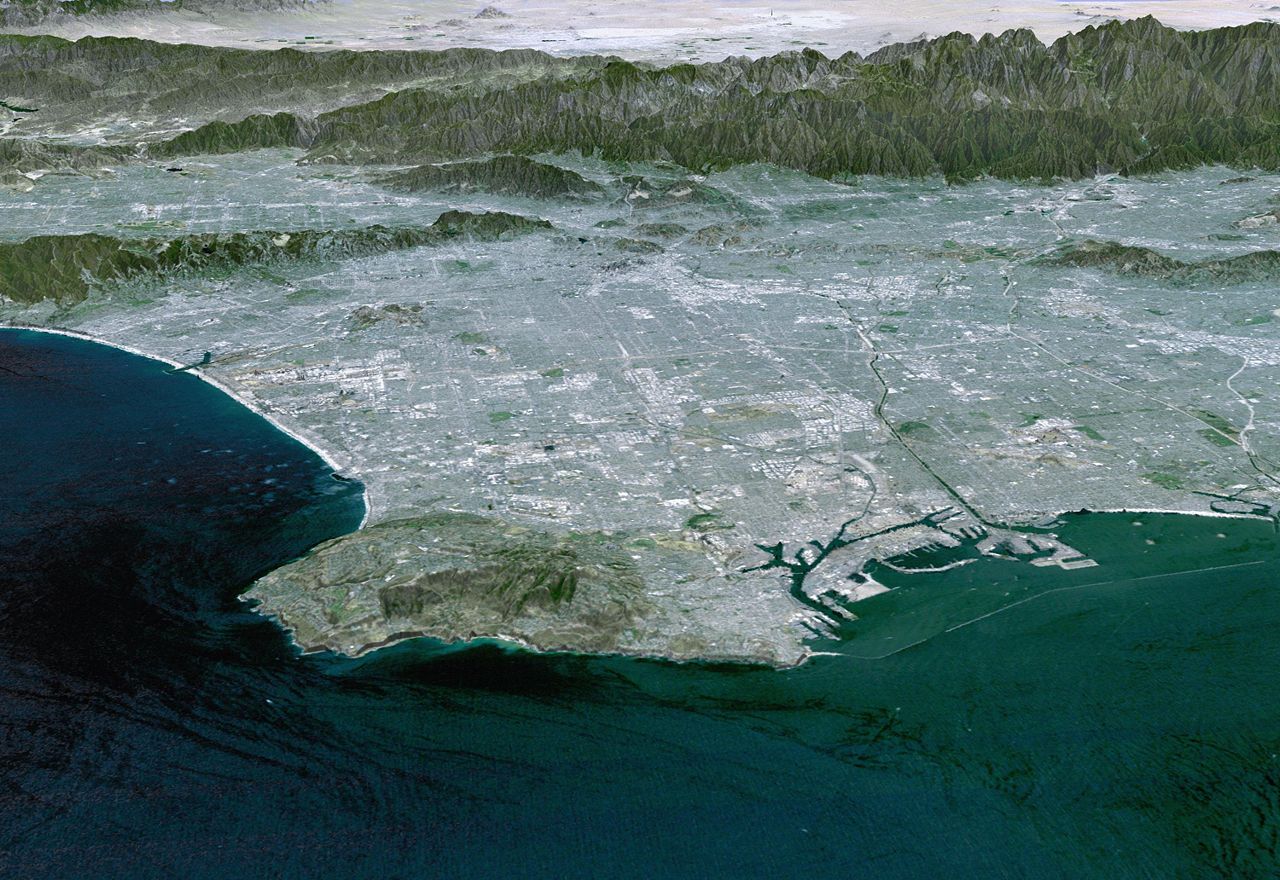
The Greater Los Angeles Area, often called the Southland, refers to the continuous metropolitan region centered on the city and county of Los Angeles in Southern California. The term typically encompasses five contiguous counties — Los Angeles, Orange, San Bernardino, Riverside and Ventura — and includes multiple metropolitan subregions: the Los Angeles basin, the coastal cities, the Inland Empire and nearby valleys. Its sprawling urban and suburban fabric blends dense central neighborhoods with extensive suburbs, coastal communities and inland desert-edge towns.
Image gallery
10 Images





Geography and components
Geographically the region stretches from the Pacific coast eastward into the foothills and plateaus that separate coastal Southern California from the Mojave and Colorado deserts. It contains a wide range of landscapes and microclimates: temperate beaches, fog-prone coastal plains, inland valleys that experience hotter summers, and mountainous areas that receive winter precipitation. Politically and administratively the area is commonly grouped into five counties, and those counties together host large cities, dozens of mid-sized municipalities and many smaller communities.
Administrative definitions and population
Different agencies use different boundaries when defining the Greater Los Angeles Area. The U.S. Census Bureau identifies a metropolitan statistical area and a larger combined statistical area that group adjacent counties by commuting patterns and economic ties. Historically the five-county combined region has been among the most populous in the nation and is widely regarded as the second-largest U.S. metropolitan area after New York in terms of population and economic scale. Population totals have grown substantially since the mid-20th century as migration, suburbanization and regional development expanded the built environment.
Economy, infrastructure and culture
Greater Los Angeles is a major global economic center. Recognized industries include entertainment and media, international trade (anchored by the Ports of Los Angeles and Long Beach), aerospace and technology, tourism, finance and a broad service sector. Transportation infrastructure is extensive: several major interstate freeways cross the region, the Los Angeles International Airport serves as a principal international gateway, and a growing network of commuter and light-rail lines connects parts of the region. Cultural life is notable for its ethnic and linguistic diversity, world-class museums and universities, and an international culinary scene.
History and growth patterns
The region’s modern expansion accelerated during the 20th century, driven by the development of rail and highway networks, the growth of the film and defense industries, and postwar housing construction. Initial growth concentrated in Los Angeles County, with later suburban and exurban expansion into Orange County and, in recent decades, the Inland Empire (San Bernardino and Riverside counties). That outward spread produced a mosaic of older downtowns, suburban subdivisions, edge cities and industrial corridors.
Notable features and challenges
Greater Los Angeles is celebrated for its economic dynamism and cultural influence, but it also faces complex challenges: traffic congestion, housing affordability, regional water management and episodic air quality problems. The area’s size and fragmented local governance create planning challenges that require coordination across county and municipal lines. Distinct from San Diego and Imperial counties to the south and southeast, the five-county Greater Los Angeles Area remains a centerpiece of California’s economy and identity.
Further reading and resources
- Definition and metropolitan overview
- County-level information
- Southern California region context
- Los Angeles County resources
- Orange County overview
- San Bernardino County information
- Riverside County information
- Ventura County details
- Growth and demographic studies
- Population and census data
- Five-county regional reports
- Statistical area definitions
- Size comparisons with other U.S. metros
- Clarification on San Diego and Imperial counties
- U.S. Census Bureau resources
Questions and answers
Q: What is the Greater Los Angeles Area?
A: The Greater Los Angeles Area, or the Southland, is a term used for the group of metropolitan areas over five counties in the southern part of California. It includes Los Angeles County, Orange County, San Bernardino County, Riverside County and Ventura County.
Q: How many people live in the Los Angeles metropolitan area?
A: As of 2005, the population of the Los Angeles metropolitan area was more than 12.9 million people. In 2009 the larger five-county region had a population of over 17.6 million.
Q: What is included in the Greater Los Angeles area?
A: The Greater Los Angeles area includes the Los Angeles metropolitan area, the Inland Empire, and Ventura County. It does not include San Diego and Imperial counties.
Q: How large is the total area of The Greater Los Angeles Area?
A: The total area of The Greater Los Angeles Area is 33,954 square miles (87,940.456 km2).
Q: When did growth start in this region?
A: Growth started in this region decades ago with first starting in LA county then Orange county and now expanding to include Inland Empire as well.
Q: Is it one of fastest growing regions in US?
A: Yes it has been one of fastest growing regions in United States for decades due to its high population growth rate .
Q: Is it bigger than New York Metropolitan Area ? A: Yes ,The Greater los angeles Area is bigger than New York Metropolitan Area as it has second largest statistical area after NY Metro .
Related articles
Author
AlegsaOnline.com Greater Los Angeles Area Leandro Alegsa
URL: https://en.alegsaonline.com/art/40593
Sources
- census.gov : "Metropolitan and Micropolitan Statistical Areas"
- census.gov : "Annual Estimates of the Population of Combined Statistical Areas: April 1, 2000 to July 1, 2009"
- dof.ca.gov : "City/County population estimates with annual percentage change"